|
|
“They’ve
found a rifle,” one of the searchers says, pointing to a couple kneeling
in the distance.
Under an unforgiving sun, along with five or six other volunteers
they had been crisscrossing the field with a metal detector. Their
discovery just might be the once-smoking gun that could solve one
of Texas’ most enduring archeological mysteries: Where was the 1813
Battle of Medina fought?
Almost as puzzling as where the battle took place is why so few have
ever even heard of it.
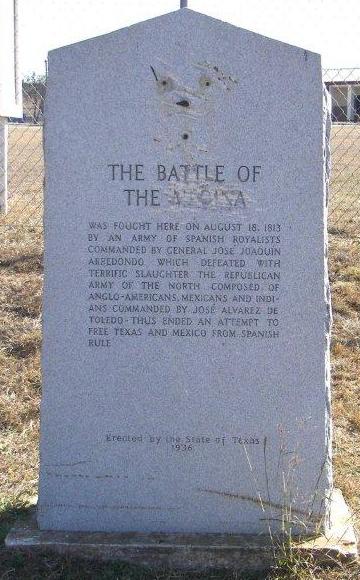
“The Battle of Medina was the biggest and bloodiest battle ever fought
on Texas soil,” says Austinite Dan Arellano, author of “Tejano Roots:
A Family Legend.” |
As he points out in his self-published book, more than 1,000 men died
in the battle or faced execution not long afterward. While the back
story is complicated – a combination of events involving American
filibustering and the beginning of Mexico’s revolution against Spain
– the numbers are enormous.
Some 4,000 Spanish royalists and 1,500 Tejanos and Americans fought
a running battle on Aug. 18, 1813. More than a dozen artillery pieces
loaded with solid iron projectiles or grapeshot (which converted them
to giant shotguns) left the field littered with body parts. What the
cannons did not do soldiers with bayonets and swords did. |
|
Arellano, a descendant
of one of the participants, is spearheading the effort to pinpoint
where it happened. He’s spent more than a decade researching the battle.
One thing’s for sure. Despite its name, the Battle of Medina did not
occur on the Media River. Most sources say the military confrontation
took place “about 20 miles south of San
Antonio.” But incredibly, in nearly 195 years, no one has fixed
the exact site of the battle.
The only comparable mystery in this state is whatever happened to
the famed Twin Sisters, the two
cannons that helped Sam
Houston win the Battle
of San Jacinto.
Speaking of cannons, a cannon ball was what started things rolling
in the latest search for the Battle of Medina field.
In the spring of 1977, San
Antonio native Edgar Ferguson, then a 31-year-old heavy equipment
operator, bought 14 acres about 13 miles beyond Military Road off
U.S. 281 south of the Alamo City.
One striking feature of the property is a massive oak, its multiple
thick trunks shading an area of at least 20 yards. Ferguson decided
to locate his mobile home near the huge tree, which must be 500 to
600 years old.
While doing work preparatory to laying a foundation, he found six
rusty iron balls in the sand that covers much of this part of Bexar
County. They lay in his yard until, as he put it, “I got tired of
mowing around them and reburied them under the tree.”
Well, he kept one.
More than three decades later, while roasting corn for an event at
nearby St. Carmen
Catholic Church, Ferguson met a couple visiting from Massachusetts.
They were doing genealogical research and expressed interest in the
Battle of Medina. (The church stands near a crypt containing the remains
of many of the battle’s victims.) |
 |
|
Ferguson told
them about having found the iron balls on his property years ago.
Aware of Arellano’s efforts to locate the battle site, the couple
contacted him. Arellano in turn got in touch with Ferguson, who
gave him permission to conduct an archeological survey of his property.
That happened May 31.
After Arellano briefed the volunteers on the battle, Ferguson went
to his house and returned carrying the ball he had kept all these
years. About the size of a baseball, the rusty iron sphere bore
pits and dents. Ferguson said it weighed about four pounds, a common
projectile size for a field gun of the early 1800s.
Charlie Yates of Dripping
Springs, a Republic of Texas era military re-enactor who owns
a six-pound cannon, says such weapons could propel a four-pound
ball up to 1,700 yards. The balls traveled at a relatively low muzzle
velocity of around 750 feet per second, but they could bounce around
and do a lot of damage, especially to massed troops or the enemy’s
cannons.
Seeing that artifact whet the appetite of the assembled volunteers,
a group ranging from ninth graders on hand with their history-minded
geography teacher to several retirees ready to play Indiana Jones.
They spent a hot half-day digging in the sand around that ancient
tree. Ferguson showed them where he reburied the balls, but none
turned up.
Meanwhile, other volunteers walked a 10-acre field and a smaller
2-acre tract on Ferguson’s property. The husband-wife team from
San Antonio found
the rifle on the larger field.
After photographing the visible portion of the rifle, the man who
found it carefully removed the rest of the sand that covered it.
Then he retrieved the rusted remnants of a child’s pump-action BB
gun from the 1950s.
“I haven’t given up,” says Arellano. “Wherever it is, the site of
the Battle of Medina needs a fitting monument, a museum…maybe someday
a state park.”
But all those on both sides who died fighting for what they believed
in cannot be honored until someone finally figures out where it
happened.
© Mike Cox
"Texas Tales" June
5, 2008 column
|
|
|
 HOME
HOME


