| |
Fayetteville
The Fayette County
Town Square Oak
and Its Guardian
by John Troesser
Cleve's
concern for the tree is reminiscent of Comanche County's Fleming Oak. Who knows?
Perhaps in time there will be a historical marker in Fayetteville as there is
in Comanche, honoring someone who took the time to call much-needed attention
to a town's oldest resident.
"There
isn't anything that you can't do something about."
Coleman County Sheriff
H. F. Fenton |
| | The
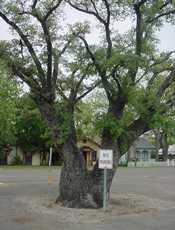
Oak that witnessed Fayetteville's fires, feuds and festivals
TE photo April
2003 |
| | Cleve
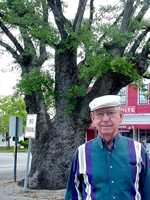
Friddell and friend
TE photo April 2003
|
Cleve
Cleve Friddell is a former Houstonian (Milby High Class of '40, Bachelor of Applied
Sciences from University of Houston) who recently settled in the bucolic wilderness
of Fayette County. To the village of Fayetteville
to be exact. A town where lawn ornaments outnumber citizens and nothing's wild
but the flowers.
The Oak
During his twice-daily constitutional
walk through town, Cleve couldn't help but notice the declining condition of the
huge Live Oak tree that grows near the precinct courthouse on the town square
- a tree surrounded by an ocean of asphalt.
The tree, of course, predates
the courthouse and come to think of it - it even predates asphalt - at least the
type that's put down as pavement. The tree was probably substantial enough to
take into consideration when the town was platted back in the 1840s.
The Tree-in-the-Street Sorority and "Old Ironsides"
Fayetteville
is a member in good standing of the Tree-in-the-Street
Sorority - a group of small towns that spreads from Columbus south to Goliad
and west to Bigfoot and Uvalde. As a matter of fact, this lone tree is Fayetteville's
membership card. Without it, membership would be withdrawn.
In the aforementioned
towns and others, settlers recognized the majesty of the Live Oak. They also noticed
its stubborn resistance to ax blades and wedges and moved on to cut trees that
weren't so tough. The dense fiber and springy heartwood of the species made history
when Florida Live Oak timber was used in the construction of the U.S.S. Constitution.
British cannonballs in the War of 1812 literally bounced off the sides of the
ship - earning it the name of "Old Ironsides." |
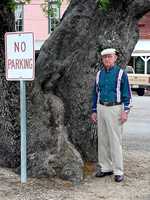
| | Cleve
provides scale
TE photo April 2003
|
Back
to our story
The Official Word - It's OLD
Cleve contacted a professional arborist
from Austin who came and gave his professional opinion of the tree and its condition.
It was officially declared old. Make that old with a capital O. A tree's age can
only be accurately determined by taking a core sample of the growth rings - but
the estimate of this specimen one runs right through decades and into centuries.
Care
The appraisal calls for deadwood removal, feeding, increased
soil activation and monitoring. It is entirely possible that with this care, the
life of the tree can be prolonged for many more years. Texas may have another
arboreal success story - like Austin's
Treaty Oak or La Grange's
Muster Oak.
Cost
The estimate for treatment and maintainence
is $3,000 for the initial phase of work and $1,500 each for the following two
years.
History in the Making
Cleve's concern for the
tree is reminiscent of Comanche
County's Fleming Oak. Who knows? Perhaps in time there will be a historical
marker in Fayetteville as there is in Comanche, honoring someone who took the
time to call much-needed attention to a town's oldest resident.
Local
papers took up the story and Cleve's cause was supported en mass by Girl Scout
Troop 1327 who set out jars in local stores for contributions.
You don't
have to drive to Fayetteville to put a donation in the jars - a fund has been
set up at the Fayetteville Bank.
Fayetteville Oak Tree Fund
Fayetteville Bank
PO Box 9
Fayetteville, Texas 78940.
© John Troesser
April 2003
More
Texas Historic Trees
| |
|