| |
 |
| What
does a turkey drive, a thirty-year feud, a lady in a clock, and a headless horseman
have in common? The answer is DeWitt County.
The present county of DeWitt,
named for colonizer Green DeWitt, was created from parts of Gonzales, Victoria,
and Goliad counties in 1846. Since that time, there have been three
courthouses in three different cities, including its present county seat, Cuero.
Somebody or somebodies didn't care for the second courthouse because on Sunday
night, April 8, 1894, it was torched. The Hallettsville Herald said it
had been an eyesore to that beautiful city for many years*.
The replacement
building was definitely not an eyesore. But getting there was a challenge.
Acclaimed Austin architect A.
O. Watson both designed and built the courthouse. He had quite a time funding
it, however. Finally in December 1896, the unpaid workers walked away, leaving
the courthouse without a roof. Citizens complained. I guess it would be hard to
hold court with rain beating down on your heads.
Watson went broke on
his "labor of love." Winter was looming, when in steps Eugene
Heiner, who saw its completion. DeWitt county got not one, but two Golden
Age architects constructing their courthouse. |
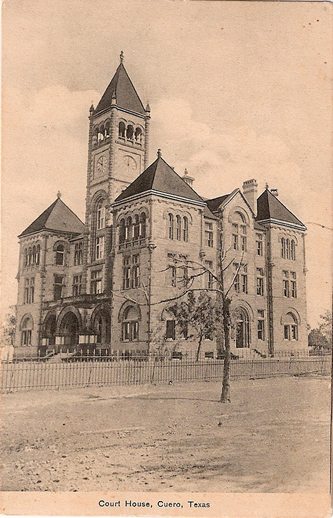 |
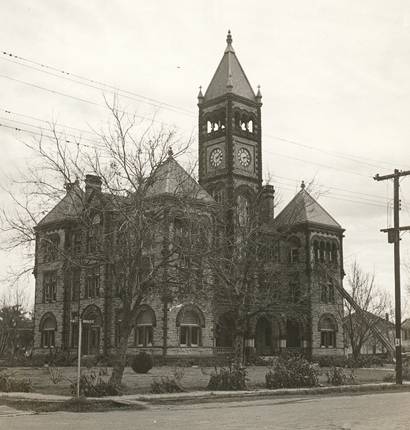
DeWitt
County Courthouse as it appeared in 1939
Courtesy of TXDoT |
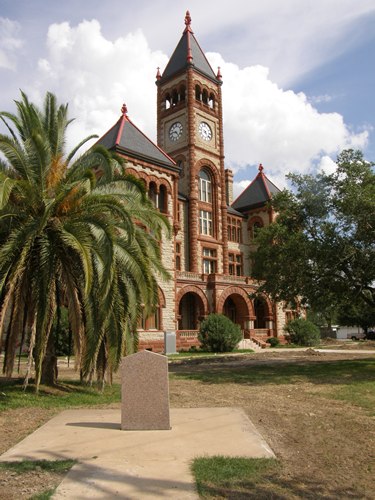
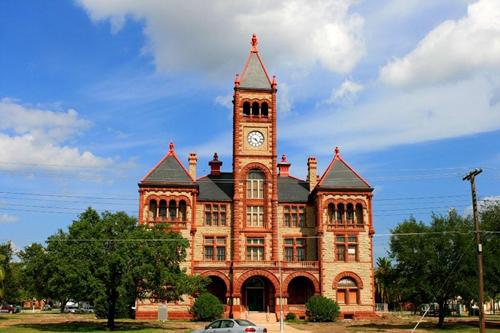
DeWitt
County Courthouse
TE Photo, July 2008 |
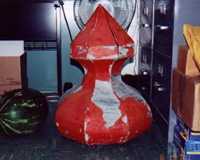
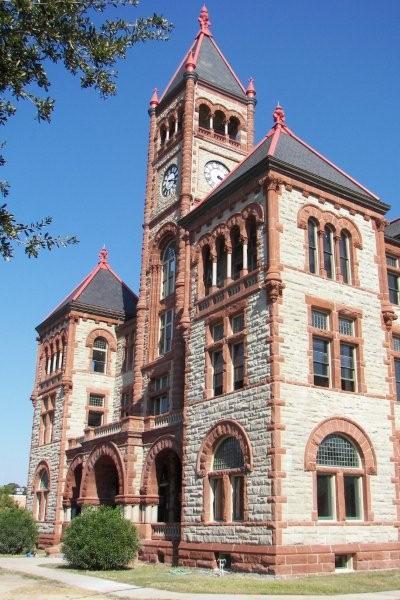
| | One
of the finials that was removed shortly before the Lady in the Courthouse Clock
disappeared.
Photo by Lou Ann Herda |
| The
1897 Courthouse & Lady in the Courthouse Clock
This
1897 Romanesque revival style structure is built of brown sandstone and pink granite
quarried from near Marble
Falls. Initially, the tower and the corner roofs were topped with fluted finials.
Soon, at night on the lighted face of the clock on the north appeared the shadow
of a full-skirted woman moving back and forth. No one knew who she was or why
she was pacing. Some figured she was the ghost of a lady who had died waiting
for her boyfriend to return. Her spirit then flew up to the courthouse clock.
Maybe that way her boyfriend could find her more easily.
Thirty years
later, one of the four lower finials fell. Officials feared someone might be killed
if others fell, so all the ornaments were removed. Legend has it that the lady
in the clock had something to do with it, for right after that, she was gone forever.
One of the original finials is kept in storage in the courthouse. I got a look
at it, and it's taller than three watermelons stacked up on top of each other
and fairly hefty. I wouldn't want that thing falling on me either.
Another
oddity is that one of the balusters on the second floor balcony above the
Gonzales Street entrance is upside down. The workers noticed it, but they thought
that no one else would. |
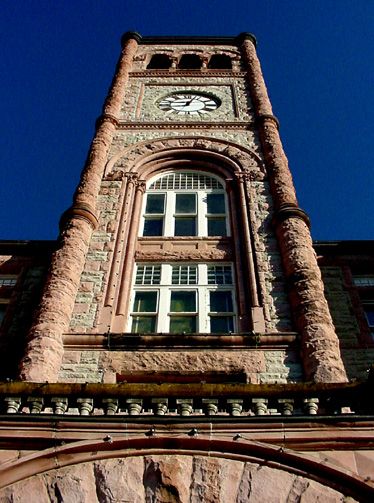 |
Courthouse
Clock Tower
TE photo, 2003 |
 |
| The
Sutton-Taylor Feud
El Muerto, the headless horseman
Now,
the county has had its share of trouble makers. The most infamous ones
are those who were involved in the Sutton-Taylor Feud. No one knows why
this thirty-year fight started, but eventually over one thousand people were involved,
including gunslinger John
Wesley Hardin. Records of this court case are on display in the foyer of the
courthouse.
The patriarch of the Taylor clan, Creed Taylor, was
a former Texas Ranger, a Texas Revolution fighter, and cattleman. At one point,
he and his Texas Ranger friend, Bigfoot
Wallace, tracked down and killed a Mexican bandit who had been stealing horses
and cattle for many years, including Creed's horses. Wallace made an example of
this bandit, resulting in El Muerto, the headless horseman. Legend has
it that this horseman, with its head dangling, can still be seen riding across
DeWitt County during the darkest nights. You'll know when you see them because
lightning flashes from the ghostly wild mustang's hooves and flames burst from
the eyes of the severed head. Sounds like a wild ride. |
Chisholm
Trail
The cattle industry was big in DeWitt County from the late
1860's to the 1880's. Trail boss Thorton Chisholm from Clinton helped blaze a
trail that has gone down in cow history as the Chisholm Trail. Before the
end of the trail drives, over 5,000,000 Texas cattle walked to the railroad in
Missouri or Kansas or to the ranges of Wyoming and Montana*. |
Cuero
Turkey Trot
Once the cattle drives stopped, people started driving something else. As
many as 20,000 turkeys have been driven down the streets of Cuero.
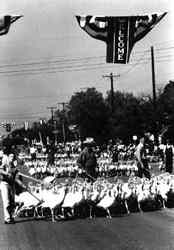
Since 1908, these gobblers, which could have been our national bird, would trot
from their roosts along main street down to the packing house. People soon started
flocking to see them. In 1912, the first Cuero
Turkey Trot was held.
Now, I'm not prejudiced against any birds,
but you won't see any eagles trotting along together to their deaths. |
| | Turkey
Trot in Cuero
Photo Courtesy TXDoT |
July
2001, Copyright
Lou
Ann Herda, Ed. D
References:
*Hallettsville Herald,
April 12, 1894, page unknown.
*The History of DeWitt County, Texas, 1991,
p. 29.
References and Additional
Reading
Many thanks to Sara Post of the Cuero Chamber of
Commerce; Peggy Ledbetter, DeWitt County Treasurer; Margie Bell; and Pat Hedgcoxe
for getting together all the materials for me, and to Barbara Jacobs and the Cuero
Library for loaning their storytime kids for the photo.
See Cuero,
Texas | Cuero
and DeWitt County Trip
More Related Topics: Texas
Courthouses | Texas | Online
Magazine | Architecture
|
Area
Hotels - Book Here & Save:
Victoria
Hotels | Hallettsville
Hotels | More
Hotels | |
|