|
The
core of the group included Jesse H. Jones, Herman and George
Brown, Gus Wortham, James Abercrombie and James A. Elkins Sr. --
all of whom founded successful corporations and acquired considerable
wealth.
But little mention is ever made of a small circle of East Texans
who were also regarded as Suite 8-F power brokers when it came to
Texas politics.
That list included Texas Governor Allan
Shivers of Woodville,
attorney and LBJ confidant Ed Clark of San
Augustine; Ben Ramsey, also of San
Augustine, who ran the Texas Senate with an iron hand for decades;
Ottis Lock of Lufkin,
often regarded as the key strategist for Ramsey and Shivers; and
Wardlow Lane, a powerful Senator from Center.
Houston's 8-F players were smart enough to know they needed the
help of the powerful East Texas group, so they often invited them
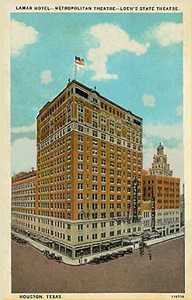
to join them at the Lamar, where decisions were made that shaped
Texas' future and its economic course.
The 8-F players also had connections to East Texas beside those
with the region's politicians
Jones was a lumber entrepreneur who started his career as
manager of his uncle's lumber company. He also owned the Houston
Chronicle, which was known for its legions of East Texas newspapermen,
including Clayte Binion and Morris
Frank, both of Lufkin.
Brothers Herman and George Brown built their small
construction firm, Brown and Root, into one of the world's largest
construction firms. George Brown also served as a director of Southland
Paper Mills, Inc. of Lufkin.
Wortham, founder of American General Insurance Co., was a
cousin of Dick Wortham, a Southland president, and Abercrombie's
Cameron Iron Works had links with many East Texas oilfield suppliers.
Judge Elkins, a founder of both the Vinson and Elkins law
firm and the forerunner of First City Bancorporation, served as
the director of multiple banks, railroads, oil companies and insurance
firms, many of which did business in East
Texas. Elkins
Lake, near Huntsville,
owes its name to the lawyer/banker.
Frequently recognized as part of the group were Polk County native
and former Governor William P. Hobby, who controlled The
Houston Post, KPRC-TV and KPRC radio. The 8-F crowd exercised
a strong influence in Texas politics. Not only did they raise money
for candidates, but the endorsement of the 8-F crowd mean that the
candidate had the general approval of the Texas business community.
Their influence extended into Washington through their association
with politicians such as John Nance Garner, Sam
Rayburn, Lyndon Johnson, and Albert
Thomas.
The 8-F power brokers are all gone today and the site of the Lamar
Hotel is a parking lot. But the tales of what transpired behind
the doors of Suite 8-F have become an integral part of Houston
and East Texas history.
All
Things Historical June
26, 2006 Column
Published with permission
|
 HOME
HOME