|
|
In
these days of evaluating our schools—exemplary to acceptable to whatever—and
multiple special legislative sessions devoted to figuring out how
to spend more money on schools while taking in less revenue, Texans
might want to remember A.M. Aikin Jr., who helped drag education and
Texas into modern times.
A generation ago, every Texan associated with education knew of A.M.
Aikin, who served in the legislature for 46 years and authored or
co-authored ever-major education bill considered during that time.
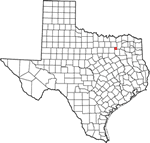
Aikin was born in Aikin Grove, Red
River County, on October 9, 1905. He attended a three-teacher
school, to which he rode horseback four miles each way each day until
he graduated from high school, which helped form his legislative philosophy
to support children to acquire an education more easily than had been
his lot.
Aikin won election to the Texas House of Representatives in 1932,
then moved to the Senate in 1937, where he served for the next four
decades. He missed only two session days in his entire legislative
tenure. Aikin chaired the Senate’s Appropriations Committee, which
was of considerable benefit to public and higher education in Texas.
With Representative Claude Gilmer, Aikin sponsored the Gilmer-Aikin
Laws in 1949, also passed with the considerate assistance of Senator
Ottis Lock, another lawmaker from East
Texas. The Gilmer-Aikin Laws centralized the state school system
and established minimum salaries and expenditures for each scholastic
based on a state formula. The point was to insure state monies to
assist every community in providing educational opportunities for
its young scholars.
Aikin also sponsored an amendment to the state constitution creating
the Teacher Retirement System in 1937, and in every legislative session
until he retired he worked to increase funding for education.
Senator Aikin had other interests as well, as is illustrated by this:
As chairman of appropriations, when the state budget neared completion,
Aikin always asked if M.D. Anderson Hospital, the state cancer treatment
center, had received its requested appropriation. If not, they all
went back to work until he was satisfied.
Aikin died in Paris, Texas,
on October 24, 1981, leaving a legacy worthy of immulation by today’s
legislators. |
|
|
 HOME
HOME