|
|
It
was May 1952 when I boarded a flight to New York City from Houston
Continental Airport (as it was then-named). A member then of the
USAF, I had just completed a leave prior to shipping overseas. So
the purpose of this trip was to report to Camp Kilmer, New Jersey
for ocean transportation to Bremerhaven, Germany.
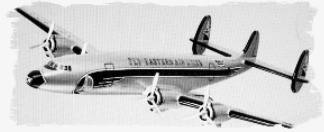
The aircraft type we boarded was a Lockheed Constellation. This aircraft
had four engines driving propellers and three rudders on the rear
stabilizer. It also had a sexy curved fuselauge. At this time, they
had only been in service about 2 years. |
|
|
Lockheed
Constellation
Courtesy Ken Rudine |
We
boarded about 1AM. There was a small thunderstorm in the area but
no rain was falling as we used a roll-around boarding stairs to enter
the aircraft. My seat was on the right side, to the rear of the wing.
Darkness surrounded us as we taxied away from the lights of the terminal
building. Finally we arrived at the end of the runway where it began
to rain. Warming up one engine at a time was accomplished as the rain
became heavier with lightning flashing. As the props rotated in those
flashes of light, I could see spirals of water. Rain water was being
thrown off the propeller tips in giant corkscrews, maybe six feet
in diameter by at least twenty feet long. The lightning flashes, revealed
those images to me like flash photos. It was memorable.
It was daylight when we landed at Idlewild Airport (now JFK). My plane
averaged about 300MPH. There was nothing significant during the trip
or landing. In New York I checked into a hotel and rendezvous with
a sergeant for a trip to Camp Kilmer. |
|
|
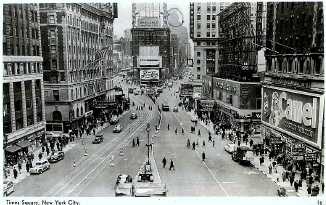
Times
Square in preparation of Mr. Rudine's Arrival
Courtesy Ken Rudine |
Although most
of my stay overseas was in North Africa, while I was in Germany I
spent time in Lansberg during the time Johnny Cash was also stationed
there.
My
years in the service ended in 1954. By 1971 I had been a manufacturing
manager at a ventilation company for 7 years. During those years the
company effort was directed at products using natural rather than
forced air ventilation. Our wind-powered Turbovent was roof mounted
in such a way to allow the installation of a motor-driven fan that
could boost the air it exhausted, if desired. |
|
|
| Turbovent
promotional ad courtesy Ken Rudine |
| I decided to
make a few “fan sections” at customer’s requests. While doing so,
I recalled the “vivid spirals of rain water” I saw coming off the
props of the airliner as I left Houston
for overseas duty in 1952. The spirals showed me that more air could
be passed through the curved, angled Turbovent blades by orienting
the spiral of air to suit the path of least resistance. |
|
|
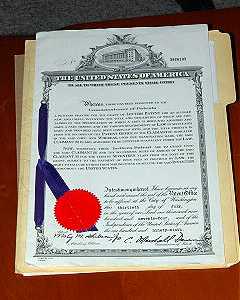
US
Patent for Turbovent
Photo courtesy Ken Rudine |
|
I filed a patent
application stating the primary claim as “Turning the fan blade
rotation in the direction of the path of least resistance would
produce 80% more ventilation with only 20% increase in vent rotation”.
I received my first U. S. Patent based on the sight I saw the night
I made my first flight from Houston
Continental Airport.
© Ken
Rudine October 1, 2006
|
|
|
 HOME
HOME