|
|
When
I was growing up in Galveston,
there were so many mansions that the thought of their value and
opulence to us were sidebars, really. They were nothing more than
where our friends' parents had grown up, and now were where old
people lived. People who told us the stories of Galveston's past.
Many of the stories I learned to love and tell to you.
The exception was what family and friends called The Big House.
It's on the corner of 25th and Broadway. The world knows it as The
Open Gates, and since 1889, it has probably been the most photographed
and recognized home in Galveston.
George Sealy built The Open Gates for his wife, Magnolia, and their
four children. It was designed by a New York architect named Stanford
White, but the construction was supervised by famed Galveston architect,
Nicholas Clayton. The style is known as Neo-Renaissance.
When I see tourists staring at it or taking photos, I can't help
but grin. I wonder what they'd think if they knew what had gone
on behind those walls. The Sealys, regardless of age, knew how to
party, and they did it formally and informally with great regularity
and bravura. One of their favorite ways to dress for a party was
in Gay-90s costumes.
And upstairs in the third floor attic was a playroom with a stage.
The various grandchildren, nephews and nieces would put on their
own productions there. Sometimes when there was a traveling marionette
troop passing through town, it would be engaged to do a special
performance on that attic stage for the Sealy children and their
friends. I remember going there for one of them on a cool spring
Saturday morning. It must have been about 1948.
More than once, the grandchildren, nieces and nephews roller skated
in the front parlor, knowing full well they'd be caught and made
to stop. And there was the lasting odor throughout the house from
Uncle Bob Sealy's elevator that croaked and groaned and smelled
like burning carbon when he took it up and down from his quarters.
That arsenic and old lace relic was so ominous that he was the only
one brave enough to ride it.
But the real treat was to be invited to The Big House on Christmas
Eve night, before the midnight service at Trinity Church. The Sealys
loved plants, and the house and the conservatory would be overflowing.
All of this in addition to the Christmas tree and seasonal greenery.
No one made egg nog that tasted nearly as good or was anywhere near
as potent as that Sealy bunch. I've tried to copy it for forty years.
Mine might qualify as a poor second, nevertheless excellent in flavor,
body and kick.
And a social function at the Big House where they were celebrating
one thing or another, also became the traditional time and place
for a Sealy heir to become engaged. I remember that just after her
debut party during the holiday season of 1956, Bill Crum slipped
an engagement ring on my friend Janey Pinkard's finger. Even at
16, to me it was an exciting event. I loved seeing Janey so happy.
And Ann Sealy tells the story of George, III, putting the ring on
her hand as they were in the hall outside of Uncle Bob Sealy's quarters,
greased down with Noxema after a day of too much sun at the boat
club.
Well over twenty of the Sealy heirs have worn the wedding veil of
Magnolia Sealy.
My primary connection with the Sealy family was through my childhood
friends, Billy, Janey and Becky Pinkard. They lived in a stucco
home behind Ashton Villa where the Sealy gazebo stands today. Without
trying to wade you through the lineage, primarily because I'm not
sure I can still get it right, it was their mother Jane who was
a Sealy by way of the Burton family.
|
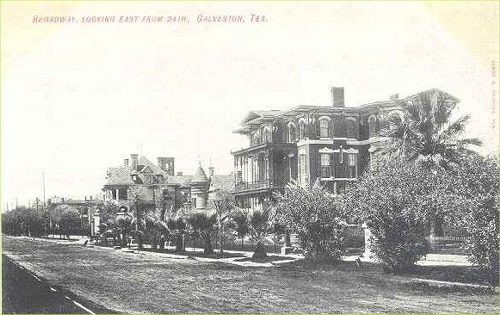 |
Broadway and
24th Street
Postcard courtesy www.rootsweb.com/ %7Etxpstcrd/ |
|
Walking from
the Pinkards' home to The Big House was quick and easy, and it was
always fun to see what fun-loving and eccentric Uncle Bob was up
to, as well as to see what good things the family's maid, Lureline,
could dig up for us to munch on.
And the way to go inside Galveston mansions was always through the
back door. Only those who qualified for the austerity of being guests
went through their main entrance.
If it were spring or summer or early autumn, we'd stroll the grounds,
eating our cookies, but would usually end up walking to the Rosenberg
Library to see what new books or exhibits had been added. The library
wasn't air conditioned then. It had an odor all of its own. I always
thought of it as the smell of knowledge, the body odor of Plato
and Don Herbert (Mr. Wizard) and the Hardy Boys' adventures.
With all of the family activities that went on for generations at
the Big House, and that were unselfishly shared with the Sealys'
many friends, especially this one who lived with his family in a
small brick home on Woodrow, it's hard for me to believe that era
somehow terminated as none stayed behind to perpetuate it.
Now that that building is a property of the University of Texas
Medical Branch, it's finally proper to call the architectural decedent
The Open Gates. The Big House is only a memory.
© William
S. Cherry
Bill Cherry's Galveston
Memories
January
23, 2008 column
All rights reserved
|
More
Columns
Bill Cherry, a Dallas Realtor and free lance writer was a longtime
columnist for "The Galveston County Daily News." His book, Bill
Cherry's Galveston Memories, has sold thousands, and is still
available at Amazon.com and other bookstores. |
|
| Texas
Escapes, in its purpose to preserve historic, endangered and vanishing
Texas, asks that anyone wishing to share their local history, stories,
landmarks and vintage or recent photos, please contact
us. |
|
|
 HOME
HOME


