|
Cowboyin'
ain't all it's cracked up to be. It's not all horsebackin' and branding
and Saturday night at the dance hall. Herewith a view of some of the
cowboy chores Roy and Gene never did in the Saturday matinee.
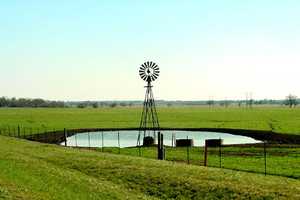
Windmills
|
| The
windmill, according to
Dr. Walter Prescott Webb in THE GREAT PLAINS, was one of three inventions
that made possible the settlement of the great central plains of North
America by the white man. The other two were barbed wire and Colt's
revolver. Truly the windmill-powered waterpump with its huge fan atop
a spidery wooden or metal tower is one of the great symbols of the
American plains, from Texas to North Dakota and beyond. Unfortunately,
the windmill is a mechanical device. All mechanical devices have to
be, from time to time, oiled or greased. |
|
| On the old-time
windmills, particularly the Aermotor mills made in the first half
of the 20th century, the gears that transmuted the whirling action
of the fan to the up-and-down motion of the sucker rod ran in an oil
bath. This bath was filled with SAE 40w or 50w crankcase oil. From
time to time that oil had to be changed. |
The oil sump
had a plug in the bottom like the plug in an automobile's oil pan.
It was generally a 1" hex-head bolt-and no matter how frequently the
oil in the sump was changed, no matter how well the plug was greased
when it was replaced, any time you went up the tower to change the
oil in the sump, the plug was rusted solid. Breaking it loose required
a two-foot Stilson wrench with a two-foot cheater pipe on the handle.
Unfortunately, the platform you had to work on was only about three
feet square. That meant about 2½ feet of Stilson and cheater pipe
hung out over anywhere from a 20-foot to a 60- foot drop to the hardpan
below. You planted your backside on the platform, put your back firmly
against the tower, held on with both hands, and kicked the bejeezis
out of the cheater pipe in hopes of breaking the plug loose. About
five times out of six-the first five times you kicked the thing- all
you did was knock the wrench loose from the plug, which meant wrench
and cheater pipe fell to the ground or into the stock tank. You then
had the pleasure of climbing down the tower, either retrieving the
wrench and cheater pipe from the fresh cow-pie they landed in, or
fishing them out of the stock tank, which is where they came to rest
if they didn't land in a cow-pie. And, of course, on at least one
try either the wrench or the pipe would fetch you a clip across the
non-kicking shin, which delayed matters until you could stop hollering.
Folks said that if you heated the plug with a blowtorch it would come
out easier. You could also set fire to the oil in the sump
that way. An oil-sump fire was almost impossible to put out, and since
the heat drew the temper out of the gears inside, the whole head had
to be replaced, which wasn't cheap. Besides, if the mill was mounted
on a wooden tower rather than a steel one, an oil-sump fire could
turn into a real adventure.
Getting the plug out of the sump wasn't the only adventure you could
have on a windmill tower. At the bottom of the mill there was a long
handle you could pull down to immobilize the head while you worked
on it, along with a loop of baling wire to slip over that handle to
make sure it stayed in place. A wise windmill grease monkey always
pulled that handle down and fastened it with the wire.
Then, of course, there was that deathly still day when not a breath
of air stirred the dust anywhere-so you neglected to lock the mill
before climbing the tower. The last breeze, a couple of days ago,
came out of the south, so the fan faced south, the tail pointing at
the north star. You confidently climbed the east side of the tower-and
just as you got belt-buckle high on the platform, a gust of wind came
out of the west. The unlocked fan swung to face the breeze-and
the tail came around to the east! If you were lucky-very
lucky-all it did was take off your hat and send it spinning to the
ground. To land, of course, in a fresh cow-pie. If you weren't
lucky it caught you upside the head. When you woke up-if you
woke up-you discovered you were the one in the fresh cow-pie.
Even if you did remember to shut off the mill, there was another very
probable adventure, in the form of a nasty surprise, awaiting you
just below the platform. You never noticed it from the ground, of
course, but when you came nose to nose with that basketball-sized
red wasp or yellowjacket nest in the shade under the platform, you
definitely noticed it. Some of the finest Olympic-quality high diving
in sports history has been performed by fully-clothed cowboys from
near the top of a windmill tower into a stock tank with a squadron
of annoyed red wasps or yellowjackets in hot pursuit.
Assuming
you managed to get the oil changed without falling off the tower,
dropping the Stilson on your shin, setting fire to the sump, or jumping
into the tank with a pursuit-squadron of wasps on your tail, there
was another chore to be performed on the windmill-and it was nastier.
About once a year you had to pull the sucker rod and change the leathers.
A windmill's pump is simplicity in itself. When the sucker rod goes
down, it is forced into the water in the well. Leather washers above
the perforated disk on the bottom of the rod are forced up by water
pressure, opening the perforations. When the rod comes up water pressure
forces the leathers down atop the perforations, sealing them and lifting
a column of water. The next stroke lifts twice as much water, and
eventually water flows out of the well casing into the runoff pipe
that supplies the stock tank. Those leathers deteriorate over time-their
usual life is about a year. When they've deteriorated enough the pump
doesn't work any more. It's time to change the leathers.
You start by turning off the mill and disconnecting the sucker rod.
Don't drop it. If your well is 300 feet deep with water to the 100-foot
level, you'll only have about 120 feet of sucker rod. If you drop
it, you've got the problem of fishing 120 feet of 1½" wooden or ¼"
steel sucker rod out of a 5" diameter well casing 180 feet down.
Sucker rods come in sections, so you lift each section carefully out
and disconnect it from the section below, being careful not to drop
the sections. The sections, having been submerged in water for a year
or so and usually being joined with metal, are of course rusted tight.
This brings you back to Stilson and cheater pipe, but in this case
you need two Stilsons and cheater pipes, one for each section of rod.
When you finally get all the sucker rod pulled you have to take the
nut off the end-more rust-remove the old leathers, soak the new ones
in water a while, put them on, replace the perforated disk and the
nut that holds it in place, and put the sucker rod back in the well-without
dropping it. By the time you've finished the wind will have died and
you'll have to climb the tower and spin the fan by hand for a couple
of hours so the tank will have water in it for the stock.
Another
thing cowboys did-and do-that you never saw Hoppy or Red Ryder doing,
is fix barbed wire fences...
more - Barbed Wire
Fences and Prickly Pear Cactus › |
|
|
 HOME
HOME