|
History in
a Pecan Shell
Settlement began in the
1870s. The name Cove was submitted for a post office, but refused
due to a prior claim. The application was resubmitted with the additional
word of Copperas added. The name supposedly comes from the copper-tasting
water of a nearby spring. The Copperas Cove post office opened in
1879.
Copperas Cove was along one of the "feeder routes" of the famous Chisolm
Trail. The Gulf, Colorado, and Santa Fe Railway arrived nearby in
1882 and the townspeople moved the two miles NE in order to enjoy
all the economic advantages the railroad
provided.
By 1884 the town had 150 people and a hotel. By the mid-1890s the
population had risen to 300, and a school district was formed. Cattle
production was replaced by farming as the area's major economic engine
in 1900.
In 1913 the population was estimated at 600, reaching 650 when the
Great Depression hit. The town's bank failed, and Copperas Cove suffered
the fate of many Texas towns in the 30s. Only 356 people called it
home in the early 1940s.
WWII was a life
saver for the town when the government established Camp Hood. The
postwar population grew to 1,052 in the early 50s. Camp Hood became
Fort Hood in 1950 and the post became a permanent facility. Growth
was such that the town soon grew into neighboring Lampasas
County. The population reached 4,567 in 1960, and more than doubled
to 10,818 by 1970. It nearly doubled again to 19,469 in 1980.
Copperas
Cove Hotels > Book Hotel Here |
|
|
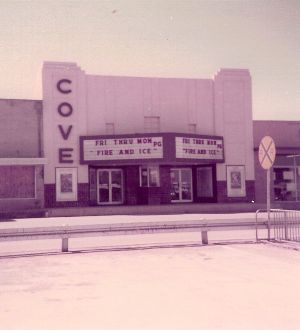
The
Cove Theatre in Copperas Cove
1984 photo courtesy Billy
Smith |
|
|
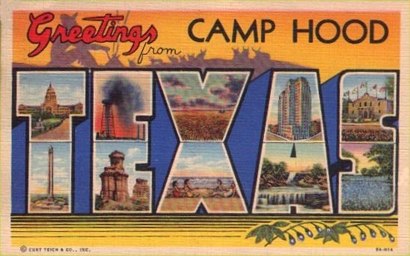
Camp
Hood
Postcard courtesy www.rootsweb.com/
%7Etxpstcrd/ |
A Coryell County
Drive
FM
116: In The Shadow of Fort Hood
by Clay Coppedge
Driving north from Copperas Cove to Gatesville
on FM 116 you're never far from Fort Hood. ... Copperas Cove is
ringed by five hills, a pattern drivers will see repeated on the
way to Gatesville. A few miles
out of town you come to FM 580, and if you just feel like it you
can detour to the town of Topsey...
If, instead of heading to Topsey
you get on 116 you will drive up on a green, bowl-shaped valley
cut by scenic creeks. Nestled between the hills and creeks is the
community of Pidcoke... read
full article
|
| Texas
Escapes, in its purpose to preserve historic, endangered and vanishing
Texas, asks that anyone wishing to share their local history, stories,
landmarks and recent or vintage photos, please contact
us. |
|
|
 HOME
HOME