|
|
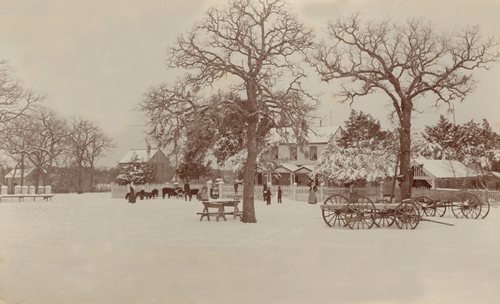
The
Melcher homestead in snow c.1895
Photo courtesy Fayette Heritage Museum Melcher Collection
|
History in
a Pecan Shell
No one is certain
of who O’Quinn was named after. The most likely source was an Irish
immigrant while other sources state that it was a Indian chieftain
by that name.
O’ Quinn’s history is typical of the rest of Fayette
County. Immediately after Texas Independence, the region was predominately
Anglo American. Beginning in the 1840s as German immigrants moved
in, the Anglos sold off their land and moved west.
Because of it’s proximity to the county seat of La
Grange (as well as many nearby communities) O’Quinn had little
chance for growth. In the early 1880s the community was granted a
post office and when the 20th century arrived – O’Quinn had a blacksmith,
a cotton gin and two stores.
The cluster of villages in this part of Fayette
County attended church services in towns other than O’Quinn and
voted in nearby Black Jack
Springs.
Although it is now hard to imagine, this village used to have two
fraternal lodges. In 1911 the U.S. Postal Service gave up on O'Quinn
and discontinued the post office. La
Grange took over delivery to La
Grange.
The census count in 1950 was twenty-five residents – about the same
as 2000. Only a single business remained open at this time.
The planting of cotton, which had
been the principle crop, was discontinued in the 1960s. Today the
land is used for the production of hay or grazing cattle. In 2010
there is a signage business and not much else. While the official
count is a mere 25, there are four times as many weekenders from Houston
and San Antonio. |
 |
O'Quinn sign
on FM 609 heading N toward La
Grange
TE Photo, January 2010 |
O’Quinn, Texas
Vintage Photos
|
| Photographer
John Melcher, whose vintage photos appear on this page, lived in O’Quinn
in the late 1900s. As a result, the Melcher collection is the crown
jewel of the Fayette Heritage Museum archives. |
|
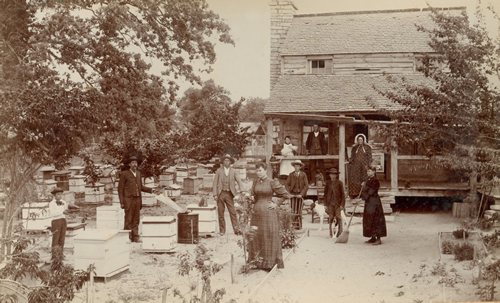
An
family run apiary near O'Quinn photographed by Melcher
Photo courtesy Fayette Heritage Museum Melcher Collection
|
|
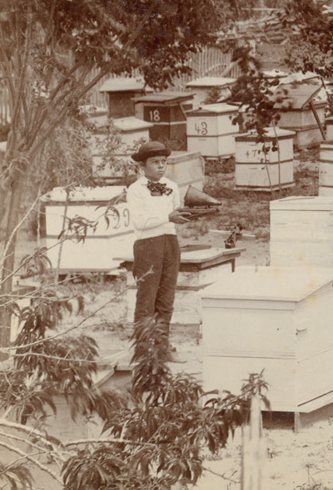
Boy
holding a "smoker" - a bellows and metal cone that held
a smoldering cloth. The smoke tranquilizes the bees - allowing the
hives to be "robbed" of honey.
Photo courtesy Fayette Heritage Museum Melcher Collection
|
|
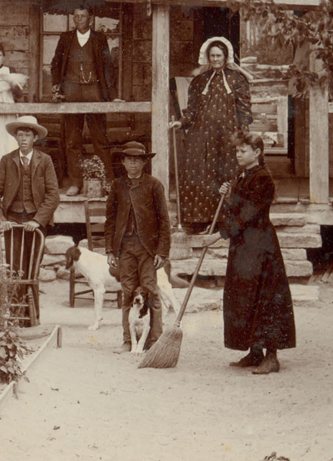
Detail
of top photo showing a girl "sweeping the yard" - a common
practice, but one seldom photographed. Her brother demonstrates
a popular method of getting dogs to pose for photographs.
Photo courtesy Fayette Heritage Museum Melcher Collection
|
|
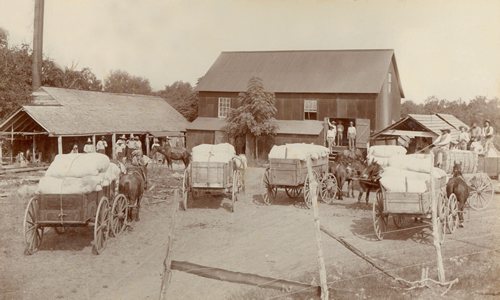
Taking
cotton to the gin
at O'Quinn
Photo courtesy Fayette Heritage Museum Melcher Collection
|
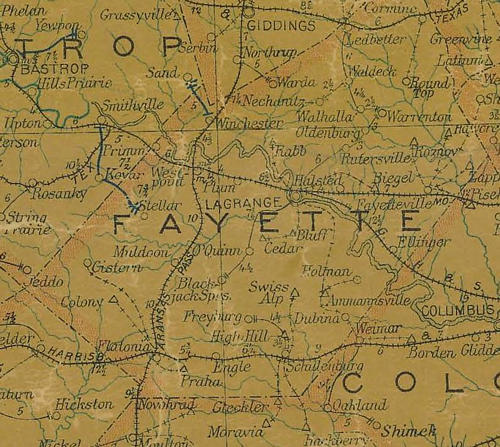
Fayette
County 1907 postal map showing O'Quinn
From Texas state map #2090
Courtesy
Texas General Land Office |
| Texas
Escapes, in its purpose to preserve historic, endangered and vanishing
Texas, asks that anyone wishing to share their local history, stories,
landmarks and recent or vintage photos, please contact
us. |
|
|
 HOME
HOME