|
It’s
been pointed out that there were two great revolutions in American
life in the 19th Century. One was the Civil War. The other was a
scientific revolution. Just as the firing on Fort Sumter was the
shot that got the Civil War going, Charles Darwin’s theory of evolution,
published in “Origin of Species” in 1859 created a similar upheaval
in the scientific world.
At the same time, scientists, naturalists and other observant types
were finding the bones of creatures that roamed the earth millions
of years ago that were unlike anything the world had seen or imagined.
Some of these creatures were truly gargantuan with neck bones alone
measuring three feet across. Even the land where people lived had
changed dramatically over the eons; in some cases it hadn’t even
been land at all – it was a sea. This was a hard thing for people
of the time to grasp.
Europeans never had much luck finding dinosaur bones. Too lush.
Too wet. The American West was neither of those things. Striding
into that vast and arid land, two scientists led the search for
dinosaur bones and new species to name. Their respective and separate
searches developed into an intense rivalry between the two bone
hunters – Edward Drinker Cope of the Academy of Natural Sciences
in Philadelphia and Othenial Charles Marsh with the Peabody
Museum of Natural History at Yale.
What started out as a shared interest between the two men turned
into a paleontological version of the Hatfields and McCoys. It’s
been called the Bone Wars and the Dinosaur Wars. The animosity and
competition nearly destroyed both men financially and emotionally
but Cope and Marsh also got people and scientists thinking about
dinosaurs in ways they had never been able to think of them before.
Their accomplishments and rivalries have been well-chronicled.
What has not been so well chronicled is the role that two Texans
played in the Bone Wars. Louis L. Jacobs, a professor of
earth sciences at Southern Methodist University (SMU) recently found
13 letters written by Cope to geologist Robert
T. Hill that brought the roles of Hill
and naturalist Jacob Boll in the Bone Wars to light for the
first time. Jacobs’ research was published last month in the journal
“Historical Biology.”
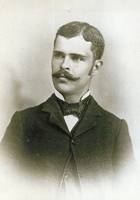
Hill,
known today as the Father of Texas Geology, was born in Tennessee
but came to Texas as a teenager and
worked for his brother’s newspaper, The Chief, in Comanche.
In his spare time he studied the rocks and strata of nearby Round
Mountain and sought to understand what he was seeing by reading
books on geology. Local people called him “Rock Boy.” His reading
convinced Hill
he was on to something new. He packed a suitcase full of rocks and
enrolled at Cornell University to study formally.
In time, Hill
would be responsible for most of what we know about the rock formations
of North
Texas and how they correspond to the Crustaceous Period. He
also named many of the geographic terms and descriptions that we
use today such as the Balcones Escarpment, Edwards Plateau, Trans-Pecos,
Eagle Ford Shale and others.
Jacob
Boll was a naturalist who worked as a paid collector for Cope and
provided him with many fossils from Texas.
Born in Switzerland, Boll found 32 new, rare species of Permian
vertebrates and first identified the Permian rocks of Texas.
He was so taken with his work that he wrote an ode to fossils, a
copy of which Jacobs discovered in his research and included in
his article. Boll died in 1880 from a snakebite he suffered on an
expedition in Wilbarger County.
The two men left an indelible impression on the world that is still
felt today, Jacobs said. “The Permian of Texas that Jacob Boll found
opened a whole interval of evolution that wasn’t known before and
it’s still the most important place to find things of that nature,”
he said. “And Hill
found rock formations that are nowhere else known in North America.
The Eagle Ford Shale that Robert
T. Hill named and mapped is one of the biggest producers in
South Texas today of oil and natural gas.”
In Hill
and Boll’s day, people had barely heard of dinosaurs, much less
oil and gas. Still, even the two scientists and bone hunters would
have been puzzled to know that by looking for clues to a lost world
they also found the fuel for a new one.
© Clay
Coppedge November
30, 2012 Column
More "Letters from Central
Texas"
|
 HOME
HOME

 Gulf
Coast
Gulf
Coast East
Texas
East
Texas Central
North
Central
North Central
South
Central
South Panhandle
 South
Texas
South
Texas Hill
Country
Hill
Country West
Texas
West
Texas Ghost
Towns
Ghost
Towns COUNTIES