|
Phantom Alligators
by Clay
Coppedge
You
won't find any alligators around Alligator, Texas anymore.
You won't find the town either, other than in the form of Alligator
Creek and Alligator Road.
It's easy to forget how thick with wildlife the prairie around here
was when the first settlers arrived. Deer, wild turkeys, wolves, bear,
buffalo, antelope, wild horses, ducks, geese and wild hogs were plentiful.
So were alligators.
Members of the Santa Fe Expedition, when they camped on the San
Gabriel River in Williamson
County, amused themselves with shooting some of the numerous alligators
that lived along the river.
The buffalo and bear were wiped off the landscape by the end of the
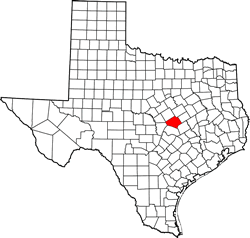
nineteenth century. The last alligator in Bell
County was killed in 1908.
The
old community of Alligator, a few miles east of Bartlett,
lives in legend, lore and in the memory of people like Bell
County historian E.A. Limmer. Limmer, 85, was born there, though
he never saw any alligators.
"All I saw was crawfish," he said last week. "Before the land was
in cultivation they had to drain out a low area, and that's where
the alligators were supposed to be."
The Alligator community consisted mostly of a church, tabernacle and
a school house. Limmer said that in the fall, Joe Pacha, G.L. Oldham,
Calvin Rice and Harvey Messer would hitch up their wagons and go to
the lignite beds near Rockdale
and come back with enough lignite to last the winter.
The lignite served its purpose well, maybe too well; one day in 1926
the school's old pot-bellied stove overheated the pipes and the school
burned down.
That was the same year that Limmer's parents moved to Bartlett
so he could start school and his sister could enter high school.
"I enjoy telling people that I was born at Alligator in Bell
County," Limmer, 85, writes in the recent Bartlett Activities
Center newsletter.
"Every Saturday morning my brother and I would go to the country with
our father. When he turned into our farm, he would let us out and
we would walk the remainder of the way to Grandpa and Grandma Limmer's
house.
"While there we would crate the eggs (24 dozen to the crate) in order
to take them to Lawrence Brothers store with Grandma's butter."
In such a manner, the Limmers paid for their week's groceries. The
way of life he describes has gone the way of the wolf, bear, buffalo
and gators.
"We would shuck and shell corn and take it to Lynn Bartlett, who would
grind the corn into cornmeal," he continued. "In exchange for our
work, Grandpa would give us 10 cents, which was the admission to the
afternoon picture show."
Alligator
Creek, which rises just east of Bartlett, makes its way southeast
for 21 miles to its mouth on the San
Gabriel River five miles east of the San
Gabriel community in Milam
County. Alligator Creek ran right through the middle of the old
Limmer farm. When the family bulldozed part of the creek as part of
a conservation plan, neighbors dropped by to see exactly what was
going on.
"They said it looked like we were building the Panama Canal," Limmer
recalled.
People
today are surprised to find that there was once a community out on
the lonesome prairie named for alligators and even more surprised
to find that the town was named for the alligators that lived there.
Alligators were once common in East
Texas but they made a living in these parts too. You can still
find them east of the Trinity River, around the coast and, sometimes,
along the Colorado River.
There was a time when alligators - not just in Texas
but all across the country - were endangered. State and federal laws
allowed alligators to make an amazing comeback from the brink of extinction
to the point where there is a limited amount of hunting of them permitted
today.
In these parts, you can hunt all you want for alligators but you won't
find any.
You won't even find the town named for them.
© Clay Coppedge
"Letters from Central Texas"
January
21, 2006 column |
| Texas
Escapes, in its purpose to preserve historic, endangered and vanishing
Texas, asks that anyone wishing to share their local history, stories,
landmarks and vintage or recent photos, please contact
us. |
|
|
 HOME
HOME