|
In the Alaskan
Territory in 1890’s, the Eskimo inhabited the land, miners discovered
gold, the place filled up with people, and their food source was
running out. Dr. Sheldon Jackson, a Presbyterian minister who served
as an agent of the U.S. Government, surveyed the agriculture possibilities
of the Yukon Territory. He had the idea to introduce domesticated
reindeer to Alaska. Using private investors, he purchased one hundred
seventy reindeer from Siberia and had them shipped to Alaska. There
was a problem. The native Eskimo did not know how to herd reindeer
and the herd perished shortly after their arrival. More purchases
followed and more failures, even after hiring herdsman to look after
the reindeer.
Fortunately every failure lead to more extensive research and someone
finally discovered that the Lapps depended on their reindeer for
food, clothing, tools, transportation, and yes, even Reindeer games!
Americans finally figured out that if reindeer were ever to be successfully
introduced to Alaska, it would only take place under Lapp supervision.
The decision was made to select a few families of Laplanders to
do the herding and give instruction to the Eskimo’s. Since there
were no full-blooded Laplanders in America they would have to be
brought from their homeland, along with the reindeer. Advertisements
were placed in several Scandinavian newspapers to acquire service
of men who were knew the reindeer. In all two hundred fifty applications
were received. Selections were made, provisions purchased, and on
February 28Th, 1898 The Manitoba Expedition set sail for the United
States with 539 reindeer, 418 sleds, 511 sets of harness and a 113
herders. The herders consisted of men, women, and children, who
were Lapps, Finns and Norwegians. This project was an apprenticeship
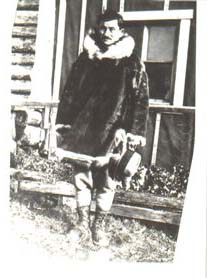
of the U.S. government. Among the herders was my Grandpa MIK who
was then only 19 years old. The expedition was brought to New York
by sea. It then traveled by train to the West Coast, and then north,
on foot and by sled. Grandpa MIK finally reached Alaska and did
what he knew how to do; teach the Eskimo how to herd and care for
the reindeer. The original herd tripled in size with the change
of the seasons and Grandpa MIK finished his apprenticeship with
the U.S. government.
By 1914, under
Lapp management, herds were estimated at 250,000 reindeer and Grandpa
MIK was a vital part of the herding process. He was an employee
of the Lomen Brothers; as well as a friend of the Lomen family.
Grandpa MIK not only helped the native Eskimo, he became a part
of the largest reindeer Industry in history. So now, I have shared
with you how reindeer and my great grandfather came to Alaska. But
wait there is more!!
The Canadian government noted the benefits provided to the Eskimo
by the reindeer. Canada purchased 8,447 reindeer from the Lomen
Reindeer Corporation for introduction into northern Canada. The
Lomen Company would oversee the delivery of the reindeer. The deer
would be driven from Kotzebue Sound in Alaska to the Mackenzie Delta.
The Lomen Brothers decided that there only choice of herders for
this kind of drive would have to be the Lapps . Andy Bahr, a Lapp,
was selected to head the drive. Grandpa MIK was chosen as his second–in-command.
In 1929, “The Artic Moses” and his small band of herders started
out from Alaska with 3000 reindeer, intending to cover the 1500
miles on foot to the Mackenzie Delta in 18 months. These men would
face temperatures of seventy degrees below zero, blizzards, prowling
wolves, boggy tundra, mosquitoes, and ornery reindeer. In the end,
their perilous journey would take more than 5 years to complete.
A single mountain range took an entire year to cross. At the end
of the trip the men ended roughly with the same number of reindeer
they left with, having to raise the ones they lost.
This was the longest trail ride in the history of North America,
and undoubtedly the most remarkable. It had featured semi-wild animals
that most North Americans had never seen, and whose meat they had
never tasted. It had taken the natives of four countries: Canada,
the United States, Norway and Denmark, to succeed and had involved
governments at federal, state and territorial levels.
My grandpa MIK was an incredible man. He left his home at the age
of 19, to come to America to help out the Alaskan natives. He left
his family, his land, and friends all for the love of reindeer,
and the survival of a culture. He returned to Norway to wed my great-grandmother,
but the two immediately returned to Alaska where he continued his
employment with the Lomen Corporation until he retired. It is the
job of my generation to keep this incredible story alive for generations
to come. There are approximately 60 of us Sami descendants (Nilluka's)
in the United States today. Now that I have shared just a touch
of my great grandfather’s story I am proud to say I am a Sami descendant
living in Southeast Texas. Alaska will always be a part of me. It
is my birth place and it is where my great grand father’s legend
lives on.
© Christy Nilluka Broussard
They
Shoe Horses, Don't They April 15, 2011 column
More Columns
|
 HOME
HOME

 Gulf
Coast
Gulf
Coast East
Texas
East
Texas Central
North
Central
North Central
South
Central
South Panhandle
 South
Texas
South
Texas Hill
Country
Hill
Country West
Texas
West
Texas Ghost
Towns
Ghost
Towns COUNTIES