|
When
most of us hear the word "redeemer" we think of the Good News of Christianity.
In Reconstruction times in Texas
after the Civil War, "redeemer" meant a political leader who
helped reclaim control of the state from the national military and
the radical Republican Congress. Samuel Bell Maxey of Paris,
Texas, is a good example of such a leader.
Maxey was born in Tompkinsville, Kentucky, in 1825. He attended the
United States Military Academy and for a year was the roommate of
future Confederate General Thomas J. (Stonewall) Jackson. Maxey was
graduated from West Point in 1846, just in time to participate in
the Mexican-American War. He resigned from the Army in 1849 and returned
to Kentucky to practice law. Four years later Maxey married Marilda
Cass Denton.
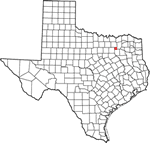
In 1857 Maxey and his father moved their families to land near Paris
in Lamar County.
Like most immigrants to Texas before
the Civil War, the main chance, a new start, explained the move. When
Texas attempted to secede from the Union in 1861, Maxey was serving
as district attorney for Lamar
County. Evidently undecided on the best avenue of service, he
simultaneously sought election to the Texas senate and a military
command--and got both. In the end he decided on military service,
rose to the rank of brigadier general in the Confederate service,
and for a time commanded the Indian Territory for the Confederacy.
Maxey returned to Paris
after the war. Postwar Texas was controlled by Federal soldiers and
the Republican Party. Radical Republicans in Congress attempted several
plans of Reconstruction, eventually settling on one that abolished
the former states and regarded them as conquered territory. For a
while Texas was ruled by the Federal
army without a civilian government. Soldiers registered potential
voters to elect delegates to write a new state constitution that would
renounce secession and the previous Confederate affiliation and leave
the state under Republican control. Republican E.J. Davis was elected
governor of the new state government.
Maxey became active in the Democratic Party's opposition to Republican
control. They defeated Davis at the end of his term, electing instead
the "Redeemer" Richard Coke as governor. The new Democratic legislature
then elected Maxey to represent Texas
in the United States Senate. Maxey served two terms in the Senate.
The Maxeys had no children of their own but did adopt a daughter and
helped to raise Maxey's namesake nephew, Sam Bell Maxey Long. Maxey
died in 1895 and is interred in Paris. The Maxey's home in Paris
is listed on the National Register of Historic Places and can
be visited by the public.
All Things Historical
July
22-28, 2001
Published by permission.
(Archie P. McDonald is Director of the East Texas Historical Association
and author or editor of over 20 books on Texas) |
| Books
by Archie P. McDonald - Order Here |
|
|
 HOME
HOME