|
|
Of
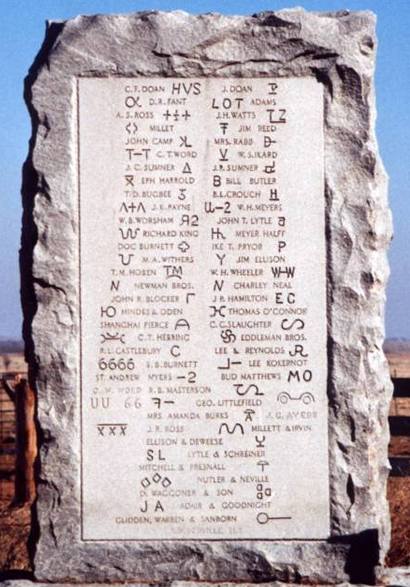
all things "truly western," probably the brand, applied with a hot
iron to the hide, is one of the most authentic. I will not argue with
those who say it is barbaric, painful or cruel as we live in a modern
world where death, cruelties and barbaric things are published daily.
One thing cannot be argued, a healed brand is still the most visible,
positive identifying process yet found. As examples of marking livestock,
both legal and illegal, here are a few true stories with a bit of
Trew flavor.
Just how old are livestock brands? No one is sure but murals have
been found in Egyptian tombs showing the branding of livestock. Early
settlements dating from Moorish times required that in order to plant,
raise and harvest crops, a practice called "transhumance" had to be
carried out. This called for periodic removal of all livestock and
large poultry from the cropping areas during the growing and harvesting
seasons.
The laws of the time, in order to prevent theft or mysterious loss
of livestock, dictated all animals must be branded before being moved.
Brands or painted markings were the only options available at the
time to identify domestic stock or flocks. |
 |
A
tale of questionable authenticity, about the Oklahoma
Territory Strip along the Cimarron River, tells of a band of horse
thieves who stole only choice ranch horses in the Texas
Panhandle, led them to a hidden ranch in the strip, where an old
man altered the ranch brands with heated wire bent into the desired
design. He only burned the hair and not the hide so the brands did
not scab or peel. The stolen stock were quickly driven to Colorado
and Missouri and sold before the hair regrew.
John
Chisum, the famous rancher of the Pecos River Country, once caught
and convicted a group of cattle rustlers who were changing one of
the many brands he adopted when he bought and sold vast herds of cattle
across Texas and New Mexico. The group
had been acquitted by court once for theft because of "reasonable
doubt." Evidently they were extremely clever in the alterations.
Mr. Chisum set a trap by roping a number of odd marked steers and
having his cowboys cut a small slit in the lower folds of the brisket
and insert a silver coin into the slot which quickly healed over.
Later, they caught the gang of thieves with some of the identifiable
steers. With the law present as witnesses, the cowboys roped the steers
and removed the coins as evidence. The thieves were sent to prison
for long terms.
That brings up the old classic tale of the rancher who registered
the brand I C. Rustlers merely added a U making the brand I C U. The
rancher then re-registered his brand as I C U 2.
Interestingly, I give a program about brands and have learned I can
take the bare letter J without the top bar on the letter, and make
every letter in the alphabet and numbers from 0 to 9. With patience,
holding the iron at different angles, slants and touch-up, it can
be done. Try it if you don't believe me.
© Delbert
Trew
"It's All Trew" August
3 , 2010 Column |
|
|
 HOME
HOME
