|
|
The
book "The Long Trail" by Gardner Sowle, published in 1976 by McGraw-Hill,
tells the real story of early cowboys, longhorns and the first industry
developed in Texas. This was the chore
of capturing, branding, taming, raising and driving longhorns to market.
Legends and myths, plus the exaggerations of many publications are
omitted boiling fact down to common sense explanations.
Just where did the longhorns originate? From the Plains of Andalusia
in Spain. The first herders were Moors, the next Spaniards. The cattle
were not called longhorns but "Spanish cattle" and were smaller in
size and with smaller horns. |
How
did these Spanish cattle come to America? In 1493, Christopher Columbus
brought cattle to America on his second voyage, landing them on the
island of Santo Domingo. The exact year they reached the main land
in today's Mexico cannot be proved but about 20 years is close.
From that point on some 10 explorers and adventurers brought livestock
and large poultry to various shores of North America to supplement
their food needs during exploration. |
|
How did these
domestic livestock become wild? They were driven along in herds and
butchered as needed for food. Poor herding allowed many to escape
and find themselves left on the prairie to fend for themselves. Indian
attacks, disease and sickness among the explorers left herding a second
priority. In 1685, a French explorer La
Salle, made a practice of leaving one cow, bull, mare and stallion
behind after crossing a river, to provide meat for the next explorer.
A Mexican Gen. Alonso
de Leon did the same on four excursions across the new lands.
Why did the formerly domesticated livestock propagate so quickly in
the new world? The climate was mild in the south, rains produced millions
of acres of good grass for grazing and there were few predators to
keep numbers in check. The huge buffalo
herds of the Great Plains were all located to the north offering no
competition for grazing. These ideal conditions were prevalent for
several hundred years allowing excellent propagation of both cattle
and horses.
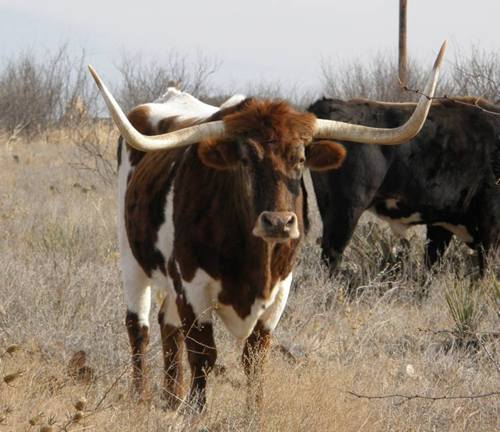
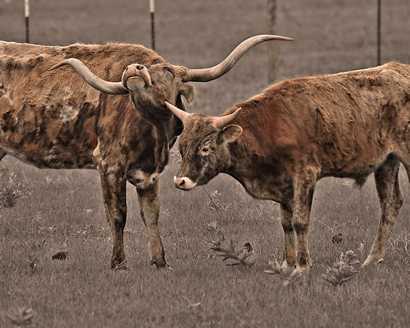
When did Spanish cattle become longhorns? Prior to the Spanish cattle
arriving in Texas, they were usually converted to beef at a much earlier
age before their horns matured. After becoming wild, many living to
die of old age, their horns became much larger and longer. |
 |
 |
|
The
old adage, "only the most fit survive" provided the vigor, survival
instinct, intelligence and evolution needed to continue and improve
the breed. These changes continued and are still prevalent in the
survivors today.
How did the first industry begin? The availability of the wild longhorn,
free for the taking, and the poor financial conditions after the
Civil War forced the early
cattlemen to capture, raise, brand and then drive this smuggled
contraband (considered to be the property of Mexico) to market to
survive. Handily, the raw materials (cattle) could walk, delivering
themselves to market to be sold thus helping create the first industry
in Texas.
© Delbert Trew
"It's All Trew" January
17, 2011 column
Delbert Trew is a freelance writer and retired rancher. He can be
reached at 806-779-3164, by mail at Box A, Alanreed, TX 79002, or
by e-mail at trewblue@centramedia.net. For books see DelbertTrew.com.
His column appears weekly.
|
|
|
 HOME
HOME
