|
|
NOGALUS PRAIRIE,
TEXAS
aka Nogallis Prairie, Nogalus, & Prairie View
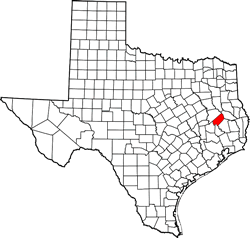
Trinity
County,
East Texas
31° 15' 20" N, 95° 5' 18" W (31.255556, -95.088333)
Farm Road 357
13 miles NE of Groveton the county
seat
Population 109 (2000) 41 (1990)
Area Hotel Here › Lufkin
Hotels |
From
"No Gallows" by Bob
Bowman
The names of some East Texas
towns can be downright confusing. And much of the confusion arises
from mispronunciations which, during the passage of time, have become
actual names.
Take, for example, the name Nogalus Prairie in Trinity
County.
Local lore suggests the name originated when two horse thieves were
hung from the branch of a large tree because the community had "no
gallows."
While a morsel of truth may lie in the story, Clell Davis of Trinity
County helped shed some light on the community's real origin.
The community was originally named Nogales Prairie because
of the walnut and pecan trees that grew there when Texas was still
a province of Mexico and Spanish families lived in the area. Nogales
is Spanish for walnut and sometimes pecan.
When the first European settlers came to the area, they spelled the
name like it sounded, and Nogales became Nogallis. The first post
office opened in 1858 as Nogallis Prairie. In the late 1800s,
it was sometimes called Logallis Prairie, but in 1894 the post
office was known as Nogalus Prairie.
No less than John
Wesley Hardin, the preacher's son and outlaw who spent a lot of
time in Trinity County,
mentioned the name in his autobiography, "The Life of John Wesley
Hardin."
Hardin shot and killed a former slave near Moscow
in Polk County in
the fall of 1868 and was on the run from federal reconstruction troops.
His brother Joe was teaching school "on Logallis Prairie, about twenty-five
miles north of Sumpter" and John Wesley
fled there.
When Joe also told him that federal troops were coming to arrest him,
Hardin waylaid and killed three soldiers in a bed of a deep creek.
He buried the bodies in the creek bed about 100 yards from where the
fight occurred.
Some 55 years ago, as a young boy growing up at Nogalus Prairie, Clell
Davis was walking along a creek bed and found some bones. "That night
at supper, I told my father about it, and he told me that his grandfather,
Alexander Davis, told him that back in the l800s, a man shot three
men and buried them near the creek bed," said Davis.
"The story really got my attention, but for some reason I never went
back to look for the bones and, after 55 years, I had almost forgotten
about it until I read Hardin's book," said Davis.
Today, however, the creek has been dammed and a pond covers the site.
"A short distance from there, you can see the old roadbed where it
used to cross the creek, and I believe this is where John Wesley Hardin
shot the Union soldiers and where they were buried," said Davis.
As far as hangings are concerned at Nogalus, there were a number that
occurred in the vicinity during and after the Civil War. During that
time, a large group of Civil War deserters were camped in the community
when they were chased down and hung from convenient tree limbs.
From the 1840s to about 1900, Nogalus Prairie was a "fair sized community,"
said Davis. From 1900 to 1918, the community had a Methodist church,
several stores and saloons, a cotton gin, grist mill, and a Woodmen
of the World lodge.
The post office closed in 1920 and today Nogalus is mostly a dispersed
rural community. Its last population figure in 2000 was 106.
© Bob
Bowman
From "All
Things Historical"
April 2, 2007
Distributed by the East Texas Historical Association. Bob Bowman of
Lufkin is a former president of the Association and the author of
more than 30 books about East Texas. |
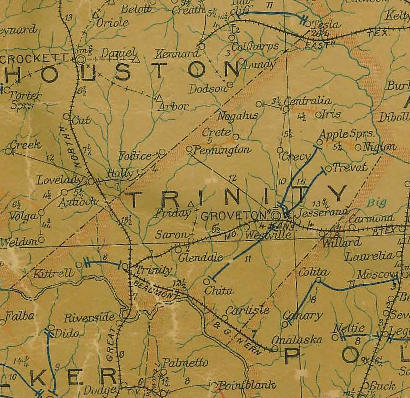 |
Trinity
County 1907 Postal map showing Nogalus
(Above "N" in "TRINITY")
Courtesy Texas General Land Office |
Nogalus Prairie,
Texas Forum
Subject:
Nogalus Prairie, Texas
The Davis side of my family were living on this Prairie from the middle
of the 1800s. My dad and grandfather related the no Gallows story
to me. Clell Davis providing some of the information given and is
my cousin. The parts that does not completely fit or still remains
unexplained is that my grandmother Irene Davis and my dad Sam Davis,
when he was young, went to wash clothes at the Spring which was near
where Claude Davis eventually had a store. At that time near the spring,
there were 3 graves marked by rusty muskets with rusty bayonets. This
was in the area where John Wesley Hardin killed the 3 soldiers chasing
him. - Jerry Davis, Hot Springs, AR, August 16, 2012 |
| Texas
Escapes, in its purpose to preserve historic, endangered and vanishing
Texas, asks that anyone wishing to share their local history, stories
and recent/vintage photos, please contact
us. |
|
|
 HOME
HOME

 Texas
Gulf Coast
Texas
Gulf Coast East
Texas
East
Texas Central
Texas North
Central
Texas North Central
Texas South
Central
Texas South Texas
Panhandle
Texas
Panhandle South
Texas
South
Texas Texas
Hill Country
Texas
Hill Country West
Texas
West
Texas Texas
Ghost Towns
Texas
Ghost Towns Texas
Counties
Texas
Counties