|
|
|
The
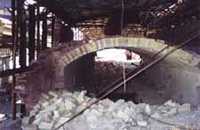
Collapsed Kiln
TE Photo |
| We
were standing in the shade in front of the Coleman City Library, waiting
for a hailstorm to cool things off, when we decided to go to the antique
store two doors down and see if they had a Coleman
Brick. Before we go further, let us say that the sidewalk (and overhead)
vegetation in front of the library creates a wonderful little oasis
on Main Street and offers sanctuary from hailstones as well. We commend
whoever is responsible. Coleman's
Library, by the way, was organized 115 years ago. The Antique Shop
people were as pleasant as could be, but they did think the request
a bit strange. Rather than identify ourselves as brick collectors,
we've learned that saying, "It's for a demented friend" works just
fine. Our answer here was: "If I wanted a brick, I'd go to the brickyard.
There's a lot of them lying around there." The directions were just
west of town at the end of Live Oak Street. |
PAY
DIRT
We
followed the directions over brick-paved streets and as we approached
the plant we could see tons of brick and tile rubble nearly spilling
over into the street. We thought we would find one marked COLEMAN
in short order and be on our way. This was not to be. The
abundant rubble reminded us of the pottery shards found around Mexican
pyramids. The Aztecs evidently suffered from severe "Butterfinger
Syndrome" or there was a lot of domestic violence, because there's
nearly as much clay at Texcoco, Puebla as there is here in Coleman.There's
something wonderfully simplistic about taking clay from a mountain
and using it to create a brick town with brick streets. We're sure
the men who sweated and broke their backs working here would agree
that this vision is positively charming.
|
|
|
Brick
plant
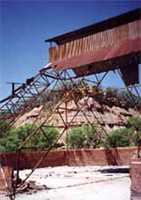
What's left of the clay mountain
TE
photo |
| The
plant was abandoned. The clay mountain still towers over the skeletons
of the buildings, but it doesn't tower like it used to. You could
tell they could see the end was coming. With every brick made, the
mountain was that much smaller. There seemed to have been a fire,
but whether or not this caused the closing, we'll have to find out
on our next trip. Of course we would never trespass, but we were chasing
a little white rabbit (obviously some little girl's lost pet) and
before we knew it we were in the brickyard searching for our way out.
The site might be a little small to shoot an apocalyptic action movie,
but it would be a great paintball arena. There appeared to be four
long kilns, one of them collapsed. Remember, we were only looking
for a brick marked COLEMAN, the pet rabbit and the way back to our
car. Well, there were bricks marked Butler and there were bricks
marked Acme and there were none marked COLEMAN. In truth, we
found two marked COLEMAN, but they were cemented into walls and were
evidently leftovers from the plant's early years. |
A
SOAP BRICK
The collapsed kiln revealed that all these other
bricks were firebricks - special "vitrified" bricks that had to
be imported from outside Coleman County. The irony of bringing in
bricks to make bricks reminded us of a Saudi who told us that the
Saudis import thousands of tons of sand every month because their
home grown sand is lacking the qualities needed for glass making.
Coleman also has silica-rich
sand around Santa
Anna.
Mysteriously, one brick, resembling a quarter of butter, was imprinted
with the word SOAP. It's texture and color though, was similar
to the firebricks. We turned to Raoul
who we keep around for just such situations and had him try to "lather
up" with water from his, not our, canteen. He merely succeeded in
abrading his palms and underarms. And you thought Lava was
rough.
The kilns were arched and resembled catacombs. The soot from the
fire made them look like the ovens at Dachau. Fallen bricks revealed
markings like: Wedge No.1 and Arch No. 2 etc. Somewhere there had
been blueprints so that brick deficient towns all across America
could order kits and build their own kilns.
To
end our story - we found our way out, took Raoul
to the emergency room (where the Doctor on duty asked if he had
been washing with a soap brick) and left Coleman
City and Coleman
County without a Coleman Brick.
We thank Coleman for
providing us with the site for this unusual, unknown (and unauthorized)
tour. There can't be too many brick factory sites left and maybe
the City will buy the property and develop it as an industrial ruin.
At the least, they could make it available to host Conventions of
The International Brick Collectors Association.
Perhaps
if brick collecting catches on, Coleman
will reopen the plant and sell bricks imprinted with: "My Grandfather
went to COLEMAN, TEXAS,
and all I got was this damn brick."
© John
Troesser
July, 2000
|
Forum
Subject: Coleman, TX abandoned brickyard
I was just surfing and happened across your article about your trip
thru Coleman and the old brickyard there. My father worked for Martin
Brick Co. for over 40 years. He was the plant manager for 30 years
or so. I and my 3 brothers worked our way thru high school and college
there, as well as a large percentage of folks from Coleman back in
the day.At one time in the 1980's Martin Brick Co. employed over 200
workers, making it the largest employer in the county. There are a
few old solid bricks left manufactured there still around, although
I have none as I am not a brick collector.The last of those were made
there back in the 1950's, at which time most brick manufacturers went
to the "holed" kind because of freight. It shut down operations about
1995 due to the high cost (at the time) of natural gas. The owner
made the effort to switch to a firing system by burning wood, but
that proved to not be successful either. Thanks for the interesting
read, it brought back memories. - Mike Merryman, April 28, 2012 |
| Texas
Escapes, in its purpose to preserve historic, endangered and vanishing
Texas, asks that anyone wishing to share their local history, stories,
landmarks and vintage or recent photos, please contact
us. |
|
|
 HOME
HOME