|
|
Texas Onions
Turning Bermudas
into Vidalias
with a Little Help from Cotulla
by John
Troesser
"The world would be a boring place without the onion."
- Julia Child |
It
may come as a surprise (readers who are easily surprised may find
themselves astounded) that the Onion is Texas'
leading vegetable crop. You were thinking maybe spinach? Tomatoes?
Cantaloupe? No. It is, in truth, the lowly but tasty little onion
that brings in $70 to $100 million per year. Furthermore, when all
onion related activities are factored in - like crating, trucking,
harvesting and putting all those little stickers on each onion, the
industry has a $350 million per year impact on the Texas economy.
It's generally accepted that sweet onion production in Texas
can be traced back to a single packet of seed from Bermuda being planted
near Cotulla
in 1898. It's also acknowledged that the Canary Islands (Teneriffe
Island,in particular) was the main supplier of onion seed up until
1946. Most atlases show the Bermuda Islands and the Canary Islands
to be something like 2,700 miles apart. This discrepancy doesn't seem
to bother most Texans: " Canary? Bermuda? What's the difference? Just
make sure there's enough for the chili." |
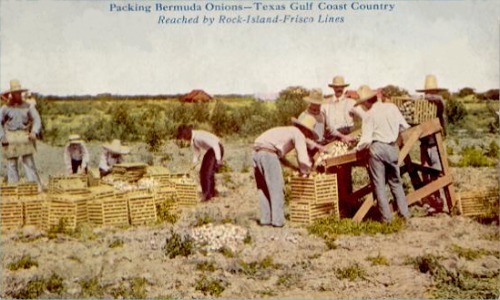 |
"Packing
Bermuda Onions - Texas Gulf Coast Country
Reached by Rock-Island Frisco Lines"
Postcard courtesy www.rootsweb.com/ %7Etxpstcrd/ |
Readers wanting
to investigate further may find that the onion known as "Bermuda"
was first listed on a manifest in 1888 as "White Bermuda" by exporters
of the time. D. Landreth &;Co., stated that "although [the onion is]
known as a product of Bermuda, is of Italian origin."
Meanwhile,
back in Cotulla:
Those first Cotulla-raised onions found themselves shipped to Milwaukee,
Wisconsin. The people of Milwaukee have always appreciated good beer,
sausage and onions. When they ate those Texas onions they went wild.
Word was sent back to Cotulla: "Milwaukee needs onions!" Immediately
Cotullans started removing cactus and began planting more Bermudas.
In 1907 over a thousand boxcar-loads of onions were shipped from Southwest
Texas. The following year production doubled and in 1917 nearly 7,000
boxcar loads were shipped. The record for a single season was just
over 10,164 boxcar loads (1946) which was enough onions to fill the
Roman Coliseum up to the brim and still fill half of the broom closets
in the Vatican.
The Canary Island farmers could barely keep up with the Texas
demand for onion seed. On top of this strain, inexperienced growers
anxious to cash in on the seed bonanza make mistakes, seriously decreasing
the quality of seed. This forced Texans to import seed from Spain
and from this new source (in the mid 1920s) came the variety known
as Grano. |
"The Mother
of All Sweet Onions"
Grano
arrived in Texas about the time an onion-breeding
program in the Rio Grande Valley was in development. In 1933 the Texas
Grano 502 came into being - an onion that is known in onion circles
today as "The Mother of All Sweet Onions"
Grano 502's name comes from the original field number of 502, however,
the onion was officially known as the "Texas Early Grano." Since
its introduction , this variety has been grown as far away as Palestine
(Israel - not Texas) and Australia. |
THE VIDALIA
ONION
Toombs
County, Georgia is acknowledged to be the birthplace of the Vidallia
Onion. Georgia had been having a problem with weeds that were growing
faster than the locally planted onion sets. Texas transplants, it
was hoped, would give the farmers a much-needed head start and so
Texas Granex onions from Carrizo
Springs (near Cotulla)
were shipped there in 1952.
Mose Coleman, a Georgia farmer discovered one day that his onions
lacked the expected characteristic bite. The onion's mildness is attributed
to the soil found in a 20 county area. (Only onions grown in these
counties - or selected parts of a few others can market onions under
the Vidalia name.)
Farmer Coleman had a hard time at first convincing people to bite
into his onions, but when they did they became believers. Soon it
seemed that everyone in Southern Georgia was growing sweet mild onions.
In 1952, Vidalia was a small Georgia town that wasn't famous for anything
in particular. It was a junction of two major highways, however, and
hosted a farmer's market that did a good business with tourists going
and coming from Florida. These produce buying tourists spread the
word about these onions and soon magazine ads appeared (right next
to the mail order Chihuahuas in teacups). The name Vidalia was being
fused with the "world's sweetest onion."
Memphis based Piggly Wiggly Markets started handling them by name
in the 50s and 60s and onion festivals in Vidalia and nearby Glennville,
Georgia pushed awareness.
Production increased tenfold in ten years and soon 14,000 acres were
in cultivation. Georgia's Vidalia harvest brings in $50 million annually.
© John
Troesser April 3, 2004 Column |
Related articles:
Tasty
Texas Ingenuity by Clay Coppedge
T.C. Nye, George Copp and the Texas Onion. If Texas weren't already
so well known for commodities like cows, cotton and corn, we might
be known instead for our onions, the state's number one vegetable
crop. The sweet yellow Bermuda onions that connoisseurs like to
say "you can eat like an apple" originated here by way of the
Canary Islands... more
The
Famous Texas 1015 Sweet Onion Cartoon by Roger T. Moore
More Texas Food
|
|
|
 HOME
HOME
