|
Mexico
Timing is Everything
by Stan Gotlieb
Photo by Diana Ricci |
|
|
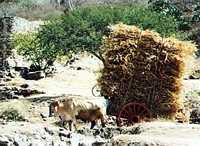
This
picture was taken from the ruins at Lambetyeco, near Oaxaca city.
It's meant to convey the mix of modern and ancient that one runs into
all the time in southern Mexico. Notice the bicycle wheel uphill from
the hay load. A more modern commuter is just about to pass. |
Question:
when does the last bus for (fill in the name of your favorite Oaxaca
destination here) come by?
Answer: after the next-to-the-last one.
This exchange tells you everything you have to know about bus service
in Oaxaca. It also tells you about when to cross the street, how to
shop for a serape, and why everyone is so agreeable.
Buses in Oaxaca leave from the center of town and travel outward.
When they get where they are going, they sit while the driver chats
with the inspector at the end of the line, and then they resume their
roundelay. Sometimes the driver stops along the way for a quart of
oil, a "Coca" or to kick a tire. Occasionally, two drivers pull up
alongside each other and chat for a moment, either verbally or by
hand signals. There is no such thing as a "schedule". Schedules are
far too restrictive, too unnatural. Why would you need a schedule?
You go when you can, stop when you must, and collect the fare from
everyone who can pay it.
That's not to say that there are no rules. They just aren't written
down; one has to divine them through observation, well-formed questions
and endless miles of bouncing, jouncing, buoyant busriding.
Rule number one: bus-stops are in fixed positions, but people
are not; no matter where they are, when they wave, you stop. Middle
of the block, middle of a controlled intersection, twenty yards past
the last passenger pickup: no matter, a fare is a fare.
Rule number two: it's up to you. If the bus is filling up,
or if you don't feel like stopping, or if you don't like their looks,
or if they are just gringo tourists who should probably be taking
a cab anyway, you can ignore rule number one. This rule applies even
to people waiting in bus stops.
Rule number three: first come, first filled. Every time you
pass another bus, you will get his passengers. Since almost all inbound
buses go to the same destination near the central market, and since
almost all outbound buses follow the same few routes until they get
well out of the center, the leapfrogging gets pretty wild. You haven't
lived until you have experienced a three-lane drag race of snorting
gear-clashing 54-passenger Dina diesel transports.
Rule number four: play your radio loud. It helps to drown out
the roar of the unmuffled diesel engine, and the screeching noise
when you put on the brakes.
Rule number five: decoration is everything. The rattier the
bus, the more likely that the driver will have festooned it with colored
(and sometimes blinking) lights, decals of the bleeding heart of Jesus,
dayglo inscriptions of his sweetheart's name, and strings of tinsel.
Some buses have complete biblical events on the dashboard (creches
and last suppers are the favorites, although I recall one particularly
bloody scene of Salome holding the head of John the Baptist).
Rule number six: never sacrifice performance for the sake of
the environment. Anyone who wants a little taste of the gas chambers
at Auschwitz is invited to stand on the curb near the back of a diesel
behemoth as it grinds into first gear and accelerates away. Pure urban,
man.
Rule number seven: make the other guy do the crawling. Folks
here claim the aisle seat first. They do not like to crawl over each
other to get in or out of the window seat. Often, the aisles will
be full of standees, even though there are empty window seats. It
seems to me that a sociologist could get several learned papers from
this behavior. My own theory is that it has to do with some deeply
ingrained aversion to sticking one's behind in someone else's face...
Rule number eight: there are no rules; at least no fixed ones.
Life is too important to clutter it up with rules. There are only
situations, and each will be unique, with it's own imperatives. Stay
loose.
Which brings us to the introduction. When do you cross the street?
When you can, whether the light is green, red or nonexistent. How
do you buy a serape? In whatever manner pleases you; that's how the
other guy is selling it. Why is everyone so agreeable? Because "yes"
means "maybe" (nobody who is simpatico likes to say "no"; it's easier
to say yes and just fade).
Get it? It's all situational: an unfolding process in which nothing
is assured, and one exists in a constant state of wonder. As in, "I
wonder when the next bus will arrive?".
© Stan Gotlieb
"Letters
from Oaxaca, Mexico" August
2003 Column
More on Mexico |
| Texas
Escapes, in its purpose to preserve historic, endangered and vanishing
Texas, asks that anyone wishing to share their local history, stories,
landmarks and recent or vintage photos, please contact
us. |
|
|
 HOME
HOME