|
It’s
no grand old movie house like San Antonio’s Aztec or Dallas’ Majestic,
but it used to be a show place – at least in the sense that movies
played there.
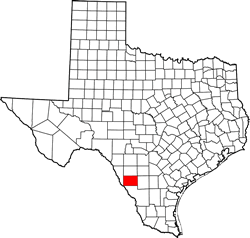
In the heart of the small Dimmitt County town of Asherton,
the old wooden building does not look much like a theater until you
walk up on the porch. Then you notice the boarded ticket windows and
can begin to visualize the deteriorating structure with green tarpaper
shingles on its sides as a place people used to go to see movies.
The story of Asherton lacks the drama that might make a good movie
(well, there is the tale of the sympathetic priest who supposedly
allowed bootleggers to hide their booze in the basement of his church),
but it certainly would do for a documentary on one adopted Texan’s
rags to riches story.
Asher
Richardson, born in Snow Hill, MD on Sept. 21, 1855, got to Texas
by joining the Army. A saddler in Co. H, 8th Cavalry, he ended up
in South Texas stationed on the Rio Grande at Ringgold Barracks.
Richardson and the military parted company on April 12, 1877. It must
have been his decision not to re-enlist, because the Army had him
down in its records as an “excellent … honest and trustworthy man.”
Rather than go back East, Richardson decided to stay in Texas. Sometime
between 1877 and the next U.S. Census three years later, he settled
in Dimmitt County and got a job on the 15,000-acre William Votaw Ranch.
His life evolving like a flickering two-reeler Western, in June 1881,
Richardson married the boss’ daughter, Mary Isabelle Votaw of San
Antonio. After the wedding, they began running the Votaw Ranch.
The federal enumerator who interviewed Richardson in 1880 listed him
as a wool grower, but he soon proved to be a fair hand at growing
business.
In 1886, Richardson got an opportunity to get some land of his own,
purchasing several large tracts from the state in partnership with
his wife’s parents. At a sheriff’s sale in 1897 he expanded his holdings
by buying the El Moro Ranch, followed by the Oak Grove Ranch in 1903.
Four years later, he bought his in-laws’ ranch.
With
title to some 240,000 acres in South
Texas, in the truest tradition of Texas entrepreneurs, Richardson
began to think even bigger. Thanks to plenty of underground water,
the area had begun to evolve into what came to be called the Winter
Garden because of its two long growing seasons. Richardson expanded
his ranching operations to include farming and real estate development.
He created the Asherton Land and Irrigation Co. and began planning
a 48,000-acre development. The centerpiece of his plan was a railroad,
which he established between Artesia Wells, a stop on the International
and Great Northern Railroad, and Carrizo Springs.
His railroad, the
Asherton and Gulf, began running in 1910. By that time, the town
named in his honor had a post office and a telephone company. Five
years later, Asherton had a thousand residents and before the Depression
had grown to twice that size.
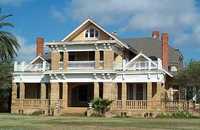
A year after his railroad began running, Richardson built the town’s
showplace, a two-story stone mansion designed by famed architect Alfred
Giles. The name of his town being a composite of his first and last
name, Richardson used a similar technique in naming his new house
Bel-Asher to honor his wife. |
|
|
Bel-Asher
c.1910
Photo
Courtesty Jason Penney |
Richardson’s
town was doing well and he had a fine house, but he did not get to
enjoy it for long. He died in San
Antonio in 1914.
Asherton continued to prosper even after its founder was gone. In
1925 it had enough residents to incorporate as a city. Two years later,
Asherton enjoyed the distinction of being one of the nation’s top
shipping points for Bermuda onions.
Things went south for Asherton during the Depression, but it enjoyed
one more boom in the mid-1950s.
The prosperous days of Asherton are long gone, but Bel-Asher endures,
still one of the most imposing structures in the county. It’s not
open to the public, but it has a state historical marker and is listed
in the National Register of Historic Places.
© Mike Cox
October
15 , 2004 |
| Books
by Mike Cox - Order Here |
|
|
 HOME
HOME