|
Being
a cotton farmer was not the easiest
way to make a living, but if a man didn’t mind working from can see
to can’t, he could get by and maybe save a little.
Texas farmers tilled the black soil to bring forth white fiber, battling
the boll weevil
and the vagaries of Texas weather to produce a crop each year. But
some years, no matter how many hours a man and his family and hired
hands put in grubbing and picking, forces beyond his control could
suddenly control his life. When the price of cotton went down, all
a man could do was hope the market rebounded next year. When it didn’t
rain enough to keep his plants alive, he could pray for more rain
next season, providing it didn’t all come at once in a flood.
But as the Depression began to worsen in the early 1930s, cotton
didn’t come back. In 1929, cotton
brought 16.9 cents a pound. Two years later, the price had fallen
to less than 6 cents. Many farmers lost their land, their homes and
finally, their spirit.
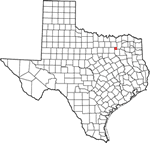
Maybe that’s what made Jake snap. No one seems to know his last name,
but many people in Williamson
County know about Jake.
For whatever reason, according to the story, Jake killed his wife
and two children. When the reality of what he had done set in, he
took his own life as well, hanging himself from a back road wooden
bridge between Hutto
and Pflugerville,
near the Williamson-Travis
county line.
That’s one story. Another has Jake being a young man who killed his
parents, pushing the car containing their bodies off the rural bridge.
Later, this story goes, Jake died in a house fire.
Whoever he was, and if he ever was, Jake seems not to have been a
happy person. His spirit, some say, lingers around the bridge (since
replaced by a more modern concrete structure) that figures in both
versions of the tale.
Somewhere along the line, the story arose that Jake’s ghost liked
to mess with cars on the bridge, trying to push them off.
Supposedly, if you stop your car on the bridge and shift into neutral,
you can feel the vehicle begin to move. If your car happens to be
dusty, the story continues, you’ll find handprints on the back. Some
claimed to have “proven” Jake’s efforts to move their wheels by spreading
flour on their trunk.
Those who like rational explanations for unusual phenomenon have argued
that the bridge must not be level, having enough of a slope for a
car to roll if it’s not in gear. Since it’s a relatively new bridge,
that doesn’t seem too likely.
An old house in the vicinity also is supposedly haunted by Jake. A
Web site devoted to Texas ghost
tales says visitors have reported hearing footsteps, children
screaming and a voice yelling, “I am coming for you.”
A variant of the Jake story has to do with a friendly ghost – or ghosts
– given to moving vehicles off railroad tracks. The story occasionally
grows around a particular grade crossing where a busload of children
supposedly died when a train plowed into their bus. If a modern day
vehicle stops or stalls on the tracks, the story goes, the spirit
of the children will push the vehicle to safety.
Retired Taylor journalism teacher Susan Komandosky remembers hearing
the friendly ghost story attributed to a rail crossing in the Round
Rock area,
and a similar
story is popular in San
Antonio. (In the San Antonio case, someone did some research
and found that a bus-train crash never occurred at the site of the
supposed haunting. But the researcher found the telling of the tale
dated to the late 1930s, when a bus-train crash in Utah received considerable
newspaper coverage in the Alamo City.)
Twenty-seven-year-old Jeremy Boehm, a graphic artist with the Texas
Department of Transportation, grew up in Pflugerville
and first heard of Jake as a high school student.
“Looking for Jake was a great way to get your date out in the country
at night,” Boehm smiled. “What better way to promote a spirit of closeness
than to tell a spooky story and then comfort your scared date?”
Boehm says that if you ever go looking for Jake, to be sure and check
out the glowing tombstone in the Hutto Cemetery.
According Boehm, when you drive south on FM 1660 at night and
approach the cemetery, one tombstone will appear to light up.
The perfect ending for this Central Texas folk tale would be to report
that the solitary “glowing” grave marker belonged to someone named
Jake, but that wouldn’t be true.
“It’s just the way the graves are arranged,” Boehm said. “None of
the other graves catch the light when a car passes.”
But no one has such a pat explanation for the stories about Jake.
© Mike Cox
"Texas Tales"
January 17, 2005 column |
|
|
 HOME
HOME