|
A
noted outlaw, the story goes, lies on his death bed
mortally wounded by a Texas Ranger's well-placed .45 slug.
"Tell me who you rode with and where I can find 'em," the state lawman
orders the dying badman.
"Can you keep a secret?" the pale felon whispers, barely able to talk.
"You bet your boots I can," the Ranger replies.
"So can I," the outlaw says shortly before dying with his boots on.
And so does the graffiti-covered old jail in what little is left of
the West Texas community of Clairemont,
once the seat of Kent
County.
Named after Alamo defender Andrew Kent, the county was organized in
1892. A land dealer named R.L. Rhomberg donated a town site for a
county seat named in honor of a young family member, Claire Becker.
|
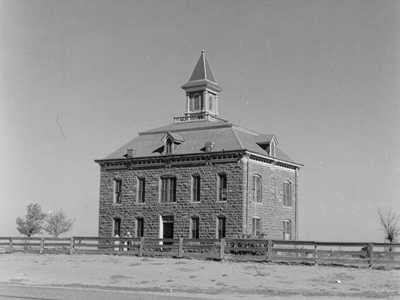
"The Courthouse
burned on April 12, 1955, at about 9:00pm - 9:30pm." - J. J.
Montgomery. The second floor was destroyed by the fire.
1939 photo courtesy TXDoT |
A
two-story courthouse with an attic and cupola became the hub of a
new community that soon featured all the amenities, from general store
to post office to livery stable.
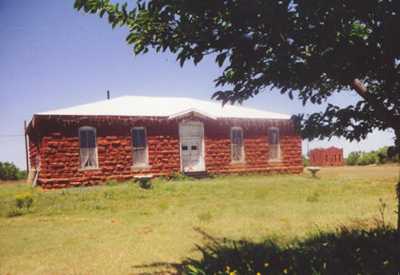
County officials had the jail built in 1895 of red sandstone quarried
from a feature southeast of town on the 0-0 Ranch called Treasure
Butte. The first floor of the 18 by 24-foot building held a steel
cage containing four cells. While a state-of-the-art facility in every
other regard, the new lockup did not feature indoor plumbing and never
did. Inmates had to use an outhouse. |
Old jail ruins
in Clairemont
Photo courtesy Erik Whetstone, Nov 2003 |
For
their money, Kent County
tax payers got themselves a sturdy slammer, known across West Texas
as virtually escape-proof. In fact, local lore has it that only one
inmate ever made it outside of his own volition—except to go
to the outhouse.
The prisoner somehow managed to get out of the jail and hotfoot it
across the street, where he ran up the stairs in the courthouse and
hid in the cupola atop the building. After going without food for
a couple of days while the sheriff and others searched for him, the
hungry escapee decided a meal behind bars beat freedom and a growling
stomach.
What got him in the clink in the first place is not mentioned in the
telling of the story in Jewell Pritchett and Erma Black's 1983 book
"Kent County and Its People."
Kent County must have
had its share of miscreants and felons over the years, not to mention
unwelcome visitors up to no good, but the nature of crime in the county
goes unreported in their book.
While acknowledging that their county once had "a wild and tough reputation"
and had seen many "brutal crimes" in its early history, the authors
wrote: "These stories have been told repeatedly by fledgling writers
who often glorified the evil deeds done to make the sensational stories
even more gruesome and gory than was factual."
Those crimes, the authors continued, included "cowardly murders, where
the victim was shot in the back" and the occasional lynching. And
it does not strain credulity to suppose that at one time or another
someone might even have rustled a cow or two or "borrowed" a horse
and forgot to return it.
"Those dark days are gone," the county historian concluded, "and old
enmities are best forgotten. We do not care to stir up any new problems
nor to open closet doors long since sealed."
That sentiment may explain why the old jail has no official state
historical marker to tell visitors anything about its history. Across
the highway, in front of what's left of the old courthouse, is a granite
marker commemorating Kent County's 90th anniversary. But the polished
stone offers no details other than a listing of the original county
officials and does not mention the old jail or why both buildings
stand abandoned and vulnerable to vandals.
Indeed, the biggest crime in Clairemont
history may have been the "theft" of its status as county seat, an
event that transformed it into the ghost town it is today.
When
a rail line came through the county in 1909, it bypassed Clairemont
by 10 miles in favor of the community of Jayton.
Clairemont slowly
declined while Jayton grew. In 1952, county residents voted to move
the county seat to Jayton.
The courthouse and jail stood abandoned by 1954. |
 |
"The old
Kent County courthouse [as community center today.] The jail is on
the right side across the street, about 500 feet from the courthouse."
- Barclay Gibson, June 2005 |
Not
long after county officials moved their offices to Jayton,
a fire heavily damaged the old courthouse. The county had what was
left of the second story removed and restored the first floor for
use as a community center. The Clairemont
post office finally closed in 1970 with the retirement of the last
postmaster.
As for Kent County's
"dark days," until someone takes the time to wade through rolls of
newspaper microfilm and pour over the county's criminal dockets, assuming
those records have remained intact, the old jail's secrets will keep.
© Mike Cox
"Texas Tales" July
20, 2006 column
[
Kent
County Jail › ]
More Texas Jails
› |
| Books
by Mike Cox - Order Here |
|
|
 HOME
HOME