|
|
Long
before motivational speaking developed as a way to make money without
having to do any heavy lifting, Texans already had a strong impetuous
to strive for greater things: The cotton patch.
Though machines have long since replaced humans in the cotton-growing
process, it's hard to imagine anyone who ever had to pick cotton express
regret that they moved on to other ways of earning a living. In fact,
the back-breaking job grew the once-common expression that such and
such - practically anything - "sure beat picking cotton." |
 |
Jean
Adele Cox (no relation) grew up during the Depression on a 68-acre
cotton farm straddling the Coleman-Runnels
County line. Working in the fields alongside her parents and siblings
helped inspire her long career in nursing, the only cotton
involved in that nurturing pursuit being swabs and bandages and the
starchy white uniforms she wore.
After retirement, Cox returned to the small frame house of her childhood,
50 miles south of Abilene.
Standing outside the dilapidated, long-abandoned structure, she surveyed
a desolate scene of cactus and mesquite. But as she looked at worn
out ground that had not seen a plow in decades, she remembered another
era. |
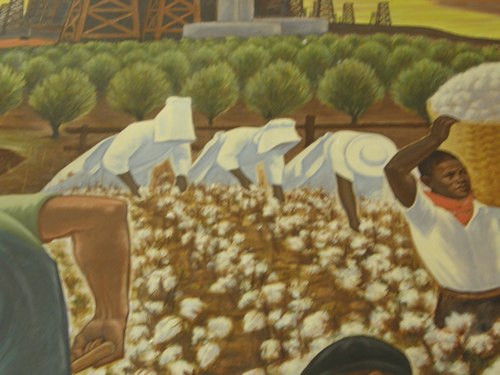
"I could see in my mind's eye my hard working father and the five
of us children moving slowly down the cotton
rows, a canvas sack strapped over our shoulders, picking the soft,
fluffy white cotton out of the
bolls, often pricking our fingers on sharp prongs which held the cotton
firmly inside the boll," she wrote in her 2001 memoir, "A Long
Way from the Cotton Patch."
Nearby sat a wagon used to carry the cotton
to the gin, about
a mile away.
Her father could pick 500 pounds of cotton
in a twelve-hour workday, from sunup to sundown, taking off only an
hour for a big lunch and a nap. |
|
Cox, on the other
hand, never managed to sack even a hundred pounds despite threats
from her father to switch her with a cotton stalk if she didn't figuratively
carry her weight.
"Working in the cotton field provided lots of time to think," Cox
continued. "I often daydreamed about life in the city - anywhere to
get off the farm." Thousands of Texans in the teens, '20s, '30s and
early '40s dreamed the same dream. |
 |
|
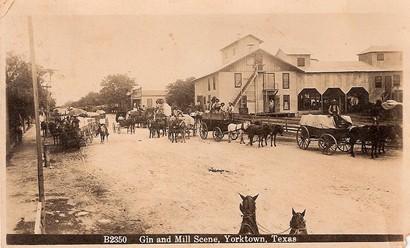
Though
anyone who ever picked cotton
would agree that was the worst part, the fun came in riding in the
wagon to the gin.
"When the wagon was full of cotton,"
Leslie Munson recalled in "A Grand Gathering," an anthology of memories
from Texas grandmothers and grandfathers, "Grandpa picked me up
and put me in the center of the cotton.
We would head for the gin,
me riding like the Little Prince, as he drove the mules to the other
side of town."
Similarly, Cox's father let her ride in the wagon when he hauled
their cotton to the gin.
Cox liked it for two reasons. One, it got her out of a couple of
hours of cotton-picking. Second, she got a kick watching the machinery
as it sucked the snowy harvest out of the wagon.
Their wagon held up to 1,400 pounds of cotton.
Every ounce hand-picked.
But cotton picking amounted to
only part of the growing process.
"By
the mid-1950s, we started using traveling cotton
pickers on our place," West Texas cotton-picking veteran Roger
Moore of Austin remembers.
"But before herbicide, you still had to hoe the SOB."
That, too, was brutally hard work.
"We hoed twice a summer and each time took my dad and me three to
four weeks," Moore said. "My dad used the expression 'hoeing the
half-mile row' to refer to anything that was real hard. Cotton-farming's
also where the term 'hoeing the short rows' came from. The half-mile
rows went all the way across our 160 acres. The short rows were
on the terraced ground, running diagonally off the longer rows."
At the end of each long row, Moore's father kept a can of water,
a drink being pretty badly needed by the time he had chopped a half-mile
of weeds and Johnson grass.
"Picking and hoeing were great motivators," Moore reflected. "When
I'd ask my dad why I had to do it, he'd said, 'I'm trying to keep
you in school.'"
The elder Moore let his son off from work for any extra-curricular
school activity. The prospect of not having to hoe the half-mile
rows also made the younger Moore much more enthusiastic about going
to college.
Moore's experiences on his family farm near Merkel
underscore the wisdom of what Cox's father used to say: "Kids that
don't learn to pick cotton never amount to anything."
Indeed, though the hard work associated with the cotton patch arguably
helped to kill rural Texas by sending young people to the cities
to escape the excruciating labor, raising cotton tended to instill
a strong work ethic in those who survived it. A long day at the
office definitely beat picking cotton. Or hoeing even the short
rows.
|
|
|
 HOME
HOME


