|
Texas
| Columns | "Texas
Tales"
Dead Man's
Hole
by Mike
Cox
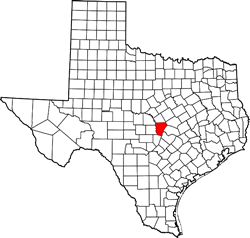
In 1999, land owner Ona Lou Roper deeded Burnet County 6.5 acres around
the hole for use as a park. A year earlier, a state historical market
had been put up at the site.
|
|
The
expression "he just dropped out of sight" had both figurative and
literal meaning in Burnet
County during and after the Civil War.
Common belief held that folks who disappeared in that area often ended
up at the bottom of a 150-plus-deep foot limestone fissure south of
Marble Falls
aptly named "Dead Man's Hole." Local lore has it that the bodies of
as many as 17 men were tossed down the hole. Some hapless souls may
have been thrown in while they were still alive, but legend is silent
on that point.
The first person of European descent to the see the hole up close
had better luck than many subsequent visitors -- he lived to tell
the tale. Ferdinand Lueders, a German naturalist, noted his discovery
of the feature in 1821 while passing through the area looking for
unusual inspects. Nearly a quarter of a century would go by before
settlers began building cabins in the area and rediscovered the hole.
During the Civil War, Central Texas proved a dangerous place for those
who didn't cotton to secession. Unionists, as they came to be called,
found themselves on the open season list. Some of them, according
to once-whispered stories, ended up at the bottom of Dead Man's Hole.
Despite the claim that the hole proved to be the final destination
of as many as 17 men, local historians have come up with only five
names, and two of those are speculative.
The
best-known Dead Man's Hole disappearee is Benjamin McKeever. Described
as a "dashing…swain" full of Southern (read racist) pride, one day
in August 1872 McKeever fired shots at a dog snapping at his horse's
heels. He missed his target several times, and also missed when he
snapped a shot at the dog's owner.
The owner was a black man, which in that era tended to mean that local
authorities would not be overly concerned about pursuing any charges
against McKeever. The dog owner's friends, however, took umbrage to
the assault and ambushed McKeever a few days later. When they unloaded
shotguns in his direction, they did not miss.
As soon as McKeever's friends realized he was missing, a search party
rode out to check "Dead Man's Hole," the formation already having
a reputation as something of a limestone tomb. Sure enough, someone
spotted a blanket and shoe known to have belonged to McKeever hung
on a ledge part-way down the dark hole.
With some effort, volunteers pulled McKeever's body up from the bottom,
though accumulated gases in the fissure caused the sheriff to pass
out.
Three of five men subsequently indicted for murder in McKeever's death
later received life sentences. The fourth defendant got a two-year
prison term and the fifth seems to have been found not guilty.
As
Burnet County became
more law-abiding, "Dead Man's Hole" fell from usage. But as time passed,
people began telling stories of its dark past. It became the most
haunted venue in the area.
Because of the gases in the hole, it remained unexplored until 1951,
when breathing equipment could be used. The Texas Speleological Society
mapped the feature in 1968, measuring it as 155 feet deep and extending
50 feet in length.
In 1999, land owner Ona Lou Roper deeded Burnet
County 6.5 acres around the hole for use as a park. A year earlier,
a state historical market had been put up at the site. The opening
to the hole has been sealed with a heavy metal grate for years.
Is
Dead Man's Hole haunted? One Web site that reports news of the supernatural
says that amateur ghost hunters with the Austin Paranormal Society
have detected Class A EVPs in the vicinity of the feature.
EVP is ghost hunter talk for electronic voice phenomena. They are
voices, according to another Web site on the subject of ghost-detecting,
"that you can understand, and [that] can be heard by most all people
over a speaker or headphone." A human voice being capable of a frequency
range of from 300 Hz to 3000 Hz, EVPs are "voices" logging in below
300 Hz or above 3000 Hz.
This investigator had no sophisticated ghost-detecting equipment to
use on a recent visit to Dead Man's Hole, but certain voices did shatter
the eerie silence hanging over the hole.
"Daddy, you said you would take me to Dairy Queen," occurred repeatedly.
"It's starting to rain," a more mature female voice said, "let's get
back in the car before we get soaked."
If Dead Man's Hole is haunted by 17 restless souls forced to drop
from sight before their time, they didn't make any fuss that day.
© Mike Cox
"Texas Tales" October
30 , 2006 column |
| Books
by Mike Cox - Order Here |
|
|
 HOME
HOME