|
When
Elmer D. Landreth hit the West Texas town of Dumont
in 1920 he found a three-classroom wooden schoolhouse with a fourth
room for the Woodsmen of the World meetings, a small frame church
shared by the local Baptists and Methodists (they alternated, every
other Sunday), a cotton gin, and one store.
The young preacher arrived at the King
County town after a two-hour, 30-mile trip on a muddy road.
Having traveled to Paducah
by train, he got a ride to Dumont on the only available form of
public transportation -- the mail car, an open-topped Model T with
a homemade wooden cargo area. In addition to mail and freight, the
driver carried passengers from the railroad station at Paducah
to Dumont for $1.25
a head.
That seemed like a lot of money, considering that since the end
of the World War the cotton market had been way down and an extended
drought had made farming even harder than usual. Still, Landreth
found, local folks were optimistic that the hard times were just
about behind them.
Dumont did not have many trees (if any), and money sure did not
grow on them, but the community had some fine people, and Landreth
always remembered his time there with fondness.
When he published his
autobiography (“The Missing Book”) in 1968, something else that
he recalled about Dumont was its simple yet effective communication
system. The town had no newspaper, commercial radio still lay in
the future, television remained a theoretical concept more akin
to science fiction than possibility and the “Internet” was the telegraph
and telephone. Even so, the people of Dumont got on just fine with
nothing but a blackboard.
Bob Lasaster and his wife operated the town’s general store, a structure
Landreth described as a “white wooden store building [with] a big
porch separating the front door and the gasoline pump where customers
could purchase the gas for the few automobiles in the community.
Outside the front wall of the building Mr. Lasaster had placed a
big blackboard, which served…as a bulletin board on which affairs
of the community were announced.”
Party invites and scheduled “preachings” went down in chalk on the
board so that, as Landreth put it, “saints and sinners alike might
know.” In addition, Landreth recalled, the board “broadcast” important
news events that Lasaster “or any other of the three or four families
who were subscribers to a daily newspaper” had heard about. That
daily would have come from Lubbock,
a hundred miles to the west, or Fort
Worth, even farther to the east. And while the newspapers may
have arrived daily, that did not necessarily mean on the same day
of publication.
While state, national and international news might take its time
in reaching Dumont, the blackboard amounted to the instant messaging
of its day. The Lasater store blackboard, Landreth continued, “was
a real institution, the only news media for the community aside
from the usual gossip.”
Not long after the young preacher hit town, the most significant
event in Dumont’s history up to that time occurred: The cotton gin
burned. Of course, that was so obvious, no one needed to write it
down on the blackboard.
At
the time, Dumont –
named for Auguste E. Dumont, Paducah’s
first postmaster – was not even 30 years old. It developed around
a dugout school on the John Parker farm in 1891. Two years later,
area residents subscribed to build a community school and in 1894
enough people lived in the area for Washington to approve the opening
of a post office.
Located near the sprawling and historic 6666, SMS and Matador
ranches, Dumont reached its population peak in 1960 with 105 residents.
The 2000 Census showed only three business and 85 people in the
community, with the latest estimate being only 323 residents in
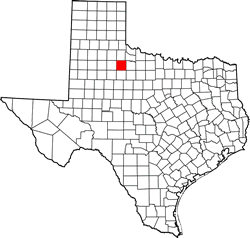
all of King County,
the nation’s third smallest in population. At least those who call
Dumont home today don’t need a blackboard to get their news, but
newspapers still come in the mail.
© Mike Cox
"Texas Tales" May
30, 2007 column
|
 HOME
HOME