|
|
The
campers moved carefully up the draw in the moonlight, their flashlight
beams criss-crossing the white limestone base of the narrow wash as
they checked for any rattlesnakes that might be out and about looking
for something to eat.
While being bitten by a rattlesnake is a serious medical matter, something
much deadlier lay ahead in the darkness. Finally they stood looking
down into a geologic feature in Big
Bend National Park called Ernst Tinaja, a deep natural
water hole dug out of the bedrock over the millenia by erosion—a place
of beauty tainted by a history of death.
“Tinaja” is a Spanish word meaning big, earthern jar. “Ernst” honors
Max A. Ernst, a German who came to the United States in 1873
and in 1884 to Pecos County in West
Texas. Six years later he gained American citizenship. Settling
in Alpine
in 1890, he lived there until 1898 when he leased a section of land
around the landmark tinaja in southeastern Brewster County.
On land overlooking a branch of Tornillo Creek, along the ore
road from Boquillas
to Marathon, Ernst
opened a store to cater to all the miners and prospectors in the area.
He built a one-room school near his store, and in 1903 succeeded in
getting the post office moved from Boquillas
to his store. By then the community he had founded was known as La
Nornia, the well. In addition to being postmaster, he served as
justice of the peace, county commissioner, school board trustee and
notary public. |
|
|
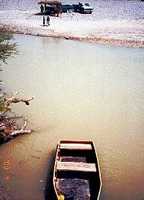
Crossing the Rio Grande at Boquillas
TE Photo |
Located
roughly a mile and a half east of Rio Grande Village (formerly known
as Boquillas),
Ernst Tinaja is a timeless death trap. When the tinaja is brim-full,
it is easy enough for an animal to satisfy its thirst along its edges.
But when the level is low, any creature jumping into the cool water
for a drink or a refreshing swim likely will never leave. That’s because
the smooth limestone offers no purchase, especially when it’s wet.
A frantic animal—or human—would not even be able to cling to the side,
much less scale the tinaja’s slippery walls. Once exhaustion sets
in, the hapless prisoner of the tinaja sinks and drowns.
Over the years, soldiers, ranchers, naturalists and later recreational
hikers have occasionally found the carcass of a javelina, coyote,
or some other animal putrifying in the water, having floated to the
surface as the decomposition process begins. Roland Wauer, who spent
years as the park’s chief naturalist, once found a dead mountain lion
in the tinaja.
The
tinaja is known to have killed at least one man and perhaps others
in the time before recorded history.
For a time during the Mexican Revolution the U.S. Army stationed a
detachment of cavalry at La Noria. On August 19, 1913, Private Morton
L. Diedel, a trooper in Company A of the 14th Cavalry, asked a fellow
soldier to join him in taking a bath at the tinaja. The soldier declined
but Diedel talked his friend Creed H. Mars into joining him. On their
way there from camp, Diedel told Mars that he could not swim. And
Mars admitted he wasn’t a very good swimmer himself. They took a dip
in one of the smaller, shallower tinajas along the draw, got dressed
and where headed back to their camp when Diedel slipped and fell into
the big tinaja. The soldier quickly disappeared under water. Realizing
he’d probably get in trouble too if he jumped in, Mars ran back to
the camp for help. At first, the soldiers tried to bale out the tank,
but finally someone who could swim jumped in and retrieved the body.
Acting as coroner, Justice of the Peace J.R. Laudrous conducted an
inquest. After talking with several other soldiers, he concluded Mars
was telling the truth and had no complicity in the death, which he
ruled an accidental drowning.
The
tinaja also seemed to attrack violent death.
On September 27, 1908 Justice of the Peace Ernst was on his way back
from Boquillas
to his place at La Norina when someone shot him as he stopped to open
a wire fence gate at a gap on the road leading from the river to Marathon.
A .44 caliber bullet hit him in the back and blew out below his stomach.
Despite his wound, Ernst managed to get back up on his horse and made
it about two miles before his intestines began protruding from the
exit wound. He dismounted and staggered over to a Spanish dagger plant,
sitting down in the shade beneath it hoping that someone would soon
come by. Knowing he would likely die, Ernst scribbled seventeen words
on the back of an envelop: “Am shot, I expect by one of the Solis
at gate. First shot hit two more missed.”
A neighbor found the wounded JP and took him to his house, where he
died the next day. In going through his pockets, Rosa Ernst found
her husband’s note. That document, along with the well-known fact
that Martin Solis’s store at Boquillas
had been adversely affected by the success of Ernst’s store at La
Noria, focused suspicion on Solis and his family. The following month
a Brewster County grand jury heard the evidence in the case but did
not hand down any indictments in connection with the murder. The investigation
went on for three years, but no one ever faced trial in the case.
Twenty-six-year-old Juan de Leon may have been on his way to or from
the tinaja when someone shot and killed him along the trail leading
up to the water hole on July 19, 1932. Not found until several days
later, he was buried where he died, his murder never solved. A concrete
cross marks his rock-covered grave. The simple monument bears an equally
simple epitaph, “E.P.D.,” (for En Paz Descanse, Rest in Peace.)
|
|
|
 HOME
HOME