|
|
|
The
giant pecan, which still stands outside Helen Bentley’s house in
Fort Davis,
grew from a sapling planted in 1873.
While the tree has long since exceeded a pecan’s typical 75- to
100-year lifespan, some pecans have been known to live for two centuries
or more. But the exceptional age of the huge tree in Fort
Davis is only part of its story, a tale that begins with the
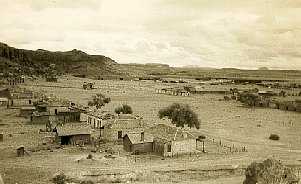
arrival of a mulatto Buffalo soldier at the army garrison that gave
this mile-high community its name.
That soldier
was Kentucky-born George Bentley, a private who came to Fort
Davis in April 1868 with Co. K, Fifth U.S. Infantry. Then 23,
he had enlisted in the Army at Louisville, KY on Dec. 8, 1866. Though
he and his fellow foot soldiers left Fort
Davis for occasional marches in the field, his primary duty
was baking bread. In May 1871, the Army moved Co. K farther west
to Fort
Quitman on the Rio Grande in what is now Culberson County, but
when his enlistment expired that December, Bentley returned to Fort
Davis and got a job as a civilian packer and teamster. Now married,
Bentley also acquired some cattle, plenty of free grazing land being
still available.
“My pa had cattle by the time he quit the army,” George Bentley
Jr. told writer Barry Scobee in the spring of 1964. “One day he
was looking after them down Limpia Canyon when he saw a little bitty
pecan switch growing out of the ground by some boulders where there
was a water seep.”
The former soldier, not realizing that the Davis Mountains did have
a small population of native pecans, wondered how the sapling got
where it did. “He said likely soldiers, or maybe Indians, rested
in the shade of the rocks and dropped a pecan that germinated,”
Bentley told Scobee.
Less interested
in the sapling’s origin than its potential to provide shade and
pecans for his growing family, Bentley plucked the sprout and brought
it home.
“My sister Flora, oldest of the seven children, planted it close
to a well that was 12 feet deep and in rich soil,” Bentley said.
With ample moisture
and nutrients, the sapling took root and grew into a sturdy tree.
After about a decade, the pecan began producing nuts, the robustness
of its yield cycling every-other-year. While even a hearty tree
can fall victim to disease, in the days before penicillan and more
sophisticated antibiotics, children stood particularly vulnerable
to dangerous infections.
|
|
One
of the cruelest diseases was diphteria, a highly contagious upper
respiratory disease often caused by bacteria in unpasteurized milk.
Victims experienced sore throats, raging fevers and increasingly
impaired breathing as a membrane grew across the trachea. Eventually,
death came from suffocation.
In the fall of 1891, within a span of two horrible weeks, the Bentley’s
teenage daughter Flora and six of her siblings had died of diphteria.
Bentley and his wife buried their children in Pioneer Cemetery,
a graveyard begun in the 1870s and used until 1914.
Dr. I. J. Bush, newly arrived to Fort
Davis, treated the children but he had few options. One by one,
they died terribly, their helpless parents incapable of intervention.
Bush later told Scobee he had never seen such a serious outbreak
of the disease. “People died like flies,” the doctor recalled in
a letter to Scobee sent in 1936, “including the Bentley children,
who ranged in age from two months to seventee years.”
As if burying their children was not hard enough on the grieving
parents, a vicious rumor made the rounds that the deaths had come
as fulfillment of a curse placed on Bentley for bayoneting an Apache
infant while in the military, an allegation not supported by any
known record.
Since his beloved daughter Flora had planted the tree in the yard,
Bentley took to calling it Flora’s Tree. In time, the couple’s
anguish waned. They went on to have three more children, including
George Bentley Jr., born in 1902.
By the time the story of the tree came to Scobee’s attention, the
old pecan had grown to a circumerance of eight feet, four inches.
Its branches extended so far that some of them had to be propped
to keep them from breaking. In good years, it produced some 200
pounds of pecans. But for as long as it stands, it will be a reminder
of one family’s horrible loss.
© Mike Cox
"Texas Tales" September
29, 2011 column
|
|
|
 HOME
HOME