|
When
Fred Gipson's family went to an old-settlers reunion and fair at Katemcy
to see the aging Herman
Lehmann put on a one-man exhibition, the Mason
County youngster got a taste of the old west far more realistic
than anything he ever saw in a Tom Mix movie.
Captured by the Apaches at 11, Lehmann spent more than eight years
with the Indians, finally reuniting with his family in Texas in the
spring of 1878. As he grew older, Lehmann became a Hill
Country celebrity, periodically earning a little money for staging
performances that amounted to one-man Wild West shows.
By the time the Gipsons reached Katemcy,
a good-sized crowd had gathered near the schoolhouse in an open field
bounded on one side by a barbed wire fence to see Lehmann demonstrate
how he once killed buffalo. Spectators stood under the pecan trees,
leaving a narrow strip of unoccupied space for Lehmann between them
and the fence.
Gipson cut out on his own, trying to make his way to a ringside seat.
But the gangling boy with the blue eyes, long upper lip, and hay-colored
hair did not make good progress. Grownups, he realized, were not much
inclined to make way for a barefoot kid. Dropping to his hands and
knees, he began to crawl through the legs of the adults-a forest rooted
in dusty boots and high-topped shoes. |
|
|
Finally
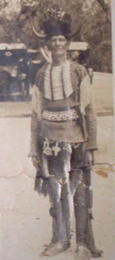
he could see the old German, dressed in buckskin, sitting astride
his bare-backed horse. Lehmann wore a hat made from a buffalo head,
the curved black horns jutting out just above his ample ears. Around
his neck hung a breastplate fashioned of bones; a white sash decorated
with flowery designs circled his quirt-thin waist; white fringe hung
from the full shoulders of his buckskin blouse.
Photo
courtesy Bettye Beard |
Just
after Gipson reached the edge of the crowd, Lehmann cut loose with
an Indian whoop from another time-a human panther's scream that would
make a grown man break out in a midnight sweat. Hearing Lehmann's
cry, a frightened steer- the substitute buffalo-let out a bawl and
charged down the fence line. Lehmann galloped close behind, bow and
arrow in his hands and his old, experienced legs wrapped tightly around
his horse. Leaning under his horse's neck, as he had done many times
before on real buffalo hunts, or when the target had been a man, Lehmann
overtook the steer.
He drew his bow, the arrow pointing at the wide-eyed crowd. A miss
might send the deadly shaft whistling in the direction of some spectator's
heart. Just as Lehmann, the steer, and Gipson lined up on an axis
as straight as a war lance, Lehmann let fly with his arrow.
Gipson heard a "thunk" and a bellow of pain as pink foam blew from
the yearling. A bloody metal arrowhead ripped through the steer's
thick hide, just inches from the boy's astonished, horrified face.
The steer made it a few more yards, running on impulses from a dying
brain. The animal's knees buckled, and it dropped in a spray of dust
as Lehmann wheeled his horse and let out another fierce yell.
Dismounting in an effortless movement, Lehmann plunged his knife into
the belly of the fallen yearling, to the horror of the crowd, he thrust
his hand inside the steaming cavity and, after some quick knife work,
yanked out the steer's glistening liver, holding it up for the audience.
Spectators gasped and gagged. Some found themselves looking at the
clouds overhead or just closing their eyes. They had come to see a
steer killed by a man who once had been an Indian captive, but they
were not ready for this degree of authenticity.
Those who still watched then saw Lehmann begin to eat the raw liver.
The Indians, and Lehmann because he had learned from them, considered
it a delicacy. Gipson did not take in that part of the program. The
bloody arrow had been enough for him. As Lehmann finished the liver
and wiped blood and bile from his aged face, the barefoot boy scrambled
back through the crowd to the safety of his family.
The
realism of that day never faded from Gipson's memory. Decades later,
it helped him as a writer of children's adventure tales, including
the 1956 Texas classic, "Old Yeller."
© Mike Cox
"Texas Tales"June
22, 2006 column
Portions of this column originally
appeared in the author's 1980 book, "Fred Gipson: Texas Storyteller."
|
| Fred
Gipson: Texas Storyteller |
|
|
|
|
 HOME
HOME