|
|
| Walter
W. Pitman’s good luck held for more than half a century. Not everything
went his way, but in big-stake deals the figurative roulette wheel
of life generally spun in his favor. |
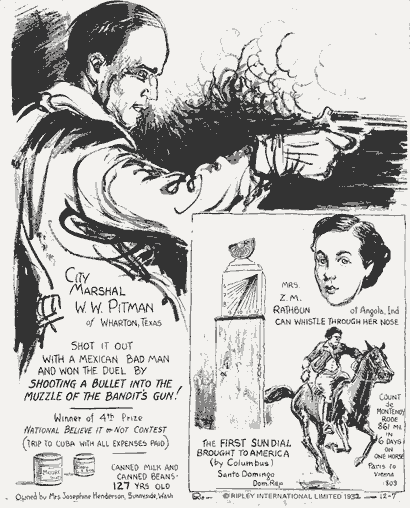
Ripley cartoon
commemorating Pitman's feat
Submitted by Mike Cox |
Born
Jan. 14, 1884 west of Muldoon
in Fayette County,
he helped out on his family’s farm until he married in 1904. Six years
later, Pitman, his wife and two children moved to Wharton.
For a time he tried to make a living selling Watkins products but
returned to farming in 1912. That being a feast or famine enterprise,
in 1916 he decided to run for constable in the precinct that included
the county seat.
Winning the election, Pitman cut a deal with the sheriff whereby he
got to live for free in the jail in exchange for helping run the lockup.
He also policed Wharton.
“Everything went along fine,” Pitman later wrote, “until about 9 o’clock
PM Sept. 15th 1917.” That was when the constable tried to arrest Francisco
Lopez for being drunk in public.
“As I approached him he jumped from the sidewalk into the street and
opened fire on me with a little .38 caliber Colt revolver and I returned
the fire as quickly as I could.”
The boozy gunman got off two wild rounds before Pitman pulled the
trigger of his single-action Colt .45. With a muzzle velocity of roughly
900 feet per second, the big bullet from Pitman’s handgun hit the
cylinder of the assailant’s revolver. Half the slug entered the chamber
holding what would have been the bad guy’s third shot, while the other
half tore into the shooter’s hand, forcing him to drop the now-useless
pistol. |
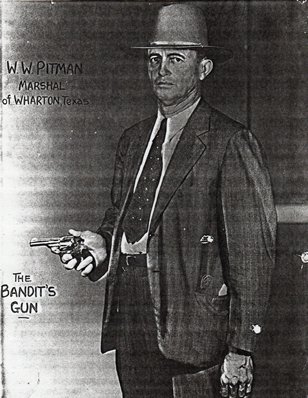 |
Marshal Pitman
with the bandit's gun
Submitted by Mike Cox |
Pitman’s next
shot caught his attacker in the shoulder, but the bullet didn’t knock
him down and he ran.
All this had happened in a matter of seconds within 30 yards of the
jail. Hearing the shooting, Pitman’s wife Ella rushed to her husband’s
rescue with a .45 in one hand and a double barreled shotgun in the
other.
Pitman took the buckshot-loaded scattergun from his wife and soon
found the wounded man hiding behind a fence corner. Adrenaline surging,
the constable raised the weapon and was about to let loose with both
barrels when his wife screamed, “Don’t shoot him!”
Realizing she was right, Pitman arrested the unarmed man without further
incident. Lopez recovered from his wound, paying a $200 fine and spending
a year in jail for unlawfully carrying a weapon. Tried for assault
with intent to murder, he got a five-year suspended sentence.
After serving two terms as constable, Pitman tried his hand at carpentry
for a time and clerked in a grocery store before running for Wharton
city marshal. Elected, Pitman settled into what would be his job for
the rest of his life.
Though he later wrote that he made a pretty fair marshal, he did not
enjoy immunity from crime. In 1930, someone broke into his house and
stole his best suit and three pistols. But the burglar left behind
the .38 with Pitman’s bullet jammed against the round that could have
ended his life.
A couple of years later, Pitman read that Robert Ripley’s Believe
It or Not! had a national contest under way to uncover astonishing
facts for use in his syndicated newspaper feature. The marshal went
to his office and pecked out on his typewriter the story of his 1917
shootout and sent it to Ripley.
“My first shot hit his pistol barrel on the left hand side about one
inch in front of the cylinder and glanced up into his cylinder,” Pittman
wrote. “It came in contact with a loaded cartridge and the two bullets
are now stuck in the cylinder. I have the pistol in my possession
and will never remove the two bullets as long as I live.”
Six weeks later, a Post reporter called the marshal to tell him that
out of some 5 million entries he had won first prize in Ripley’s contest
– an all-expense-paid trip for two to New York and then Cuba.
Pitman took the soon-to-be-famous pistol to the Houston Post for verification.
On June 23, 1932 newspapers across the nation told the story of Pitman’s
incredible shot. In the depths of the Great Depression he and his
wife soon departed on a two-week vacation of a lifetime.
Later that summer, fortune smiled again on Pitman when he and another
Wharton County
officer had a run-in with the outlaw couple Clyde
Barrow and Bonnie Parker. When the two lawmen tried to stop a
stolen car occupied by the pair, someone inside the vehicle opened
fire as the driver did a speedy U-turn and escaped. Neither officer
was hit.
Three years later the marshal’s luck finally played out. On Nov. 9,
1935, the 51-year-old lawman suffered a massive heart attack. His
family buried him in the Wharton
cemetery two days later.
The jammed pistol that arguably gave Pitman an extra 18 years of life
remains in the holdings of Ripley’s Believe It or Not! Odditorium
on New York’s Times Square.
© Mike Cox
"Texas Tales" December
3 , 2009 column |
|
|
 HOME
HOME