|
Tesnus,
Texas is one of those ethereal ghost
towns — except for a railroad siding and a sign, no physical evidence
of it remains.
Fortunately for posterity, one of the few surviving former residents
emailed me to share her memories of Tesnus, as well as providing a
collection of family photographs showing where she had lived and other
scenes. |
| Founded
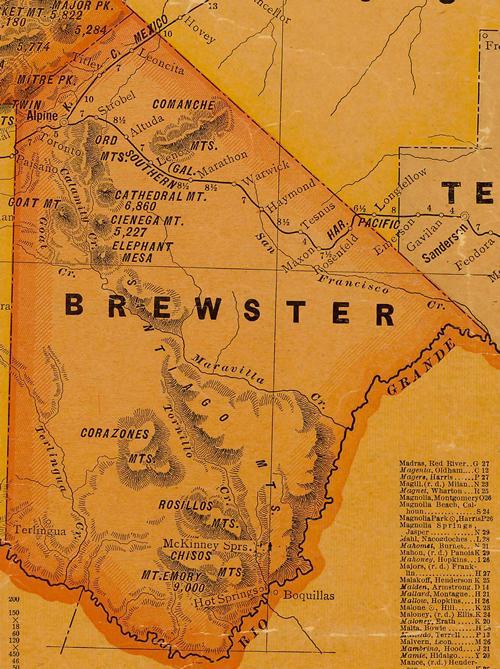
in 1882 when the tracks of the Southern Pacific Railroad reached a
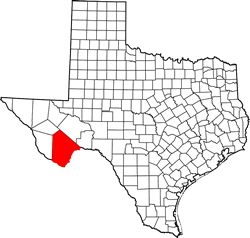
point 23 miles southeast of Marathon
in sprawling Brewster
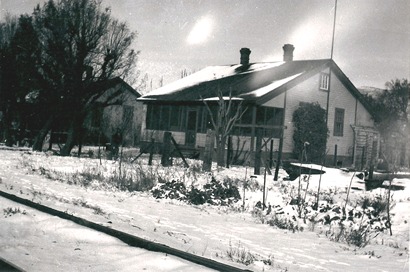
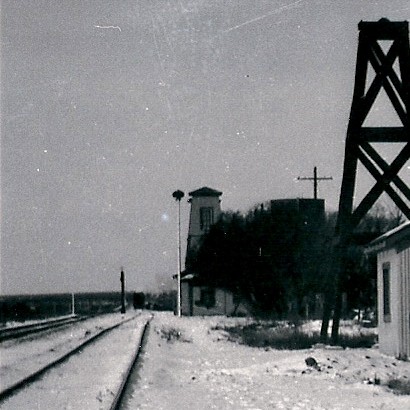
County, the town (a stretch of the word) consisted of a railroad
section house, houses for the section foreman and the water pumper,
telegrapher’s house and a few other structures. In addition to its
role in keeping the tracks maintained and the locomotive boilers full,
Tesnus provided ranchers
a way to ship their cattle to market. |
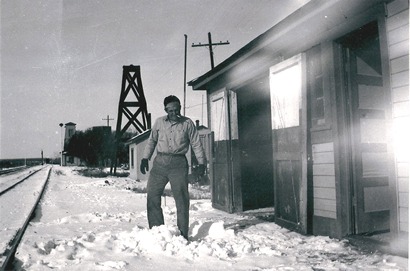
| Signal foreman
standing outside in the snow |
First called
Tabor, the railroad enclave lost that name when a post office
application got rejected by Washington because a similarly named town
already existed in Brazos
County. Then Sunset arose as a fitting name for the place,
considering the famed Sunset Limited passenger train came through
each day. But nope, Montague
County had a monopoly on Sunset,
Texas.
Someone finally came up with a solution to the name problem that met
the approval of the Postal Service, but more of that in a bit.
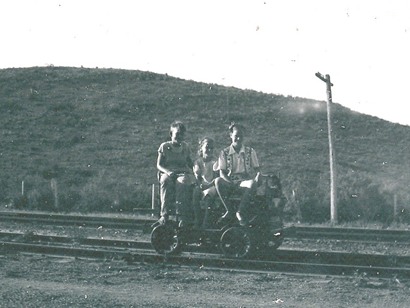
In 1945, the railroad installed a new man as signal maintainer at
Tesnus. He arrived with his wife, who became the Tesnus postmistress,
and five of their seven kids. (Two of their girls had married and
lived elsewhere.) |
| Signal foreman's
kids on the motorcar |
The addition
of this new family pushed Tesnus’ population up to about 20 people.
Throw in the folks who lived on the surrounding ranch and the postmistress
had a small, but consistent volume of mail to handle.
“Patrons came up the steps to the front porch and she served [them]
through her bedroom window,” remembers one of the signal maintainer’s
children, who because of the career she had as a case worker for a
state agency asked not to be identified. “Maxon and Haymond were the
railroad towns on either side of Tesnus and those who lived in them
and a ranch foreman came to Tesnus to get their mail,” she recalls.
Occasionally, the railroad
would move in a work crew that lived in temporary housing the company
constructed. At other times, workers would stay in gang cars left
on the siding for weeks or months until a particular maintenance project
got completed.
Despite
the occasional influx of additional railroad
workers, not much ever happened in Tesnus. The most sensational crime
was when the assistant telegraph operator went on a toot and shot
up the Tesnus sign. Occasionally, a railroad bull (detective) or train
crewman would throw a hobo off a train, leaving him temporarily stranded
there.
“Mama would feed them in return for chopping kindling,” the former
resident says.
One time a skunk did get in the chicken coop.
“I was supposed to hold the dog while Mama shot the skunk,” she says.
“But he was bigger than I was and broke away. Got there about the
time Mama shot, but the skunk sprayed her, my sister and the dog.
Tomato juice helps, but nothing cures except time.”
When a train hit a deer and word reached town in time for the meat
to still be fresh, her brothers went to the spot, field dressed it
and cut it up for venison on the family table. Classic big brothers,
they once barbequed a rattlesnake steak and tried to talk their little
sister into eating it. While she didn’t fall for that, the brothers
did serve her older sister grilled mockingbird one time, telling her
it was dove.
Of Tesnus, she continues, “It was mostly a railroad
town, in the middle of the Gage Ranch. There was a siding for trains
to meet or pass each other and it was a place for the chugga puffers
[steam locomotives] to stop for water, coal, and salt. (There was
ice in the refrigerator cars.)”
She said the ranch foreman lived in a house on the dirt road to Marathon,
inside of a mile from Tesnus.
OK,
how did they finally come up with a lasting name for Tabor cum Sunset?
Proving again the power of simplicity, to use railroad metaphor, someone
suggested switching the caboose with the locomotive and spelling Sunset
backwards as in T-e-s-n-u-s. |
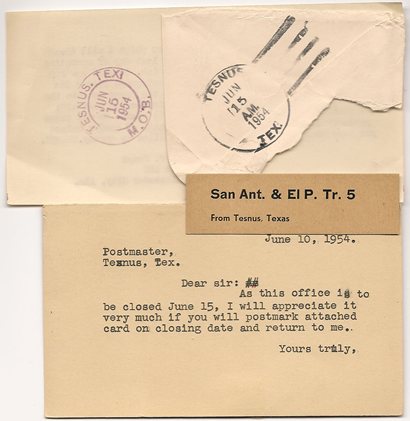 |
| The last-day
postmark from Tesnus |
But clever nomenclature
is powerless against change. With diesel-powered trains needing fewer
stops than “chugga puffers,” the railroad closed its operations in
Tesnus midway into the 1950s.
When word got out that Tesnus would be no more, the town’s last postmistress
had one last flurry of business mailing out last-date-of-service cancellations
to stamp collectors across the nation.
The post office closed on June 15, 1954. The railroad razed all the
structures it had there, leaving only the siding.
“Now,” the former Tesnus resident (Tesnusan? Tesnusite?) says, “when
someone asks where I am from, I normally tell them I am not from anywhere,
because my home town was torn down.”
© Mike Cox
"Texas Tales" September
24, 2009 column |
| Texas
Escapes, in its purpose to preserve historic, endangered and vanishing
Texas, asks that anyone wishing to share their local history, stories,
landmarks and recent or vintage photos, please contact
us. |
|
|
 HOME
HOME