|
A
lot of parents these days are worried about whether their children
are spending too much time on their computers or texting inappropriately.
Advertising for everything — wholesome and unwholesome —
is everywhere on the internet, and predators prowl social networking
sites looking for gullible victims. The new media has become as freewheeling
as the Old West.
So maybe we should take a break and remember a simpler time, an era
when corporate America or openly shady sorts could influence vulnerable-to-suggestion
youngsters with words and images printed on paper.
A public relations effort by one powerful Texas-based corporation
certainly helped shape my life back in the late 1950s — in a
positive way. Like most Baby Boomers, I learned about smoking and
drinking from the people we used to credit with having the power to
mold children — adults, not clever advertisers. But it was an
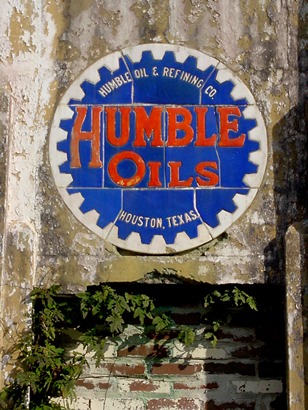
oil company that helped fuel my interest in Texas
history. |
 |
I
was nodding off in the easy chair in front of the TV one night in
1996 when Austin writer
and historian Ken Ragsdale called shortly before 10 o'clock.
"Didn't wake you up, did I?" asked Ragsdale, then an active man in
his 70s. "I just got back from my four mile walk and wanted to let
you know I've got some stuff I want to give you. Been cleaning out
my office. You can have it or throw it away."
The next day, Ragsdale helped me load several large shopping bags
in my Baby Boomer Buggy, a sports utility vehicle.
That night, I began digging into the bags. Ragsdale had given me some
nice things for my Texana collection, including something in a white
envelope that caused me to pause. The arrival of a similar envelope
more than four decades ago had been as exciting as the happy day a
few years earlier when my small gray plastic, baking soda-powdered
U.S.S. Nautilus from Kellogg's had finally shown up in the mail.
On the left side of the envelope, the distinctive lettering read:
"Your Copy of Texas Sketchbook." Below that was a drawing of the famous
Rose Window at Mission San Jose in San
Antonio. Beneath that it said, "Humble Oil & Refining Company."
The
envelope held a pristine copy of the "Texas Sketchbook: A Collection
of Historical Stories from the Humble Way." The 102-page softcover
book, first published in 1955, was illustrated by the late artist
E. M. (Buck) Schiwetz. (The oil company revised and reprinted the
book in 1958 and again in 1962.)
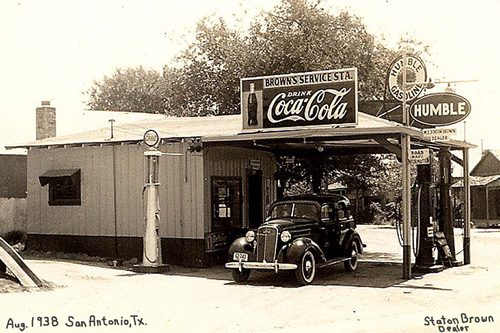
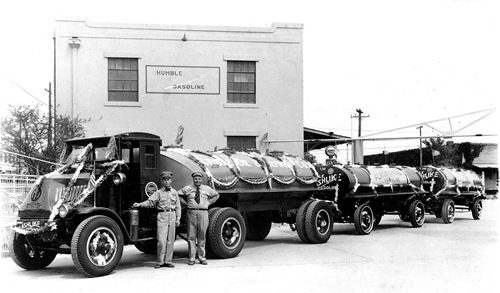
Humble, a Texas oil company created in 1911 which in the 1970s became
Exxon and in the 1980s had bad luck in Alaska with an oil tanker named
the Valdez, published thousands of copies of the “Texas Sketchbook”
and distributed them for free to anyone who wanted one, including
school kids. |
 |
 |
I
used to sit and read this book in a gray Naugahyde chair with jet
black iron arms and legs, a classic piece of 1950s furniture my grandparents
had. It was not comfortable, but it took spilled Welch's grape juice
in stride. Schiwetz's drawings portraying various aspects of Texas
history were a high octane additive for my young imagination, forming
impressions that lasted a lot longer than that funky chair.
The somewhat cynical man holding the book looked at it differently
than the chubby 10-year-old in that chair had years before. Where
was the powerful, insidious corporate message in this publication?
No giant business would publish and freely distribute a book without
some angle. Let's see. The Fifties. An anti-Communist message? No.
Anti-regulatory message? No. Buy gas from us? No.
Nope, nothing like that. The anonymous corporate PR type who wrote
the short foreword said only that the stories in the book, which ranged
from a piece on old Spanish missions to an article on the history
of the Texas Navy, had been published previously in the company's
every-other-month magazine, the Humble Way. They were being printed
in one volume because of "interest and inquiries from readers."
The stories, the author continued, "are not tall tales of Texans who
speak perhaps too pridefully of their state, but simple stories of
pioneers and pioneer places. Each was checked and approved by the
Texas State Historical Association."
I looked at the foreword one more time. Surely I was missing something
here. Then I found it. The last paragraph: "May all who read (the
Sketchbook) find it a fitting memorial to the past, an inspiration
to the present, and a hope for the future."
With that clever 1950s corporate propaganda in mind, I've saved this
copy of "Texas Sketchbook" for my daughter Hallie, hoping that someday
she'll find it more interesting than manga anime “novels” or Hanna
Montana and her friends.
Author’s note: This column is adapted from an essay by the
author first published on Sept. 20, 1996.
© Mike Cox
"Texas Tales" March
26, 2009 column |
| Books
by Mike Cox - Order Here |
|
|
 HOME
HOME


