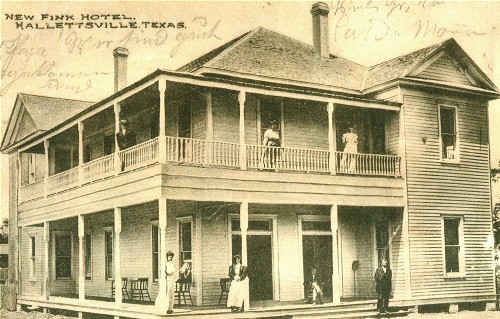
|
The Finkelsteins,
along with their four children, started the business, around 1904,
in a three-story brick building that had once been owned by the
Masonic Lodge. According to the paper, it was located on land where
the Texaco station stood (in 1959).
In 1909, the Finkelsteins built the structure that would become
Fink’s Hotel and go down in history as one of the most admired establishments
in the city. No doubt this was due to the kindness of its owners.
It was said that the Finkelstein family had a deep faith in God
and believed in sharing all they had with others, rich and poor
alike. The tastes of the hotel’s customers ranged from beans and
biscuits to caviar and champagne. And evidently the menu was such
that guests, no matter what their status in life, could come away
satisfied with the cuisine.
Fink’s Hotel was known far and wide as a place where people were
never turned away, regardless of their ability to pay. In the early
days, persons on horseback or traveling in carts and covered wagons
would seek lodging at the hotel. The newspaper reported that many
came via the Old Spanish Trail seeking fortune in the deep Southwest.
Immigrants arriving at the port in Galveston
were told about Fink’s Hotel and encouraged to seek it out if they
were traveling through the area. Old timers said that gypsies visited
Hallettsville
annually in those days. They camped on the outskirts of town. Often
times they remained an entire season and would do their peddling
and begging from the back door of Fink’s Hotel.
The establishment was a favorite of tramps and they would leave
messages on gate posts for other hobos – informing them that “Dad
and Mother Fink” would always give them food and shelter on those
cold, dreary nights.
During the depression in 1933, Fink’s Hotel struggled like all the
rest but they survived. While many small businesses went under,
the Finkelsteins continued on while feeding more unfortunates, free
of charge, at the backdoor.
According
to the paper, both Mr. and Mrs. Finkelstein passed away in 1938,
leaving the hotel to their four children – three of them stayed
on and managed the business.
In 1940, a dreadful flood hit the town and while many establishments
were submerged in six feet of water, Fink’s Hotel personnel gave
free coffee to anyone who cared to be served. The hotel became headquarters
for the American Red Cross during that terrible time.
Difficult days came upon the aged hotel in 1945; business was at
its lowest and the owners decided it was finally time to say good
bye – in early 1946, the doors of Fink’s Hotel were closed for good.
The newspaper article concluded: “With the removal of Fink’s Hotel
there remains only cherished memories to those who hold the old
landmark a treasure house of bygone days.”
The story of the Finkelstein family is typical of the character
of folks back then. In those days, people truly cared for one another.
Just like the strangers who visited Hallettsville
so long ago would find a fitting motto in Fink’s Hotel: “Where there
is room in the heart, there is room in the home.”
© Murray
Montgomery
Lone
Star Diary February
6, 2010 Column
|
 HOME
HOME