|
|
Texas
| Columns | Lone
Star Diary
Richard Gaertner's
Story
by Murray
Montgomery
"Gaertner ... can remember things from the past that folks half
his age would probably have a hard time recalling. His memory is sharp
and clear, so much so that he can recall the more insignificant details
of an event that most people would tend to forget." |
 |
Every
town needs a storyteller and Moulton
is fortunate to have a mighty good one in a feisty fellow named Richard
Gaertner.
Born on Feb. 4, 1908, this friendly 96 year-old gentleman was raised
in Lavaca County,
most of his life being spent on the family farm some five miles northeast
of Moulton.
He moved to town a few years ago and is now residing at Shady Oaks
Nursing and Rehab.
His social life is a weekly routine – on Monday evenings he drives
his minivan over to Flatonia
to play bingo at the legion hall with his “lady friend,” then on Thursdays
and Fridays he plays more bingo in Moulton
at the KC Hall and the American Legion Hall. “I try to spend only
five dollars at Bingo, I just go to visit,” says Gaertner. After dinner
on Fridays, he plays dominoes with some other fellows at the Main
Bar.
Gaertner, a confirmed bachelor, can remember things from the past
that folks half his age would probably have a hard time recalling.
His memory is sharp and clear, so much so that he can recall the more
insignificant details of an event that most people would tend to forget.
In a recent interview, he was asked a number of questions about how
it was to grow up in the Moulton
area. His eyes seemed to take on an added sparkle when he began to
spin yarns about the things that happened in his life years ago. |
|
|
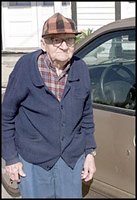
Richard Gaertner
Photo courtesy Murray Montgomery |
“When
our family first came over from the old country,” said Gaertner, “they
wanted to settle over in High
Hill, which is located in Fayette
County. But the people there were all Germans and we were Czechs.
The Germans wouldn’t allow no Czechs to live there back then so our
family changed their name from Zahradnick to Gaertner and that’s the
name I grew up with.”
Richard’s branch of the family founded their farm, in Lavaca
County, back in 1880 – they started out with 200 acres which they
had planned to purchase for six dollars an acre. But Richard recalled
that a fellow from Oklahoma said he had a prior claim on the land
and the Gaertner’s had to pay twelve dollars per acre to get it. Over
the years the family acquired more land and the farm grew to 500 acres.
There were five children in the family – Richard had three brothers
and one sister – he has outlived them all.
The Gaertner’s raised cotton as
their main crop, along with corn, and some wheat for making flour;
they also maintained a garden to help feed the family. The kids had
to do their share of the work and there was plenty to do. But young
Richard didn’t care much for picking cotton.
You get the impression that he would rather have been fishing or swimming
with the neighbor kids over at Rocky Creek or the North Fork of the
Lavaca River.
On Saturdays, as was the case with most country folk, the Gaertner
family would go to town. “Momma was in charge of the buying and selling,”
said Richard. “She would buy the basics such as sugar, flour, and
coffee, while making some money selling eggs.” His daddy would go
to the saloon and drink beer. Richard recalls that the town was full
of people on Saturdays back then (around 1914). “There were so many
people you couldn’t hardly walk around, it isn’t like that anymore.”
Cotton was big business in those
days. Gaertner remembers that in 1920 they made 40 bales, each bale
weighed 500 pounds. They would take the cotton to the gin in Moulton
and collect their money. At the time, cotton was going for 45 cents
a pound. “Papa kept bringing more bales and each time the price would
drop. It finally was down to 6 cents a pound and they told Papa not
to bring anymore.”
Richard went to the Baursville
School. But he couldn’t go ‘til the cotton was all picked. He had
to walk three miles to school. The classes only went as high as the
8th grade. “The first two years I didn’t learn anything, but then
I got where I knew as much as the rest of them,” he said.
Growing up in Moulton,
the railroad was
a big part of Richard Gaertner’s life and he has many stories on that
subject as well. His mother seems to have had a considerable influence
on his life and it was she who told him many of the tales that he
shares today.
One of Momma’s stories was about a railroad crew that was coming from
Flatonia laying track
towards Moulton when a local farmer confronted them. The farmer had
two big sons and each was armed with a shotgun. The old farmer declared
that the railroad
would never cross his land.
The crew stopped work while the foreman tried to figure out a way
to get the tracks down. He came up with a plan and waited until dusk
when the farmer and his boys went home. The foreman hired another
crew and started to cross from the south with the strategy being to
complete the job after meeting the workers coming from the north –
having the entire track laid before sunup. The job wasn’t quite complete
when the farmer showed up, but after seeing that the work was nearly
finished; he just shook his head and went home.
Gaertner has seen many changes over the years. He saw the coming of
the automobile and airplane. “I saw my first airplane in 1918,” he
said. “Another kid and me were riding bicycles when we saw the plane
come over. It was flying low and then landed. We finally found it
in a pasture and there was a bunch of people there. It looked like
a picnic with so many people. Them two fellows on the plane were going
from Houston to San
Antonio when they ran out of gas and had to land.”
When the automobile arrived in Lavaca
County, Gaertner’s family was among the first to purchase a new
Model-T Ford. “Back then the county gave each car an identification
number, Dr. Guenther had number one, and our family had number 157,”
he said. “There weren’t any real roads back in them days, only ruts,
and when it rained a lot those ruts would fill up with water, that
made it nearly impossible to drive.”
It seems as though the Gaertner’s new car had a 60-inch wide wheelbase,
and the ruts were only 56 inches in width. But Richard’s daddy found
a way to solve that problem. “Papa heard of this fellow over in Breslau
who had a junked car with a 56- inch frame,” said Gaertner. “Papa
bought the frame and put our car body on it, after that we could drive
in them ruts just like everybody else.”
Horses were scared to death of the automobiles according to Richard.
He remembers one time when he saw a car pass by a wagon, and the horses
became so wild that the fellow on the wagon jumped off and ran for
the woods – the man had never seen a car before.
Richard Gaertner was raised in the Catholic faith but he doesn’t get
to church much these days because he doesn’t like to take his hat
off. Seems as if he removed his hat once while touring Europe and
because he doesn’t have any hair on top, he caught a bad head cold.
“Now I never take my hat off,” he said. “I even wear it when I eat
and I can’t go to church because you have to take your hat off in
church.”
In 1980, Richard and the other family members decided to sell the
farm. But before they would agree to the transaction, it had to be
understood that they could still live on the place. The buyer agreed,
and two acres was fenced off – Richard and his brother, “Rudy,” lived
together there. And even though he lives in town now, Richard still
drives to the country and checks on the home place every Monday before
he goes to Flatonia for
bingo.
After the farm was sold, he decided to do some traveling and see the
country. First he drove to Las Vegas several times. “It took me two
days to get there,” said Richard. Then he commenced to tour the world,
with travels to Europe, Africa, Germany, France, Switzerland, and
other countries as well. Once he flew out to California and caught
a ship to Alaska. He also took a ship from Puerto Rico and visited
South America. Richard really enjoyed his trip through the Panama
Canal.
Before the interview with Richard concluded, he just had to share
one more tale. This one must have been his favorite, by far, because
the story made him laugh so hard that he had a tough time finishing
it.
Again, the story was about an event concerning the railroad in Lavaca
County. According to Richard, there once was a fellow working
at the railroad “roundhouse” in Yoakum.
The man left work a little early one day and went home to get some
rest. He crawled in bed with his wife and started to go to sleep.
But she shook him and said that she was feeling bad and needed him
to go get some medicine from the drug store. Being a considerate husband,
he got up, put on a pair of pants and went to buy the medicine.
“When he reached in his pocket to pay for that medicine, he pulled
out a handful of money and it wasn’t his,” said Gaertner, “he had
somebody else’s pants on.” The story goes that they never did find
out who those pants belonged to, or where the other fellow was – he
might even have been hiding under the bed when the husband came home.
“That’s a true story,” Gaertner laughingly explained. “I had kinfolk
working in that roundhouse and they told me it was true.”
© Murray
Montgomery
Lone
Star DiaryMay
14, 2005 Column
Update: |
 |
Richard Gaertner
and Helen Muehlstein -
Moulton Shady Oak 2010 Valentine King and Queen |
Subject:
Moulton
story teller...
The Moulton storyteller, Richard Gaertner, has passed away. He celebrated
his 104th birthday in this picture on Feb. 4 - another valuable piece
of history is gone. I am happy that I had a small part in telling
his story. - Murray Montgomery, March 05, 2012
I thought y'all might be interested in this picture of the Moulton
story teller, Richard Gaertner. We ran this photo in the paper - he
was elected Valentine King at Shady Oaks Nursing and Rehab. in Moulton.
The queen is Helen Muehlstein - Mr. Gaertner just turned 102.
Here is the caption that ran with the photo: Shady Oak Nursing and
Rehabilitation announces during activities on Monday that the 2010
Valentine King and Queen are Richard Gaertner and Helen Muehlstein.
The King and Queen are nominated and voted on by staff members. King
Richard Gaertner has been a resident for nine years. He proudly holds
the title of being the oldest resident at Shady Oak, having just celebrated
his 102 birthday. He enjoys playing dominoes and cards and telling
his stories!!! Queen Helen Muehlstein has been a resident for nearly
five years. She is active in all phases of Shady Oak life and especially
likes being outside, playing bingo and doing religious things. - Murray
Montgomery, February 17, 2010
Richard lives in the Shady Oaks Nursing Home in Moulton,
as he did when I wrote the article; he was 96 at the time and still
driving. Just wanted to let you know that he just turned 101 - he's
in good health but I don't think he drives anymore. - Murray Montgomery,
February 18, 2009 |
|
|
 HOME
HOME