|
History in
a Pecan Shell
By Brewster
Hudspeth
The town’s probable namesake was early settler R. W. "Mustang" Moore.
The honor was not made for donating land, starting a school or for
being a railroad official. Mr. Moore was found in the doorway of
his cabin – dying from wounds received in an 1861 Indian raid.
A second (and more often repeated) story claims that a stranger
detrained in the town and uttered that he could take "no more" of
Texas. He found the nearest crossbeam
that could support his weight and hanged himself. This amusing but
dubious story doesn’t provide the name the town was operating under
when the stranger arrived. It would seem that if this story was
true, we’d be writing about Nomore, Texas. But it’s a colorful story.
The next event in Moore’s timeline came in 1870 when August and
Louisa Obets transmigrated from Henri Castro’s settlement. The Obets
became Moore’s first “permanent” settlers (which means they were
not killed by Indians).
After living in a sod-covered house, this pioneering couple built
a frame house in 1876 – providing an anchor for civilization to
affix itself to. Mr. Moore’s name lived on as Moore Hollow.
In August of 1881 fifty acres were sold for the development of a
townsite. The buyer in turn, granted a right-of-way to the International-Great
Northern Railroad in early 1882. With the prestige of having a railroad
connection, the community became Moore Hollow Station and
was granted a post office under that name. It was that same year
of 1882 when the first general store opened and a Masonic lodge
was established.
In two short years, the town added another general store, a saloon
and a hotel. The population had grown to 50, doubling by 1890. The
100 residents felt the name cumbersome, so in 1892 the Hollow was
dropped, becoming Moore Station. In 1897 the Station was
dropped, making it just plain Moore – the name by which it's
known today.
The town was thriving around 1900 and even a yellow fever epidemic
in 1903 didn’t thwart growth. By 1910 it was and one of the largest
towns between San Antonio
and Laredo.
What yellow fever couldn’t do, the boll
weevil did. The great infestation of the early 1920s ruined
the cotton crop – Moore’s economic
engine. The switch from farming to ranching eliminated the need
for workers and the town declined in population.
The population
reached 350 but dropped to 180 by 1950 – the year the Moore schools
merged into Pearsall’s ISD. Fom
the 1970s to 1990 the number of residents stabilized at an estimated
230. The 2000 census shows a population increase to 644.
|
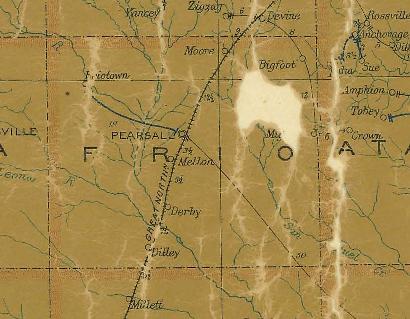 |
Frio
County 1907 Postal Map showing Moore
(NE of Pearsall)
From Texas state map #2090
Courtesy
Texas General Land Office |
| Texas
Escapes, in its purpose to preserve historic, endangered and vanishing
Texas, asks that anyone wishing to share their local history, stories,
landmarks and recent or vintage photos, please contact
us. |
|
|
 HOME
HOME