|
Swinney Switch
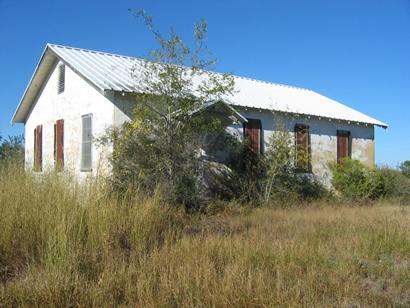
Church
November 2005 photo courtesy Robin Sellman |
History in
a Pecan Shell
Sidney J. Swinney
is the town's namesake. In 1917 Mr. Swinney opened a store on his
300 acres of land and gave the community the railroad designation
of "switch" thinking that it would be a cinch to attract a railroad
and / or settlers. Mr. Swinney also organized a brush arbor church
which later built a small chapel. The railroads took other routes,
leaving the fledgling community under-developed and unattached to
the rest of the world. In the 1930s only the church and two businesses
formed the town but the people residing in the area retained an active
volunteer fire department. |
A MAN’S VISION…
SWINNEY SWITCH!
by Robin Sellman
|
I’ve
procrastinated a bit, but I have always wanted to tell what I know
of the story of Swinney Switch.
My great-grandfather was Sidney Johnson Swinney, the owner of the
Swinney Switch General Store. He was born May 22, 1875 and died January
3, 1948 at the age of 72. He was married to Julia Reynolds for over
50 years.
“Papa” Swinney, originally a farmer of 117 acres, built the store
around 1925-1926. The original store was a small frame building, but
about a year later, he built a new building out of rock. Although
other businesses have claimed to be the “original” Swinney Switch
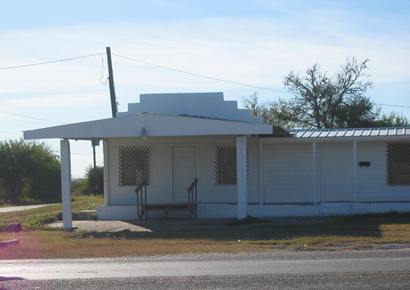
store, the small white building at the bottom of the hill was the
original establishment. |
The original
Swinney Switch Store
November 2005 photo courtesy Robin Sellman |
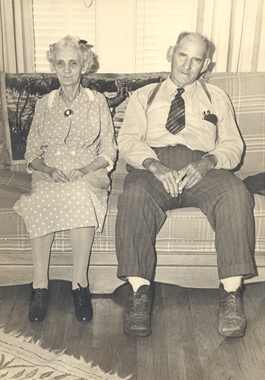
Julia and Sidney
Swinney,
Store Proprietors
Vintage photo courtesy Robin Sellman |
Located
on the west side of the intersection of FM 3024 (old Highway 9) and
FM 534, the store was also the gathering place for those wanting to
play a good game of dominoes with Swinney. It was common for customers
to wait on themselves in the store if he was in the middle of a game.
He would remind them to write their purchases down in the log. He
trusted everyone.
The store was a general store where customers could buy staples, produce,
crackers and canned goods out of the shelves, and ice-cold soda pops,
and tobacco. He also sold bologna & cheese out of his coke box. He
would sell it by the chunks because he did not own a meat slicer.
There was no alcohol sold in Papa’s store!
Outside, Swinney sold gasoline. In the early years, the oil company
would not let the store have a pump, so the gas was pumped from two
50-gallon barrels. Eventually, he was able to modernize by installing
two gas pumps.
Joyce Swinney Lemma of Corpus Christi, granddaughter of Sid and Julia
Swinney, remembers the summers at the store fondly. She recalled,
“I pumped many a gallon of gas when I would be helping him in the
summers. Papa would be playing dominoes and asked me to wait on the
customers. This was when gasoline was rationed, and we had to collect
ration stamps for each gallon of gas. Once, I forgot to collect the
stamps and had to chase the customer to the intersection to get them.
When I told Papa, he scolded me and told me never to do that again.
Now, I see how dangerous it was.”
Mrs. Lemma also recalled her Papa selling sweets, a favorite of any
child. “He also had a glassed-in candy counter, and he would let me
select one piece each day. Nannie (Julia Swinney) would wake from
her nap around 4:00 p.m., and we had a cold Dr. Pepper every day.
Those are some nice memories.” |
 |
Swinney Switch
Logo
Courtesy Robin Sellman |
Sid
Swinney had great hopes of luring the railroad through the area and
to “switch” at his store because he believed that it would be good
for business. He had visions of helping build a town. He is the one
that named the settlement “Swinney Switch” in hopes of getting the
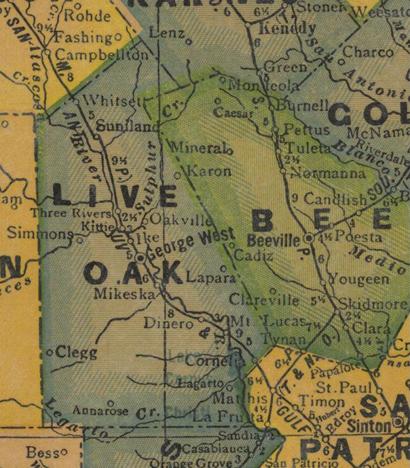
attention of Missouri-Pacific Railroad. That dream was never realized,
and the railroad went by Dinero instead.
He was forced to close the store in 1943 because of failing health.
In addition to the store, Swinney desperately wanted to build a church
to further the Kingdom of God. He was a deeply religious man. After
meeting under a brush arbor for quite some time, Swinney donated an
acre land that the church was eventually built on. The Baptist church
was organized in 1932. It was pastored through most of its history
by Reverend Carroll Jones. The University of Corpus Christi supplied
“fill in” pastors in the later years of the church. Rev. Jones eventually
presided over the funeral service of Papa Swinney in 1948.
In his eulogy, Reverend Jones gave an accounting of Swinney’s life
and told of his persistence in having the church built. He recounted
the sacrifices Papa Swinney made to build and pay for the church and
how many lives were changed because of the influence of Sid J. Swinney.
During the funeral service, Rev. Jones quoted Swinney as saying “I
would give anything in this world if I could just live a better life.”
He said, “I love God, but sometimes I am just not able to show Him
how much I love Him.”
The church and property reverted back to Swinney’s estate when the
church disbanded somewhere around 1968. It was later donated to the
South Texas Children’s Home, Mineral,
Texas.
Copyright Robin Sellman |
Looking for
the Lemon Grove in Swinney Switch
I'm trying to find
information on Swinney Switch, Texas and found your article on Texas
Escapes. Great publication and thank you. I'm interested in a story
my father told me about his lemon tree that he grew from seed in Alabama
and that survived a tornado two years ago. He told me that the seed
came from a friend of his that was from there. The story she told
of the community was a little different than what I'm reading online,
as these things often are with time. She told him that the town was
called Swinney Switch because Swinney was hired by the railroad to
switch the tracks when the train came through. According to her story
and then my dad's story, he lived out there alone for a while just
switching tracks. This woman's father settled there and planted a
grove of lemon trees. She described the lemons as big and sweet. My
father, a gardener at heart, asked her to bring fruit back to Alabama.
She did and he says it was as big as a basketball and that his wife
made four gallons on lemonade out of one fruit and that it WAS sweet.
I'm so fascinated by this story and wonder if there is a grove of
heirloom lemon trees in Swinney Switch with lemons the size of basketballs.
I know it's unlikely, but I wonder if there's anyone who lives there
now or if there's a contact nearby that might know about these trees.
I'd love to visit and collect seeds. I'm not a horticulturist, just
a fan of heirloom plants and a good story. I'm also in Austin, TX
and originally from Houston so it's not a big stretch for me to go
looking. If you have any information about who might live there or
a local historian, it would be greatly appreciated! - Kind regards,
Mariposa Lopez, March 25, 2019 |
 |
Live
Oak County 1940s map showing railroad connecting Dinero
(bypassing Swinney Switch)
From Texas state map #4335
Courtesy
Texas General Land Office |
| Texas
Escapes, in its purpose to preserve historic, endangered and vanishing
Texas, asks that anyone wishing to share their local history, stories,
landmarks and recent or vintage photos, please contact
us. |
|
|
 HOME
HOME