|
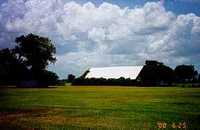
The green fields
and blue skies of Iago
TE Photo 2000 |
History in
a Pecan Shell
In the beginning
was cane and it throve. The sugar-bearing variety was introduced
and then came the plantations, although nothing on the scale of the
Louisiana estates. Then came a blight and the Civil War and each threw
a wet blanket on Iago's early days. It didn't bother too many people
since there weren't many people living there to begin with.
The land was pretty much abandoned until the railroad came through
about the turn of the century. Clarence D. Kemp had started a store
in the 1880s and opened a post office there that ran from 1891 to
1900. He sold stamps and groceries to the few people who still lived
in the area.
In 1911 Kemp sold some land to G.C. Mick who surveyed the land and
laid out a town plat. A school came about in 1902 because who (besides
Louisiana) wants a bunch of ignorant children running around a sugar
cane field? The 20s were Iago's salad days (they diversified from
sugar cane) with a blacksmith, drugstore, barber and several groceries
and mercantile stores making an appearance.
We didn't mention churches in the last paragraph because there was
just one. It might have been called the First Federated Church of
Iago, for it was used by four different religious groups who would
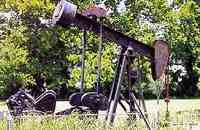
take turns using the building. They drilled an oil well in the churchyard,
which must've really annoyed the sermon-givers, but the money was
welcome and paid off the church. |
 |
Iago, Texas
Forum
Subject:
Iago
My grandfather named the town, Iago, and it was accepted.
I grew up in Iago and attended the Iago Federated Church. My great
grandfather was the Wharton County Sheriff, Clarence D.Kemp. Sincerely,
Elizabeth McDaniel Wallace, August 29, 2024
Subject:
Boling /
Iago / New
Gulf
My mother grew up in the Texas Gulf Sulfur company town of New
Gulf ca. 1928-1944 and graduated from Boling High School. Her
father and numerous relatives worked with TGS. As I recall she spoke
of her first job as a teen with a Brockmann's Drygoods Store in
the town.
My grandfather had a home in Iago for many years which is still
standing on the main street parallel to the old railroad and current
highway. Our family visited and even stayed there several stints
in between venues from 1944-1955 in which I attended Iago Elementary
for short times. We stayed in a homemade trailer house on the property
among the pumpjacks and oil tanks. Granddad kept a milk cow which
he stake-tied and grazed on the abundant grass along the tracks.
One day tragedy hit when it got loose on the tracks and was hit
by a train.
The one store in the fifties was on the corner, building still standing.
For a prolonged period there was a Red Ryder BB gun in the window
that I coveted and dreamed of having every visit. I saved every
penny I could gather and earn to buy it when we returned again with
constant fear it would be sold. Fortunately, it or one like it was
there when finally I bought it on one of the visits.
I visited periodically Boling,
Iago and the
TGS ghost town and plant out of nostalgia over the years and
recently retired back to the region. On Nov 23, 2015 on such a tour
with a visiting relative we learned of the old Boling jail which
I was unaware of over the many years and visited it. It was supposedly
built in the pre-'20's and been recorded as a historic site. Hopefully
it will be preserved as a Texas landmark eventually. It may be a
worthwhile addition to your site on Boling. http://www.tinytexasjails.com/?page_id=618
- Wallace L. McKeehan, November 26, 2015
Editor:
We would enjoy hearing from any readers who have stories of syrup
making, cane-raising, oil drilling, snakebites or any other stories
relevant to growing up in Iago. Please email history@texasescapes.com
|
 |
| Texas
Escapes, in its purpose to preserve historic, endangered and vanishing
Texas, asks that anyone wishing to share their local history, stories,
landmarks and recent or vintage photos, please contact
us. |
|
|
 HOME
HOME