|
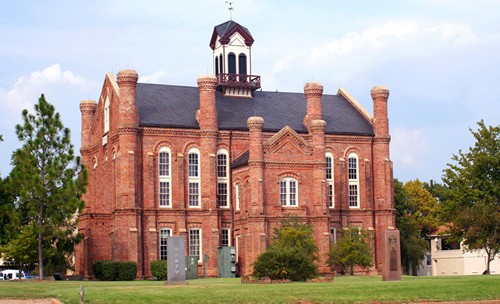
1885 Shelby County
Courthouse today
Photo courtesy Lori
Martin, 2006 |
| When
Bison Bill and I first pulled into Center
in Northeast Texas, we could not help but notice the numerous chimneys
surrounding Shelby
County's 1885 courthouse. Bison Bill got out his calculator and
found that a total of twelve chimneys encompass that beautiful brick
structure. We later discovered that the architect, J. J. E. Gibson
of Ireland, had wanted his masterpiece to look like the castles he
had seen while growing up in his native country. This courthouse is
now the only remaining Irish castle style courthouse in the United
States. |
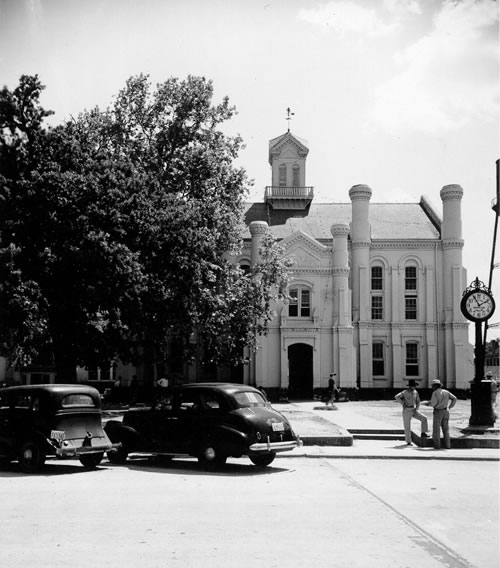
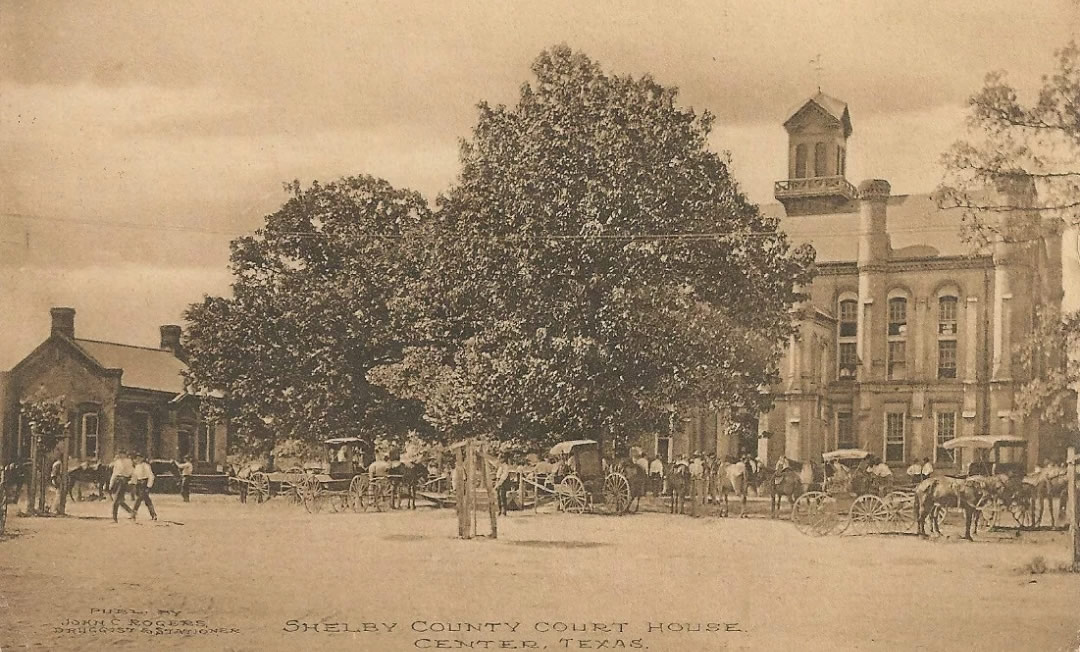
Shelby County
as it appeared in 1939
Photo
Courtesy TxDoT |
This
impressed the socks off of Bill, who had clad his feet earlier in
the day because of the chill in the air. We wandered around the courthouse
square and eventually ran into someone who knew so much about the
courthouse that I could not believe my eagle ears.
Shelby County,
organized in 1837, was one of the original counties of Texas. Named
for the American Revolutionary soldier Isaac Shelby of Kentucky,
its county seat, Center,
has been just that since 1866. The present area of Shelby County was
a part of the Municipality of Tenaha when Mexico became independent
of Spain in 1821.
The courthouse itself is a two-story Romanesque brick building. The
two million-plus bricks were made by the architect, while the mortar
was made from sand toted via oxcart from Louisiana some forty miles
away.
The architect thought hard about the hot Texas summers, so he shuttered
each window. So while the windows were opened, the courthouse still
remained cool. The ceilings are also high, which further helped make
the courthouse temperature bearable. But having windows opened caused
a bit of an aviary problem. Oftentimes, newspapers would be handed
out to those attending court to act as a shield from any unwarranted
"attacks" from above. One time, the attention of the court kept straying
upward as a lone bird flew from gable to gable. The judge asked if
someone could do something about it, and BANG! Someone did.
|
|
|
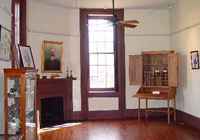
Architect
Gibson's portrait overlooks the front room and courthouse artifacts.
The desk was the one he used to design the courthouse
Photo
by Lou
Ann Herda |
|
|
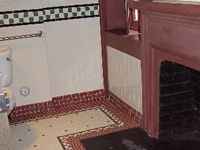
The
only courthouse with a fireplace in the restrooms
Photo
by Lou
Ann Herda |
The
first floor used to hold offices for county officials. Since the renovation
was completed in 2000, these rooms now contain historical artifacts.
Gibson's portrait hangs above one of his fireplaces, and the various
tools used to make the courthouse are displayed. The wooden floor
is refinished to a shine, and the walls look clean and new.
Placed in the center of the courthouse is an 1885 coin, commemorating
the year the courthouse was finished. Before the renovation, there
were no inside facilities. Since folks prefer the comforts of porcelain
toilets and air conditioning over a wooden, splintery outhouse, two
restrooms were built inside. As a result, this courthouse is the only
USA courthouse that has fireplaces in the restrooms (until I hear
otherwise). |
|
|
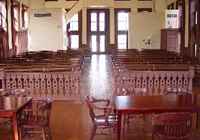
Courtroom.
Notice the balcony in the back where the deputies used to be stationed
during trials and the two sets of stairs
Photo
by Lou
Ann Herda |
|
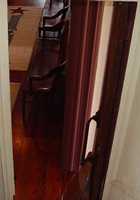
There is a door
in the front hallway that can only be opened from the inside. That
was the original escape door for the judge. Upstairs is the huge
courtroom, complete with the original benches. The floor sweeps
down to the judge's bench. There are two sets of stairs in the back.
Before desegregation, one was used for the White folks to enter,
while the other was for the African-American folks. Above the center
of the back is a balcony where two deputies used to stand with their
shotguns just in case there was a problem with the verdict.
|
|
|
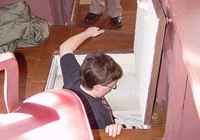
Author's
son Taylor makes a quick escape down the judge's escape hatch.
Photo
by Lou
Ann Herda |
|
Speaking of
which, next to the judge's chair on the floor is the escape hatch.
If the verdict upset the crowd, the judge would open the hatch,
climb down the stairs, and go out the one-way-only door. The deputies
would keep one eye on the crowd and one eye on the outside to see
when the judge had mounted his horse and made his escape. Only then
could the crowd leave.
|
|
|
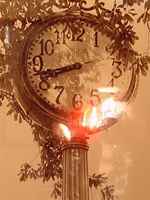
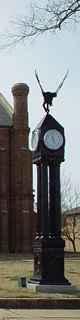
Photo
of the former clock in front of the courthouse
Photo
by Lou
Ann Herda |
| The
outside clock has caused quite a controversy. When we first saw it,
we thought it looked pretty good, especially since they had the sense
to put an eagle on top. But after hearing what had happened to the
previous clock and all the sentimentality surrounding that 100+ year-old,
non-working, nearly one-of-a-kind timepiece, I noticed that the eagle
looked more like a buzzard, as one townsfolk put it. Since the courthouse
and its square are properties of the Texas Historic Commission, by
state law, there is supposed to be no changes to the looks of the
courthouse or its grounds without first getting permission from the
commission. Well, the current judge didn't like having a broken clock
in front of the courthouse, so he had it removed without permission
and had a new one put there. Talk about a feud! There's more to it
than this, but that's all I have to say about that. |
|
©
Lou
Ann Herda
April,
2002
Special thanks to Dowell D. Youngblood, volunteer for the
Shelby County Historical Society, for his astounding rendition of
the history of the courthouse. Also to Pam Phelps, executive director
of the Shelby County Chamber of Commerce, for gathering materials
about the history of the county and its courthouse. |
Related
Story:
The
Castle Builder by Bob Bowman
Architect Jacob Joseph Emmett Gipson, and the Shelby and Panola County
courthouses. |
|
|
 HOME
HOME