|
|
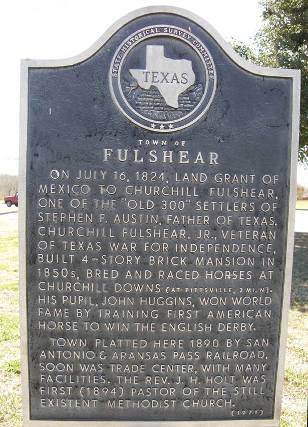
Historical Marker
FM 1093 in front of city hall
Photo courtesy Barclay
Gibson, 2009 |
History in
a Pecan Shell
Churchill Fulshear, namesake of the community and one of Stephen Austin’s
“Old
Three Hundred” had a plantation near present-day Fulshear prior
to the arrival of the railroad in 1888.
Fulshear’s son, also named Churchill, granted a right-of-way to the
San Antonio and Aransas Pass Railroad (the SAAP) that year and the
new town of Fulshear was platted in 1890. Fulshear drained population
from the existing community of Pittsville when that town ignored the
railroad and paid dearly for the slight.
A school district was formed in 1893 and a Methodist church was established
the following year. The population reached 250 people by 1898 with
most essential businesses being established – including a hotel.
The town was dealt a severe blow in 1910 in the form of a downtown
fire but recovery was swift and the town prospered as never before.
By 1929 Fulshear’s population topped 300 residents, served by 10 stores.
By the early 1930s, Churchill Fulshear’s Plantation home was demolished,
breaking its oldest physical tie to the past. The population declined
by 2/3rds and it never reached 300 again until Houston
started growing toward the town in the 1970s.
By 1988 the population had increased to 623 but after a slight dip
in the 1990s, it grew to just over 700 for the 2000 census. |
Historical Marker:
Town of Fulshear
On July 16, 1824,
land grant of Mexico to Churchill Fulshear, one of the "Old 300" settlers
of Stephen F. Austin, father of Texas. Churchill Fulshear, Jr., veteran
of Texas War for Independence, built 4-story brick mansion in 1850s,
bred and raced horses at Churchill Downs (at Pittsville, 2 mi. N).
His pupil, John Huggins, won world fame by training first American
horse to win the English Derby.
Town platted here 1890 by San Antonio & Aransas Pass Railroad, soon
was trade center, with many facilities. The Rev. J. H. Holt was first
(1894) pastor of the still existent Methodist church. |
| Texas
Escapes, in its purpose to preserve historic, endangered and vanishing
Texas, asks that anyone wishing to share their local history
and vintage/historic photos, please contact
us. |
|
|
 HOME
HOME
 Texas
Gulf Coast
Texas
Gulf Coast East
Texas
East
Texas Central
Texas North
Central
Texas North Central
Texas South
Central
Texas South Texas
Panhandle
Texas
Panhandle South
Texas
South
Texas Texas
Hill Country
Texas
Hill Country West
Texas
West
Texas Texas
Ghost Towns
Texas
Ghost Towns Texas
Counties
Texas
Counties