|
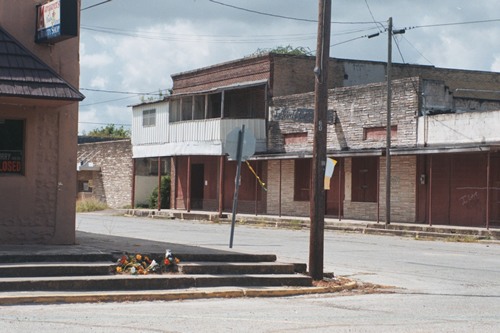
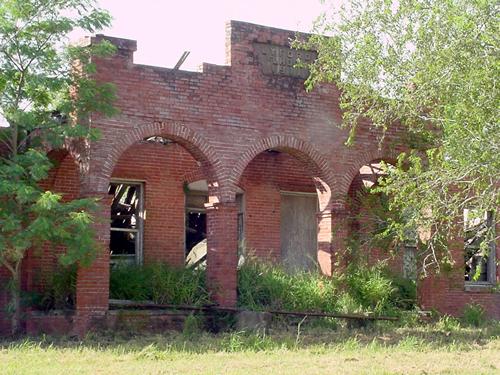
Lyford street
scene
TE Photo, October 2003 |
History in
a Pecan Shell
In
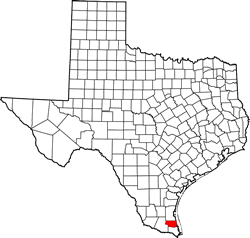
the 1700s, Spanish colonists owned three land grants in what is now
Willacy County.
The grant that includes present-day Lyford was the San Juan de Carricitos
grant.
For all the Texas towns named after railroad presidents, their daughters,
engineers and conductors, this one is named after a railroad lawyer.
William H. Lyford, was once an attorney for the Chicago and Eastern
Illinois Railroad. Evidently there was some connection to the trains
that brought the first Anglo settlers into the region.
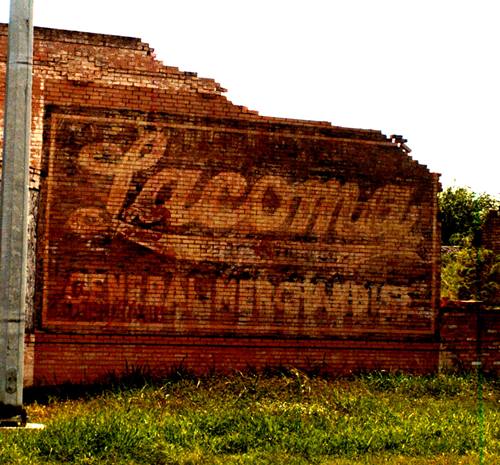
But long before it took this name, the region had been known by the
droll and unlikely name of Como Se Llama - after a nearby lake called
Laguna Del Como Se Llama. The name could be loosely translated
as Lake "Whats-its-name."
The St. Louis, Brownsville and Mexico Railway arrived on Independence
Day, 1904. The Gulf Coast Irrigation Company was formed from 34,000
acres of land bought from the King Ranch and it was on this land that
Lyford was built. Lyford was a tent city for its first two years.
In 1906 the plat for the town was drawn up and filed in 1907. Settlers
were brought in by rail from Illinois, Indiana and Iowa. The first
public building was a combination school, church and community center
called Pioneer Hall.
The post office opened that same year and the Lyford Hotel was completed
in 1909. A man named Reuben Deyo was responsible for planting the
first citrus in the area and for the first few years of its existence
Mexicans and Anglos were separated into two communities.
US soldiers and Texas Rangers were stationed in Lyford in 1913 and
1914 during the "border unrest" caused by the Mexican Revolution.
Lyford had 300 people in 1914 with most of essential businesses for
a developing town - including a newspaper. By the late 20s the population
had doubled to 600 and by 1940 it had swelled to 1,150. The high-water
mark was reached in 1968 when 1,541 Lyfordians called the place home.
|
 |
| Texas
Escapes, in its purpose to preserve historic, endangered and vanishing
Texas, asks that anyone wishing to share their local history, stories,
landmarks and recent or vintage photos, please contact
us. |
|
|
 HOME
HOME