| |
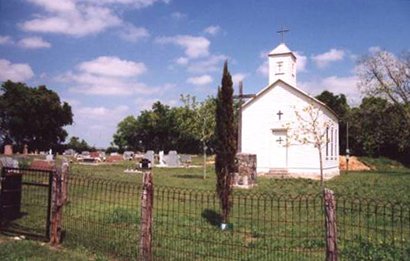
St.
Mary's Chapel & Cemetery
Photo courtesy Barclay
Gibson, April 2004 |
My
Town: Twin Sisters
"What
I know about the community of Twin Sisters Texas"by
Johon Haas
Joel
Cheery homesteaded on the Little Blanco river about four miles up stream from
where Twin Sisters is now located on US 281. The community he settled was known
as Middle Town, Texas since it was halfway between San
Antonio and Fredricksburg.
The township was surveyed out where the Little Blanco river and Cherry Creek come
together. (That is now private property.) The town consisted of a general store,
a livery stable, a hotel and a couple of houses. All of this was burned down by
some outlaws after they robbed the general store and shot and killed Joel Cherry
and his wife some time in the early 1860’s. All that remains of the town now are
the survey stakes that lay out the streets and roadway that ran from San
Antonio to Fredricksburg. There is
still a map of the town registered in Comal County.
Shortly after Middle
Town was destroyed Max Kruger started the community of Twin Sisters. He built
a general store that is still standing as a private residence. The general store
also served as a post office and the basement served as a jail. In the late 1860s
Max Kruger and some men in the community including my Great Grandfather got together
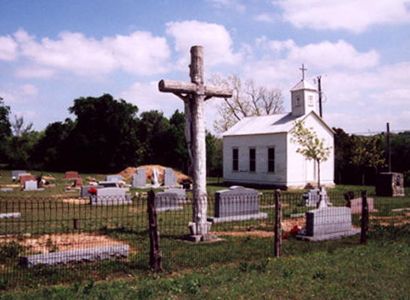
and built St. Mary’s Catholic church and the Twin Sisters School house just down
the river from the general store. Both buildings are still standing and still
in use. The school is the meetinghouse for the Sons of Hermann Lodge and the church
has a mass there once a year on All Saints Day. These two buildings are on the
same piece of land about fifty yards apart. The churchyard is now a cemetery and
my Great Grandfather was the first person to be buried there. All my relatives
are buried there and I have a plot with my headstone already in place.
Mr. Kruger was responsible for building a dance hall and community center along
with a bowling alley in 1869 that opened to the public in January 1870. These
buildings were named The Twin Sister Hall and Bowling Alley. In 1967 the bowling
alley burned to the ground and was later rebuilt in Spring Branch Texas. The Twin
Sisters Dance Hall still serves to this day as a community center for weddings,
family functions, fundraisers for charity, etc. The dance hall is now owned and
operated by The Twin Sister Hall Club, Inc. a non-profit organization that still
to this day has a dance their on the first Saturday of the month to keep the hall
open and operating. The hall features live bands and is open to the public. The
Twin Sister Hall could be the oldest dance hall in Texas but was called a community
center instead of a dance hall in the beginning. So, if you are ever in this part
of the world on the first Saturday night of the month drop in and have a good
time the old fashioned-way with the family. All ages are welcome and children
under six get in free.
Right in the middle of the community of Twin
Sisters on US 281 is a store called Little Blanco Antiques that has real bargains
for the antique lover on weekends. You can even buy a live miniature horse at
the old general store. Twin Sisters Population is about 20 or so and I am proud
to say I am one of them.
Just ask for Johon.
- Johon Haas, February
2006 |
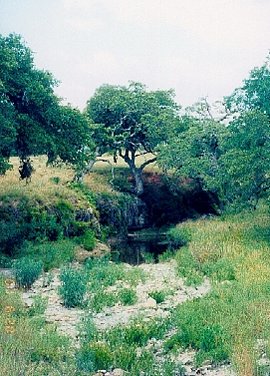
| | The
creek at Twin Sisters
TE Photo | |
|
History in
a Pecan Shell
Named for a pair of hills, the town dates from 1854 when a man named Joel
Cherry homesteaded on the Little Blanco River. By the late 1850s the town had
become the center for German settlers in the area. The post office was applied
for in 1856 and granted that year, although operations were suspended during the
Civil War.
By 1890 Twin Sisters was prospering with a mill, gin and three
stores. One man named Kruger became a one-man entertainment committee - opening
a store, dance-hall, bowling alley and brewery. Non-legal entertainments like
shoot-outs and brawls enlivened the scene, but eventually made Mr. Kruger return
to storekeeping.
A severe drought in the 1890s put Kruger and many others
out of business. The post office was closed in 1951, and mail was routed through
Blanco. |
St.
Mary's Chapel and Cemetery
Photo courtesy Barclay
Gibson, April 2004 |
Historical
Marker TextSaint
Mary's Help of Christians Catholic ChurchIn
1850s when first Catholic families came to Blanco County, worship was in homes
and halls. Land was purchased in 1887. By efforts of Father Virgilius Draessel
and people of Twin Sisters, this church was built and dedicated in 1889. Stone
for foundation came from quarry about a mile from site. Other building materials
came by wagon over 30 miles of rough roads and trails.
Recorded
Texas Historic Landmark, 1965 | |
|