|
 |
History
in a Pecan Shell
First settlement began in 1853 when cabins were built on the banks
of the Blanco
River. The following year investors of the Pittsburgh Land Company,
bought Horace Eggleston's land grant and platted a town they called
Pittsburgh after the company's founder, General Pitts. The new community
was on the south side of the river.
That same year a Methodist church was organized and the building also
doubled as the first school. The Masonic Lodge of Twin
Sisters moved to Pittsburg in the late 1850s.
The county was organized in 1858 and instead of Pittsburgh, a new
town on the opposite bank of the river was to become the county seat.
The Pittsburgh Land Company didn't seem bothered by the snub, for
they donated 120 acres of land for the new town. A post office was
granted in 1858 and two years later the county's first courthouse
was built.
The Masons penned a charter for a Masonic University in 1874, but
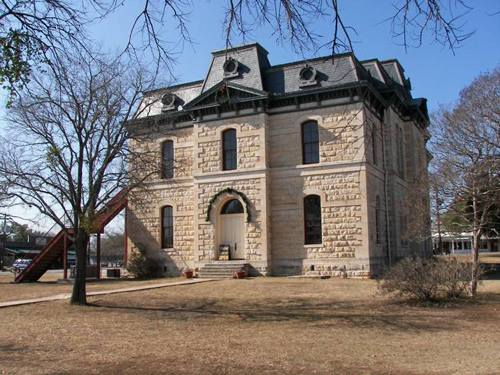
after the foundation was laid, funds dried up. A native stone courthouse
replaced the log structure in 1875. Architects for the project were
the Ruffini
Brothers (Frederick E. and Oscar) who were to become prolific
builders across Texas. The former courthouse
burned in 1876 and that's the year the citizenry of Johnson
City first petitioned for an election in hopes of "stealing" the
title from Blanco. Johnson City
lost.
In 1884 a high school was built on the abandoned foundation of the
university that never was. The school opened in the fall of 1884,
and the first class graduated three years later. Johnson
City won an election in 1890 and the records were transfered there
from Blanco the following year. The rivalry between the two towns
continues to this day.
From a population of less than 500 in 1904, Blanco grew to 1,100 by
1939, the year they incorporated. In the 1940s, it dropped back to
453 but once again grew to 1,238 for the 1990 Census. In 2000 it reported
1,505 residents.
The courthouse has been restored in recent years, making one of the
best preserved former courthouses
in the state and is a fine example of the Ruffini
Brother's work. |
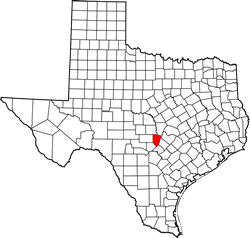
Blanco, Texas
Attractions & Landmarks
|
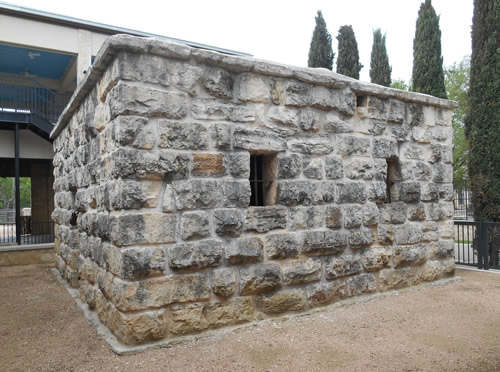
The 1877 Blanco
County Jail in Blanco
Photo
by Michael
Barr, April 2021 |
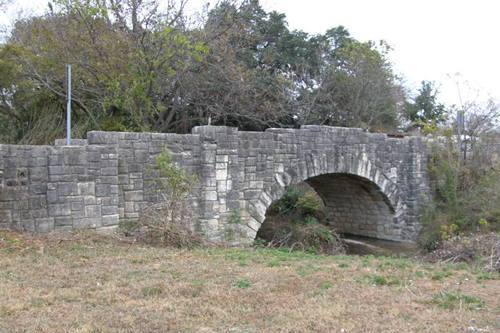
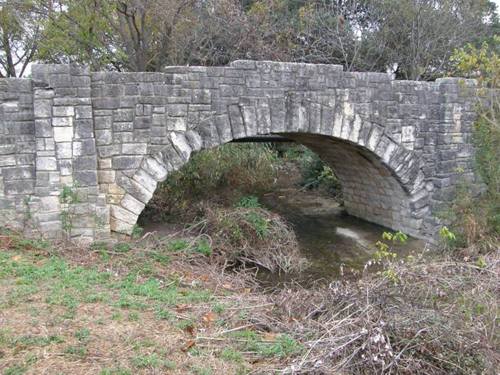
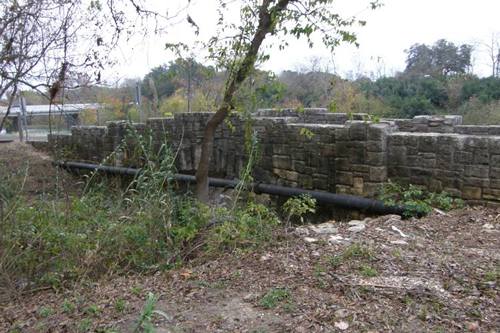
The
CCC stone arch bridge
Photo courtesy Barclay
Gibson, December 2007 |
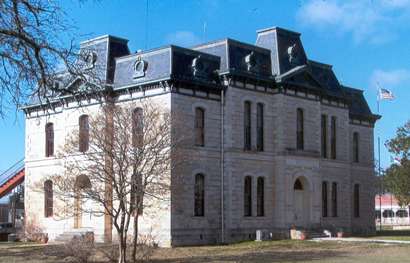
The
1885 former Blanco County Courthouse in Blanco
Photo courtesy Texas State Library and Archives |
Blanco
County Courthouse
A
Bitter Election in Blanco County by Michael Barr
Another
Slow Night at the Blanco County Jail by Michael Barr
The
Ghost on Highway 281 by C.F. Eckhardt ("Charley Eckhardt's
Texas" Column)
"... About a year and a half later John was in the old Jailhouse
Barber Shop in Blanco, and he mentioned seeing the guy with the
knife alongside 281. "Oh," somebody said, "you saw Lackey's ghost."
... As it turned out, John wasn't the only person who'd seen Lackey
trying to hitch a ride north toward Johnson City. A lot of people
were aware of him. Truckers don't like to drive that stretch on
fall nights..."
The
Bones in the Courthouse Crawlspace by Johnny Stucco
What the exterminator saw...
Courthouse
Savior by Terry Jeanson
Persistence and Tenacity Preserves Blanco Landmark
JoNell Haas and The 1885 former Blanco County Courthouse
The
Revenge of 'Devil John' McCoy by Murray Montgomery
E.G. McCoy, of Blanco, came to Gonzales and had a chat with the
local editor. McCoy’s narrative of an event involving his father
was published in the Inquirer way back in 1879. His father, John,
was a pretty tough ol’ boy and had a natural dislike for Indians.
I think you will find by reading the article, that John McCoy wasn’t
one to forgive and forget.
Dove
Hunting and the $24 Doctor Bill by Mike Cox
|
The restored
1885 Blanco County courthouse in Blanco.
Photo courtesy Terry
Jeanson, March 2007 |
Another view
of the Former Blanco County Courthouse in Blanco
Photo courtesy Barclay
Gibson, December 2006 |
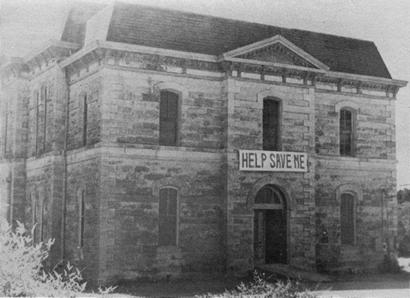
The courthouse
before restoration
Courtesy of the San Antonio Conservation Society Foundation |
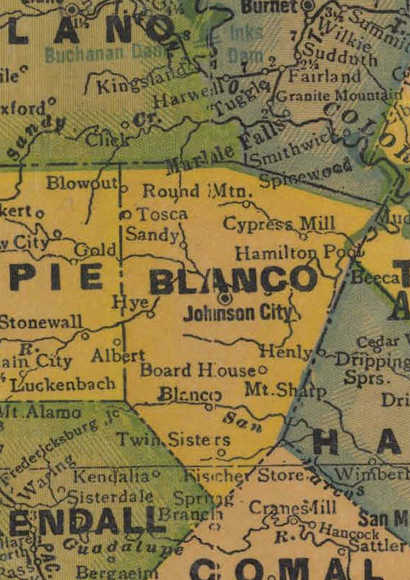
Blanco
County 1940s map
From Texas state map #4335
Courtesy Texas General Land Office |
| Texas
Escapes, in its purpose to preserve historic, endangered and vanishing
Texas, asks that anyone wishing to share their local history, stories,
landmarks and recent or vintage photos, please contact
us. |
|
|
 HOME
HOME