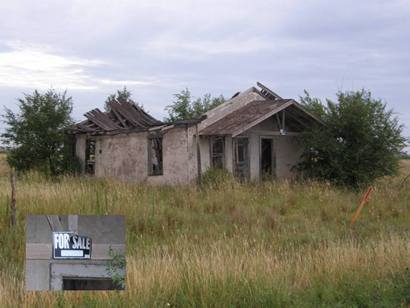
|
|
 |
History
in a Pecan Shell
Begun as a Quaker Colony in 1879 by Indianan Paris Cox, the town was
first named Marietta for Cox’s wife Mary. Cox had traded his
sawmill back home in Indiana for land in Crosby and Lubbock counties
and built a sod house here. Other settlers endured their first Texas
winter in tents and it turned out to be their last Texas winter as
well. The Cox family remained and brought in a crop, which enabled
them to recruit more settlers. The town had a primitive school taught
in a dugout in 1882 and two years later the town was granted a post
office. At this time the name was changed to Estacado. The residents
built a meeting house in 1884 and classes were moved there.
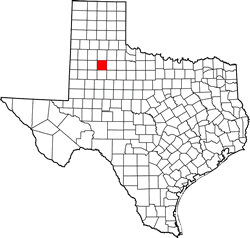
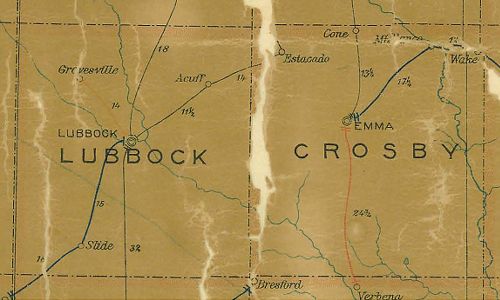
From its inauspicious beginning, Estacado became Crosby County’s first
seat of government in 1886 despite it’s off center location. The number
of residents was given as 200 by 1890 but when Emma,
Texas took the county seat status of Estacado in 1891, the writing
was on the wall. Paris Cox had died in 1888 and no one shared his
vision or attempted to steer the community through the hard times.
The final straw came in a plague of locusts combined with a drought.
Only a handful of people remained. The Society of Friends had left
the town but things improved slightly as the 20th century made its
appearance.
The post office shut its doors in 1918 and mail was routed through
Petersburg.
The 1930 census reported just under 70 people living in Estacado and
ten years later it was 80. That same number has been in use through
the year 2000. |
Estacado,
Texas Photo Gallery:
Photographer's
Note:
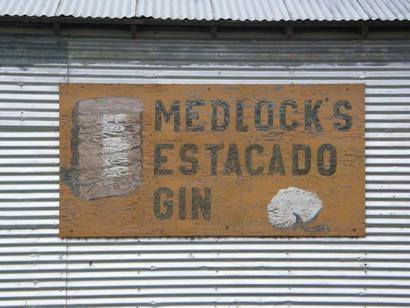
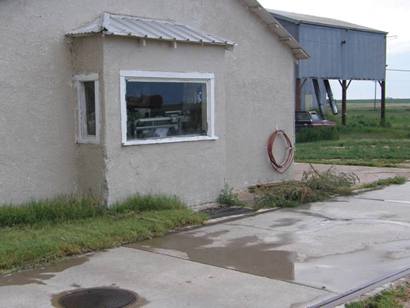
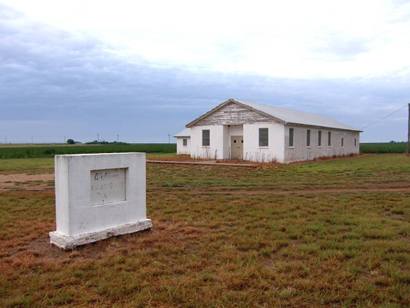
T. Lindsay Baker has Estacado listed in one of his Ghost Town books.
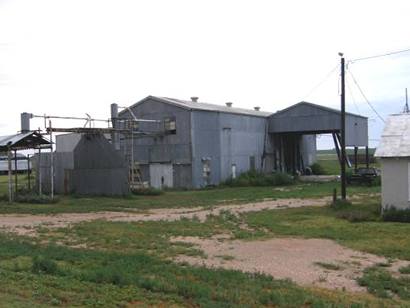
There are a few occupied dwellings. The Gin looks operative. - Barclay
Gibson, July 2009 |
 |
 |
 |
 |
Historical
Marker:
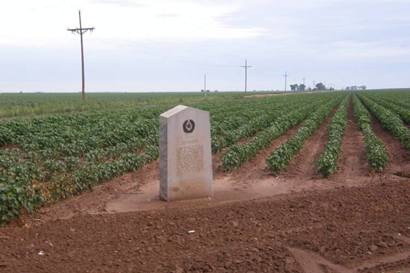
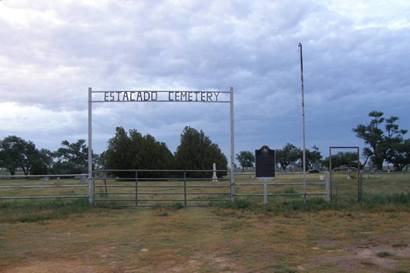
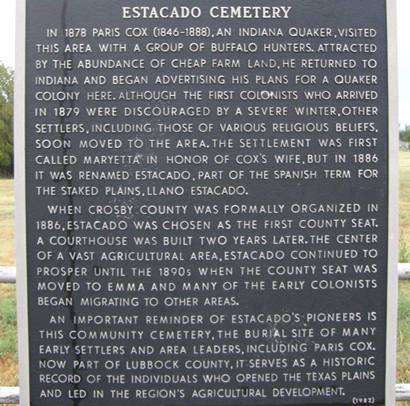
Estacado Cemetery
In 1878 Paris Cox
(1846-1888), an Indiana Quaker, visited this area with a group of
buffalo hunters. Attracted by the abundance of cheap farm land, he
returned to Indiana and began advertising his plans for a Quaker colony
here. Although the first colonists who arrived in 1879 were discouraged
by a severe winter, other settlers, including those of various religious
beliefs, soon moved to the area. The settlement was first called Maryetta
in honor of Cox's wife, but in 1886 it was renamed Estacado, part
of the Spanish term for the Staked Plains, Llano Estacado.
When Crosby County was formally organized in 1886, Estacado was chosen
as the first county seat. A courthouse was built two years later.
The center of a vast agricultural area, Estacado continued to prosper
until the 1890s when the county seat was moved to Emma
and many of the early colonists began migrating to other areas.
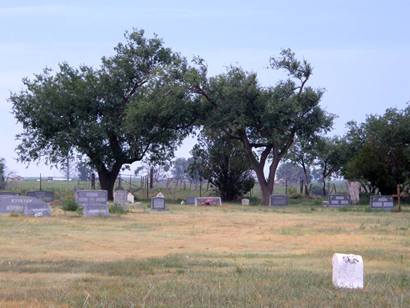
An important reminder of Estacado's pioneers is this community cemetery,
the burial site of many early settlers and area leaders, including
Paris Cox. Now part of Lubbock County, it serves as a historic record
of the individuals who opened the Texas
Plains and led in the region's agricultural development.
(1982) |
 |
Estacado,
Texas Forum
Subject:
Conway and
Estacado
Town dried up after Interstate 40 routed a half mile north. My distant
cousins' family operated the motel, er, tourist court, there as
well as a cafe. Cousin Johnny made spare change at the filling station
running a wrecker service on Route 66. He chargesd rich folks plenty,
but a family in need he didn't charge at all.
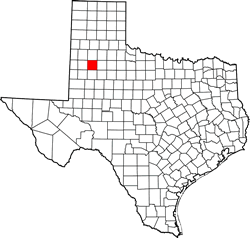
I missed Estacado. It's still there on the Crosby/Lubbock county
line, and was once a county seat for many counties back when. Gin
still operating with maybe 5 or 6 homes still occupied. Once a quaker
settlement named Marietta.
Thanks for an interesting [magazine]. Keep up the good work. - Benny
Poulson, Ralls, Texas, September 12, 2006
|
| Texas
Escapes, in its purpose to preserve historic, endangered and vanishing
Texas, asks that anyone wishing to share their local history, stories,
landmarks and vintage/historic photos, please contact
us. |
|
|
 HOME
HOME

 Texas
Gulf Coast
Texas
Gulf Coast East
Texas
East
Texas Central
Texas North
Central
Texas North Central
Texas South
Central
Texas South Texas
Panhandle
Texas
Panhandle South
Texas
South
Texas Texas
Hill Country
Texas
Hill Country West
Texas
West
Texas Texas
Ghost Towns
Texas
Ghost Towns Texas
Counties
Texas
Counties