|
Lying
in the Trinity River at Parker’s Bluff, near Palestine,
a cluster of remnants from an old sidewheeler steamboat serve as reminders
of an era when cotton was king
in much of East Texas.
The A.S. Ruthven, weighing 144 tons and measuring 127 feet
long, was built at Cincinnati, Ohio, in 1860 by a shipyard that turned
out 288 steamboats.
While most of the steamboats were placed in service on the Ohio, Mississippi
and Missouri rivers, the Ruthven came to Texas, where she was
placed in service hauling cotton
down the Trinity River to Galveston. |
|
|
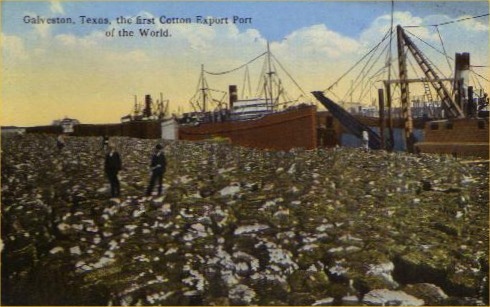
"Galveston,
Texas, The First Cotton Export Port of the World"
Postcard courtesy rootsweb.com/
%7Etxpstcrd/ |
But the craft
had barely established herself on the Trinity when Texas seceded from
the Union and the Ruthven’s owners leased her to the Texas
Marine Department for use as a transport vessel. On the last day of
1861 she arrived at Galveston
with a pair of artillery pieces, part of a shipment of fourteen for
the defense of Galveston Island during the Civil War.
In 1862 the Ruthven was running between Galveston
and Buffalo Bayou and during October of that year, she was inoperable
and had to be towed up Buffalo Bayou to escape the Union attack on
Galveston.
When
the Civil War ended, the Ruthven went back to the Trinity River
and, with the Texas cotton markets open again, she resumed hauling
bales from East Texas
to Galveston.
But the Trinity was a fickle river. Some boats lingered too long upstream
and found themselves trapped by low waters and were forced to wait
until spring rains lifted the river.
During the 1866-87 cotton season, the Ruthven made successful
runs from East Texas to
Galveston,
delivering more than 2,200 bales. |
|
|
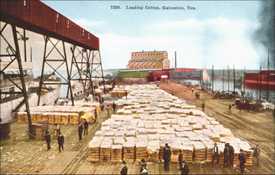
"Loading
Cotton, Galveston, Texas"
Postcard courtesy rootsweb.com/
%7Etxpstcrd/ |
In March of 1867, the Galveston Weekly News reported: “Coming
up, the Ruthven met 14 flatboats at various points, all loaded
with cotton for Galveston.
We understand that the Ruthven will go as high up as Wild Cat Bluff
and will return up the river and remain above Magnolia until next
fall. The snow, sleet and hail fell on the deck of the boat to a depth
of six inches. The cold was so severe that the steam pipes of the
steamers and sawmills were frozen and burst. Such severe weather in
the month of March was never known before.”
The Ruthven continued to serve customers on the Trinity through
the l860s, but with growing competition from the railroads, the Ruthven
was pulled from service. In the early 1870s George Anderson Wright
of Palestine
bought the old sidewheeler for $900, moved her to Parker’s Bluff,
and began to dismantle parts of the vessel.
The steamboat’s boilers, engines and machinery were removed and sold
to gins and sawmills in the area. The cabin was also removed and incorporated
into the construction of a large Palestine home. The hull of the boat
was left to deteriorate in the Trinity.
In
the 1970s an archeology team from the Texas Historical Commission
traveled to Parker’s Bluff to determine if any of the Ruthven’s
wreckage could be salvaged. While the boat’s hull had survived nearly
130 years in the river, the remains were in poor shape and had been
scattered along the river.
To the general public, the only visible reminder of the Ruthven
is an anchor recovered by a group of young men in the l920s or 1930s.
© Bob
Bowman
Bob Bowman's East
Texas September
18, 2005 Column, Updated 6-9-12
A weekly column syndicated in 109 East Texas newspapers |
|
|
 HOME
HOME