|
It
is on one of the most enduring mysteries in East
Texas.
In the early 1900s, an explosion and fire struck the old Emporia
sawmill south of what is now Diboll.
More than thirty sawmill workers, most of them black, are believed
to have perished in the conflagration.
Burned beyond recognition, the men were reportedly buried in a mass
grave somewhere on the Emporia town site, now a part of Diboll,
with no tombstones to mark their final resting place.
While few records exist to confirm the incident, there is enough
information about old Emporia to hint that the story may be true.
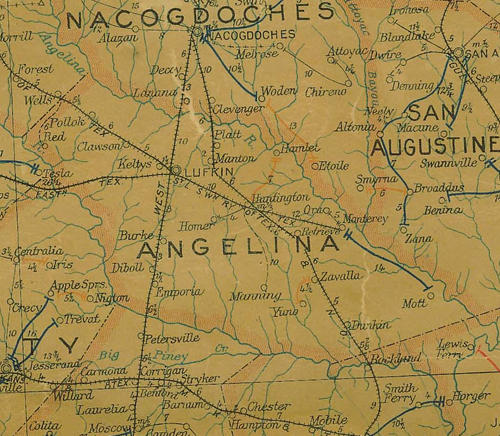
Emporia
began with the purchase of 5,755 acres of land north of the Neches
River by Samuel Fain Carter and M.T. Jones from W.H. Bonner on November
3, 1892.
Within a year, the town had a sawmill owned by Carter and Jones,
a post office, company houses, a school, a church, a store, a hotel
and a railroad spur to ship lumber to the Houston, East and West
Texas, the main line leading from East
Texas to Houston.
Two years later, another sawmill owned by T.LL. Temple and his family
sprouted north of Emporia with the name Southern Pine Lumber Company.
The establishment of the mill led to the founding of Diboll
and one of Texas’ largest lumbering empires.
Carter and Jones, both from Houston,
were no strangers to sawmills. Jones was a well-known and wealthy
lumber dealer who owned two sawmills at Orange.
He was also the uncle of Jesse Jones, who founded the Houston Chronicle
and served as new New Deal architect of the Franklin D. Roosevelt
administration.
Born in Alabama and raised at Sherman,
Texas, Carter settled in Beaumont
in 1882 and within a short time owned an interest in a sawmill at
Village Mills.
He later moved to Houston.
With the startup of the Emporia sawmill, Joseph P. Carter not only
became the mill superintendent, but served as Emporia’s first postmaster
in 1893. Samuel Fain Carter’s brother, Press, served as a bookkeeper
and manager of the Emporia commissary store.
At its peak, Emporia had a population of about 300 with 125 employees
working at the mill and with logging crews in the woods. With a
daily cutting capacity of 75,000 board feet a day, the sawmill specialized
in lumber for railroad cars and timbers for bridges.
Emporia apparently lacked most of the conveniences of older and
more established sawmill towns of the day. Employee housing, except
for cottages for mill managers, were of unpainted clapboard construction
with outdoor toilets. The town had a commissary store, a community
church and meeting hall, and a small school.
There were at least two recorded fires at the sawmill. In July of
1897 the mill burned to the ground. By 1900, Emporia built a new
sawmill and acquired additional timberlands in Tyler
County and bought a sawmill at Doucette.
The second fire that occurred in March of 1906 and killed the thirty
or so employees dealt a death blow to the town. The disaster could
have been the result of inadequate water to fight the fire. A news
article in 1904 said “water is so scarce that, in order to operate
the mill, water has to be hauled from the Neches River,” a mile
distant.
Following the fire, the company sold its Emporia and Doucette mills
to Thompson-Tucker Lumber Company, which owned mills in Polk
and Trinity counties.
Today,
there are no remnants of Emporia except for a cemetery behind a
convenience store on U.S. Highway 59. The cemetery contains a large
number of unmarked graves with pieces of petrified wood and native
rock to mark their location.
The oldest marked grave is that of a Waltman child who was born
December 11, 1880, and died August 14, 1882.
Cemetery officials said a long-standing legend claims a black cemetery
lies in the thick woods around the graveyard, but no signs of it
have been found.
The Emporia sawmill supposedly stood beside what is now the Union
Pacific railroad crossing of Maynard Street at milepost 106 in South
Diboll. So far, no one has located the purported mass grave at Emporia,
but it is rumored to lie somewhere east of U.S. 59 in Diboll’s
South Meadow area.
|
 HOME
HOME