|
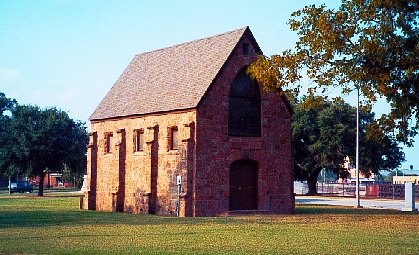
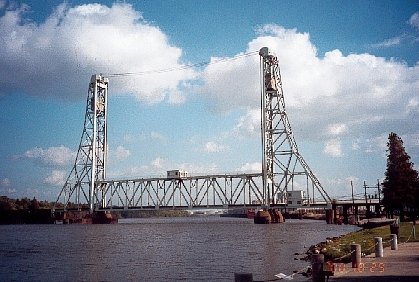
The Railroad
Bridge in Beaumont
Click on image to enlarge
Photo courtesy Paul Winstone |
 |
|
History
in a Seashell
Beaumont dates from 1824 when it was known as Tevis Bluff
after Noah and Nancy Tevis - the first settlers. In 1835, Henry
Millard and partners bought the Tevis' property for a planed town.
Millard's wife's maiden name was Beaumont.
The First Congress of the Republic
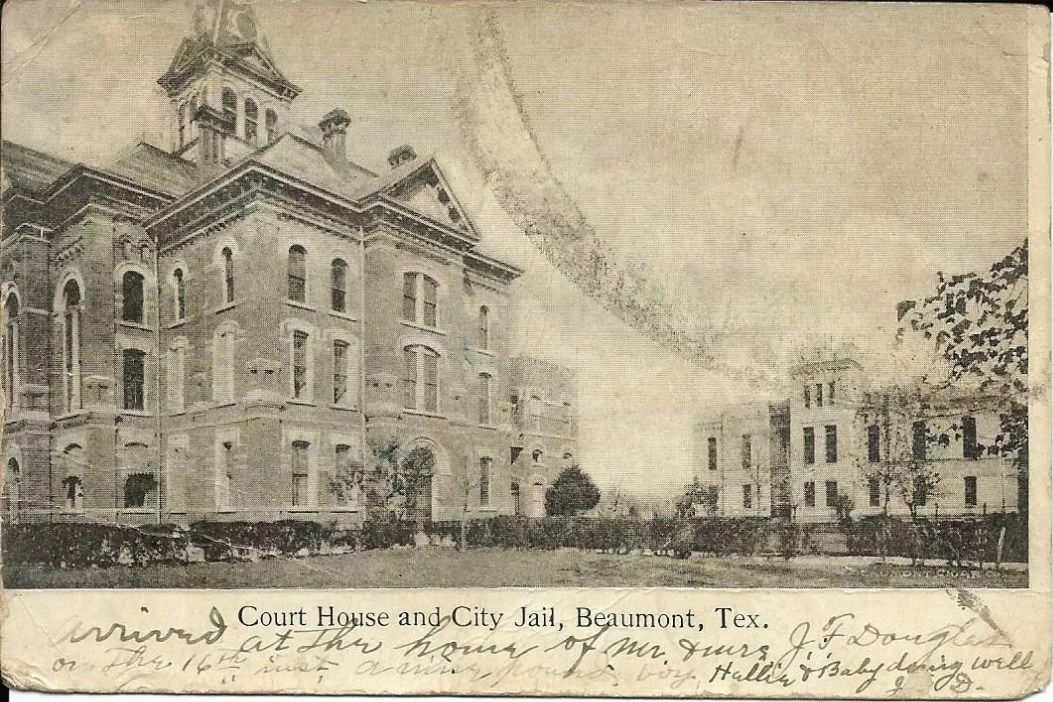
of Texas granted it a charter in 1838 and Beaumont was designated
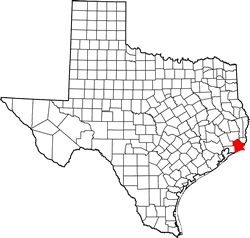
the county seat for Jefferson
County.
By the early 1900s the city had four railroads and a population
of 9,427.
The city's history - as well as the State's - is divided by the
discovery of oil at nearby Spindletop.
They were only a few days into 1901 when Spindletop blew in - reportedly
on the last length of pipe sunk before the well was abandoned.
Three major oil companies - the Texas Company, Gulf Oil and Humble
- were formed within a year of one another in 1901-02.
1908: The Neches River was joined to Port
Arthur by dredged canal.
1910: Population 20,000
1920: Population 40,000
1925: A second oil discovery was made at Spindletop
1930: population 58,000
1941: Wartime prosperity comes with shipbuilding and increased oil
1943: Martial law is declared after the Beaumont race riot erupts
1950: Population 94,000
1960: Population 119,000
In the early 1960s the police department was reorganized after an
investigation by the Texas House of Representatives looking into
prostitution and gambling - unsavory residue from the oil boom.
1970: Population 115,000
1980: Population 118,000
Book Hotel Here > Beaumont
Hotels
|
Beaumont, Texas
Landmarks / Attractions
|
Beaumont's
pride is demonstrated by its numerous restorations and a vibrant reclamation
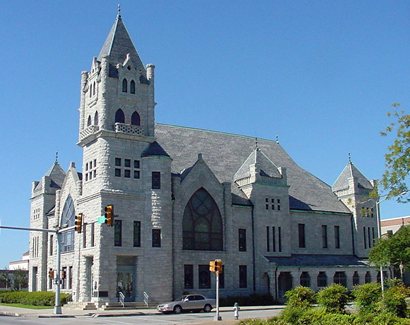
of the downtown area. The Hotel Beaumont, the Tyrrell
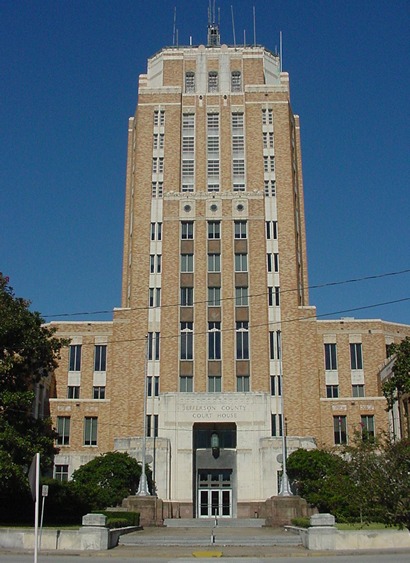
Historical Library , the 14 story Art Deco Jefferson
County Courthouse, a beautiful Federal Building and the current
restoration of the Jefferson Theater and Hotel Beaumont makes this
city an example for others.
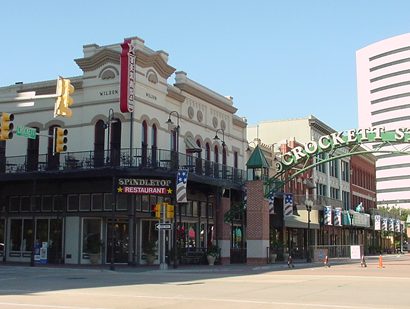
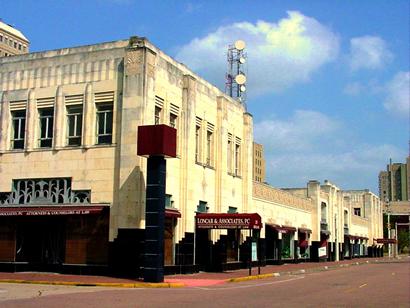
Parking is not a problem in a downtown that practically shines. Be
sure to check out The
Kyle Block - one of the best examples of Zig Zag architecture
in the state.
Among the city's museums are the John J. French Museum, the Gladys
City Boom Town Museum (a full-scale replica of the Spindletop boomtown),
the Texas Energy Museum with a large collection of Thos. Edison mementos
and the Texas Fire Museum - with an excellent collection of vintage
fire-fighting equipment. |
 |
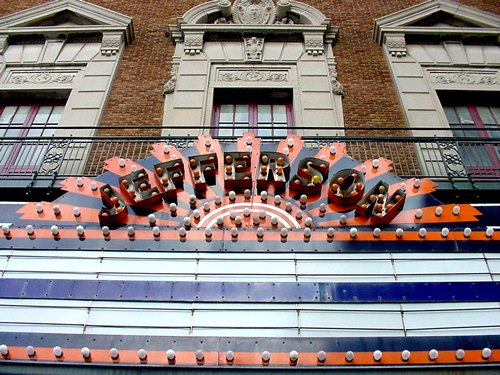
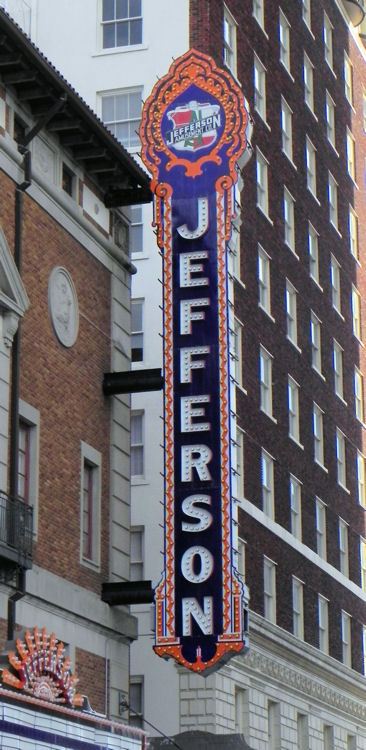
Historical Marker:
345 Fannin St.
Jefferson
Theatre
Built in 1927 by
the Jefferson Amusement Company, this theatre quickly became a landmark
in downtown Beaumont. Emile Weil, Inc., a New Orleans architectural
firm, designed the structure. The interior is a showcase of fine materials
and workmanship, with marble staircases and Spanish-style decoration.
In addition to motion pictures, the Jefferson Theatre featured dramatic
stage productions, vaudeville shows, and other live entertainment.
1978
Recorded Texas Historic Landmark |
|
|
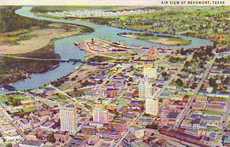
Aerial view
of the Neches
River and downtown Beaumont
Postcard courtesy Cruse Aviation
|
|
|
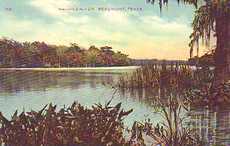
The Neches
River in Beaumont
Postcard courtesy Cruse Aviation
|
|
|
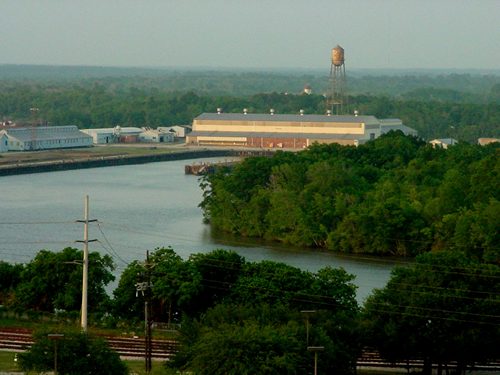
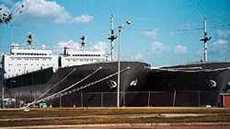
Ships
across from Pipkin Park in Beaumont
Photo by John
Troesser, 2000 |
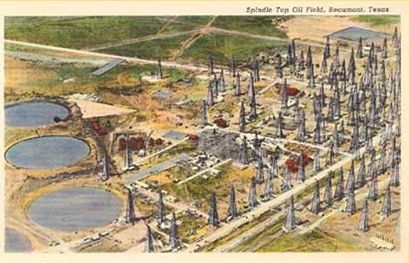
Spindle
Top Oil Field, Beaumont, Texas
Postcard courtesy rootsweb.com/%7Etxpstcrd/ |
Spindletop:
Selling Wind and Hot Air by Michael Barr ("Texas in Hindsight")
Spindletop:
When Oil Became An Industry by Archie P. McDonald, PhD ("All
Things Historical")
The
Vanishing of Marine Sulphur Queen by Mike Cox ("Texas Tales")
"...So far as is known, the Texas woman was the last person
to see the 504-foot, 7,240-ton tanker and her 39-man crew...."
YOCUM'S
INN: The Devil's Own Lodging House by W. T. Block, Jr. ("Cannonball's
Tales")
Located on the old Opelousas cattle trail northwest of Beaumont.
"A gentleman's life... held no attraction for Squire Yocum,
a man who literally was nursed almost from the cradle on murder
and rapine, and for many years Yocum's Inn was actually a den of
robbers and killers."
A
Brief History of Pioneer Entertainment in Beaumont, Texas by
W. T. Block, Jr. ("Cannonball's Tales")
Home
of the Cardinals by Archie P. McDonald (from "All Things
Historical" column).
Lamar University in Beaumont
Dick
Dowling by Archie P. McDonald (from "All Things Historical"
column). Sabine Pass' commander, Lieutenant Richard William Dowling,
namesake of the Dick Dowling Junior High School.
The
Case of Beaumont's Missing Marble Corpse by W. T. Block, Jr.
("Cannonball's Tales")
It was July of 1901 in Beaumont, and the frenzy of oil excitement
rushed on unabated. Gusher No. 15 had just blown in on the hill,
and each arriving train deposited a new horde of traders and roughnecks,
boomers and hangers-on of every hue in a city that was already smothering
with new population... In the midst of all the oil madness, there
emerged one of the strangest tales ever to unfold in the "sawdust
city," the case of Beaumont's missing corpse that had turned to
stone...
Olive,
Hardin County, Texas - An Extinct Sawmill Town and the Olive-Sternenberg
Partnership That Built It by W. T. Block, Jr. ("Cannonball's
Tales")
"Three miles north of Kountze, in Hardin County, Texas, where
once the burly and towering pine trees shaded the forest floors
beneath them, the town of Olive thrived between 1881 and 1912. It
took its name from Sidney C. Olive of Waco, who was one-half of
the partnership of Olive, Sternenberg and Company, the owners of
the large Sunset Sawmill, which spawned the community.
In 1876, while Beaumont was celebrating the hundredth anniversary
of the United States, the same owners built the Centennial Sawmill
on Brake's Bayou, Beaumont's first large lumber mill, and operated
it until 1883...."
The
Tale of Hardin County's Wild Family by W. T. Block, Jr. ("Cannonball's
Tales")
What 'boy' is there among us, either youthful or aged, who has not
experienced a longing at some time or another to escape to the forest
-- far from the amenities of civilization, such as table manners
and school bells -- to live carefree and survive, Tarzan-like, from
the products of the thickets and streams?...
"The
Boll Weevil" by Mike Cox
One of many long and short lines serving Texas was the Trinity and
Brazos Valley Railway, better known in the early 1900s as "The Boll
Weevil." With headquarters in Houston, it ran from Cleburne to Beaumont.
Chartered in 1902, and later operated for years in receivership,
the line became part of the Burlington-Rock Island in 1930.
Snowfall
in Galveston by Mike Cox
On Feb. 14, 1895 it snowed 28 inches in Beaumont.
Book Hotel Here > Beaumont
Hotels
|
Miss
Rita of Beaumont's Dixie Hotel by John Troesser
The Philanthropic Madam of Oil City
“Godfather
of Beaumont” by Fred B. McKinley
Frank Yount and the Yount-Lee Oil Company, “the Godfather and Financial
Gibraltar of Beaumont.”
"Babe"
Didrikson by Archie P. McDonald
The outstanding woman athlete of the twentieth century.
"The Babe, who earned her nickname from sandlot baseball companions
who thought she batted like Babe Ruth, was born in Port Arthur,
Texas, on June 26, 1911, to Norwegian immigrants Ole and Hannah
Didriksen. The Babe later changed the spelling of the family name
slightly. The Didriksen’s moved to Beaumont in 1915..." more
Napoleon
Bonaparte Wiess by W. T. Block
Steamboat Captain and Confederate Soldier.
Capt.
William E. Rogers: Beaumont Steamboatman by W. T. Block, Jr.
Perhaps no one in early Beaumont was as popular and well-known as
the steamboat captains, and one of them whose biography comes readily
to mind was Capt. W. E. Rogers...
Former
slave's death in 1889 attracted rare news coverage by W. T.
Block, Jr.
In February 1889, Beaumont Enterprise published an obituary about
a Black centenarian, nicknamed "Old Sock," in an age when Black
obituaries were usually printed only in Negro newspapers...
The
Magnificent Montague by Bill Cherry
His real name is Nathaniel Montague, but probably less than a handful
of people know his given name. To the public, he’s always been known
as The Magnificent Montague. He was born in New Jersey, left there
before he graduated from a black military school to travel the seas
as a merchant marine. And he got off of his ship in Galveston because
he heard there was a disc jockey position open at a Beaumont radio
station. He wanted to play music. It was 1954...
Ida
Lee by C. F. Eckhardt
On March 21, 1924, Mrs. Ida Lee Daughtery of Hall, Texas, died.
She was a woman of some reputation—not as a ‘soiled dove,’ but as
a devoted wife.
Meeting
Miss Rita by Frances Giles
My first and only meeting with Mrs. Rita Ainsworth took place on
a hot and humid summer day in southeast Texas. Is there any other
kind? I was about 14 years old at the time...
The
Boys of Summer by Frances Giles
Beaumont had long had different farm teams which groomed players
for the big league, and Stuart Stadium was only 3 blocks from our
house on Emile Street. In the 1957 season, our neighborhood was
drawn into the fringes of the big time...
That's
My Mom by Frances Giles
The main sport played by kids in our neighborhood was baseball.
I've mentioned before we had an unusually long season, mainly because
it stayed warm for so long in Beaumont. The fact is, we just loved
the game...
Bandit's
bad baby brother by Wanda Orton
Native Sons:
The
Big Bopper by Clay Coppedge
The
Big Bopper by by Archie P. McDonald
|
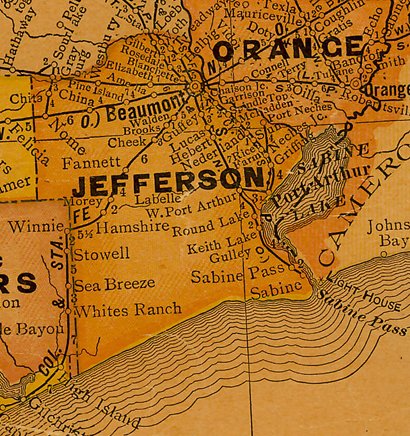
Jefferson
County 1920s map
From Texas state map #10749
Courtesy
Texas General Land Office |
Beaumont
Tourist Information
Beaumont Chamber of Commerce
409-838-6581
1110 Park St, Beaumont, TX77701
http://www.bmtcoc.org/ |
| Texas
Escapes, in its purpose to preserve historic, endangered and vanishing
Texas, asks that anyone wishing to share their local history, stories,
landmarks and recent or vintage photos, please contact
us. |
|
|
 HOME
HOME

 Texas
Gulf Coast
Texas
Gulf Coast East
Texas
East
Texas Central
Texas North
Central
Texas North Central
Texas South
Central
Texas South Texas
Panhandle
Texas
Panhandle South
Texas
South
Texas Texas
Hill Country
Texas
Hill Country West
Texas
West
Texas Texas
Ghost Towns
Texas
Ghost Towns Texas
Counties
Texas
Counties