|
In
May of 1836, less than two months after Mexican troops killed every
defender of the Alamo,
another massacre at a frontier garrison bloodied the Texas landscape.
The incident left Texas with a slice
of history almost as riveting as the Alamo.
The murder, wounding and kidnapping of settlers by Indians at Fort
Parker became the catalyst for the remarkable story of Cynthia
Ann Parker, a child taken from the fort and raised as an Indian.
Fort
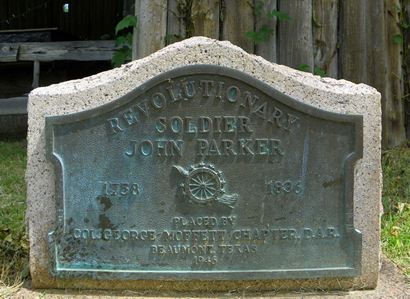
Parker was founded by Elder John Parker and his three sons,
Benjamin, Silas and James, and other families from the Predestinarian
Baptist Church of Crawford County, Illinois. Traveling by ox-drawn
wagons, they came to Texas in 1833, settled
along the Navasota River, and built Fort Parker for protection against
Indians.
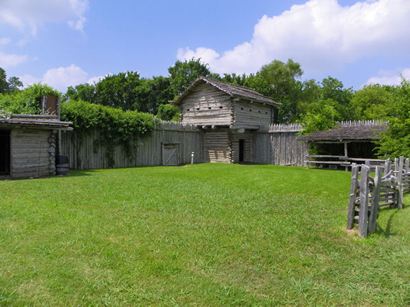
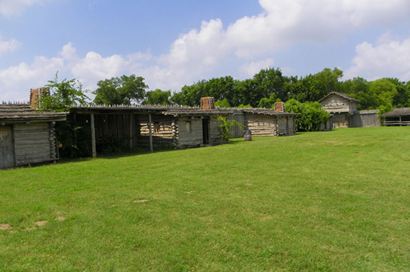
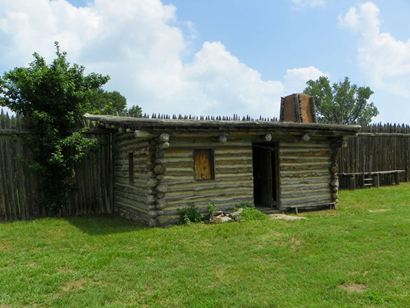
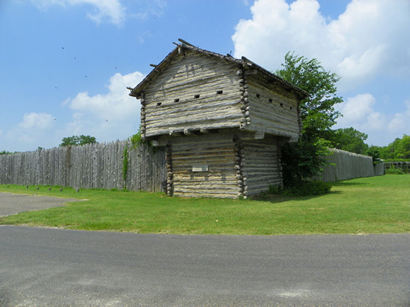
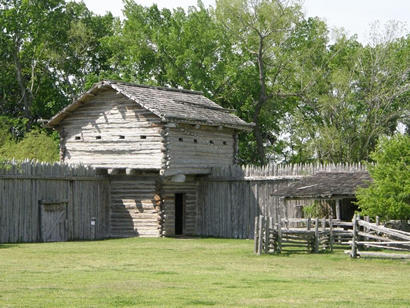
Completed in March of 1834, the stockade's walls were constructed
of split cedar logs buried in the ground and extending up 12 feet
with sharp points. Inside the walls were two-story blockhouses, rows
of log cabins for living quarters, and a livestock corral. |
 |
 |
The
Parkers and other families moved inside the compound and began farming
outside the walls. Since there had been no Indian troubles, they felt
so secure they left the fort's gates open so workers could come and
go with ease.
But on May 19, 1836, while the men worked in the fields and the children
played inside the fort, more than 100 Indians -- Comanche, Kiowa,
Caddo and Wichita -- appeared at the gates with a white flag of peace.
Benjamin Parker left the fort to talk to the warriors, who told him
they wanted a safe place to camp and some beef. As Parker returned
with beef, the riders surrounded him and killed him with their lances.
Before the gates could be closed, the raiders rushed inside the fort,
and killed Elder John Parker and his son Silas. As the men in the
fields rushed to the fort, the Indians escaped with two women and
three children. Behind them, five settlers lay dead and others were
wounded, some of whom died later.
The next morning the 21 survivors, led by James Parker, started for
Fort
Houston near present-day Palestine.
It took six days to travel the 60 miles. The two captured women and
one of the children were soon ransomed and returned to the Parker
family. But Cynthia Ann Parker, 9, and her brother John 6, both children
of Silas and Lucy Parker, were kept by the Comanches. John became
a Comanche warrior, married a Mexican captive, and settled on a ranch
in Mexico.
Cynthia
Ann became the most famous of the captives. She was adopted by a Comanche
family, her named changed to Naduah, and resisted ransom several
times. In her teens she married Comanche chief Pete
Nocona and had three children, one of whom became Chief Quanah
Parker.
In the winter of 1860, a group of Texas Rangers led by Captain Sul
Ross attacked an Indian camp along the Pease River in the Texas
Panhandle. Cynthia Ann Parker and her daughter Prairie Flower
were caught trying to escape.
Noticing her blue eyes, Ross knew Cynthia Ann was not an Indian and
sent for her uncle Isaac Parker, who identified her.
The former hostage was returned to her family in East
Texas, but could not adjust to the white man's ways. She died
in 1864 at the age of 37, six months after the death of Prairie Flower.
Both were buried in Fosterville Cemetery near Poynor.
Cynthia Ann's son, Quanah
died in Oklahoma in 1911. In 1957 the bodies of Cynthia Ann and Prairie
Flower were exhumed and reburied at Fort Sill, Oklahoma
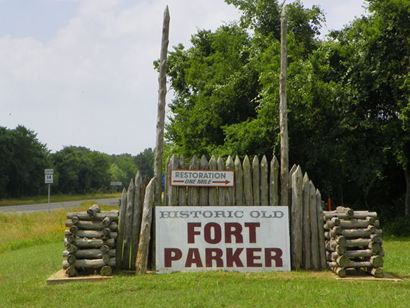
Old Fort Parker - where the Cynthia Ann
Parker saga began -- was reconstructed and is now operated as a state
historic site. |
 |
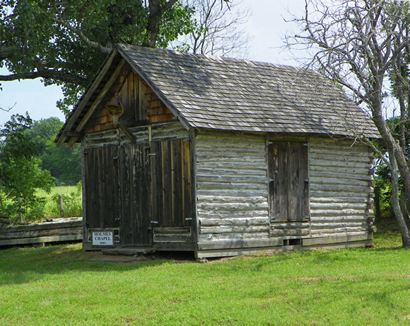
Inside Old Fort
Parker, restoration in progress
Photo
courtesy Barclay
Gibson, June 2010 |
|
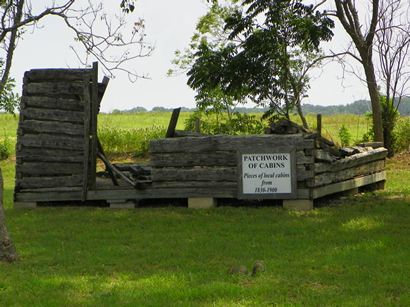
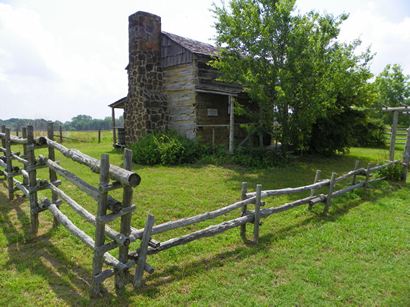
Patchwork of
Cabins
Pieces of local cabins from 1830-1900
Photo courtesy Barclay
Gibson, June 2010
|
|
|
 HOME
HOME