|
With
names like Lindsey Springs, Fastrill and Alceda, they played a supporting
role in the development of Texas' forest
products industry between 1890 and 1940.
Today, they're little more than trails or clearings in the forest.
They were logging camps - the short lived and sometimes mobile communities
which supported the earliest East
Texas sawmills.
Frequently called "front camps" because they were located
at the edge of a forest, the settlements usually lasted only as long
as the timber they cut. When a tract was exhausted, the camps -- housing,
stores, equipment, people -- were loaded onto railroad cars or trucks
and moved to another location. |
|
|
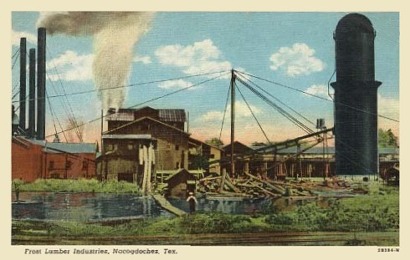
"Frost
Lumber Industries, Nacogdoches,
Texas"
Postcard courtesy courtesy www.rootsweb.com/ %7Etxpstcrd/ |
Lindsey
Springs
One
of the oldest logging camps, Lindsey Springs, was built by Southern
Pine Lumber Company in 1897 in Angelina
County on a tract of timber purchased to serve the lumber company's
new mill in Diboll.
The camp was built in three sections, each surrounding the natural
springs which formed a creek and provided drinking water for the camp
families. The town had about 110 people in 25 households, including
a boarding house with 11 boarders. Professions included laborers,
teamsters, saw filers, tie makers, section foremen, log contractors,
foremen, commissary clerks, carpenters and a potter.
While Lindsey Springs had a tram railroad to connect it with Diboll,
the residents of many other logging camps in East
Texas were marooned in the forest, and became reliant on each
other.
The camps, although rustic, did provide the necessities of life for
their inhabitants, such as schools, commissary stores, churches, recreational
facilities, post offices, and often a doctor.
Housing, which was provided by the lumber companies, was temporary
and usually consisted of small, wood-frame structures with attached
porches. The buildings were often designed so they could be easily
moved. |
Acol
Acol,
a logging camp owned by Angelina County Lumber Company, was moved
on railroad cars so it could be moved from forest to forest. The town
later became famous in forest history for its "wandering post
office." (See Acol,
Texas) |
Fastrill
One
of the most famous logging camps was Fastrill,
located near the Neches River
in Cherokee County.
Southern Pine built Fastrill
in 1922. Of all the company's logging camps -- including Alceda,
White City, Bluff City, Lindsey Springs, Walkerton, Neff, Huff, Gilbert,
Buggerville, Gipson, and Apple Springs -- Fastrill
is remembered best by the company's logging families.
"It was as pretty a logging camp as a person ever went into,"
recalls Wesley Ashworth, a carpenter who lived there. "It had
wide, long streets, sycamore trees up and down the streets, and they
were really pretty. It was on a sandy hill, but it was a beautiful
logging camp."
Fastrill -- which lasted until 1941 -- got its name from a combination
of three lumber company officials: FA from F.F Farrington, a former
Diboll postmaster; STR from P.H. Strauss, who was in charge of camps
or Southern Pine; and ILL from Will Hill, the company's woods foreman.
[See Legacy of an Oldtimer
by Bob Bowman] |
|
The
logging camps were critical to the early growth of lumber companies
because they kept a steady flow of logs flowing from the forests
into the sawmill towns. But as newer methods of logging and transportation
became available, the logging camps began to fade from the woods.
Today, theyıre only a dim memory -- except to the people who lived
there.
All
Things Historical
January 4, 2004 Column
Published with permission
Syndicated in over 700 East Texas newspapers
See Bob Bowman's
East Texas
|
|
|
 HOME
HOME