|
One
of East Texas' earliest
architectural conveniences is making a comeback of sorts these days.
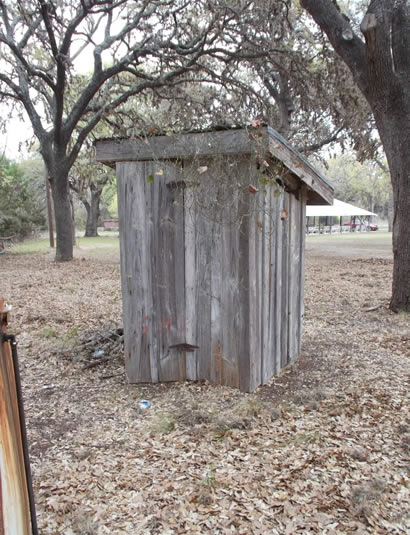
The old-fashioned outhouse, which served thousands of rural East Texans
before indoor bathrooms became affordable, has again become fashionable,
but not as a working privy. It is showing up in historical displays,
as art and in advertisements. |
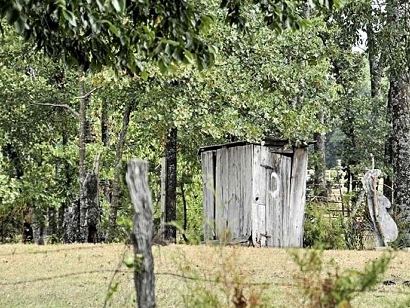 |
A photo of the
outhouse Vursey Bragg built behind her home near Hemphill
in 1952 was recently used in home improvement ads by Milwaukee¹s Equitable
Bank.
The bank paid Bragg's granddaughter, Vicki Brucia, $75 for the rights
to use a picture of the privy, which sports the traditional crescent
moon cutout on its door. Vicki rescued the old structure several years
ago and restored it with loving care. She even found a 1952 Sears
and Roebuck, once a substitute for toilet paper, and admits the outhouse
is a working model. The Bragg outhouse is one of several found on
an internet web page devoted to privies throughout America, a sure
sign that the outhouse movement is growing. Vicki said the $75 she
received from the Milwaukee bank is probably a lot more than her grandmother
spent to build her privy a half-century ago.
A few months ago in Houston,
I passed through a museum exhibit on rural America and, sure enough,
there was a wonderful collection of outhouses of all kinds, including
some made from brick and stone.
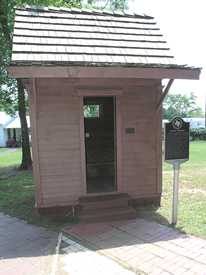
Our favorite outhouse stands on the grounds of the Rusk County
Memorial Library and Museum at Henderson. |
|
|
Arnold
Outhouse on the grounds of the Rusk County Memorial Library and Museum
Photo courtesy Sam
Fenstermacher, June , 2006 |
|
|
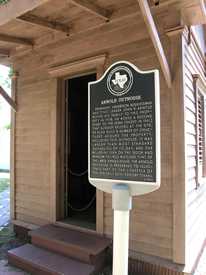
Arnold
Outhouse historical marker. (Click on photo for close-up of marker)
Photo courtesy Sam
Fenstermacher, June , 2006 |
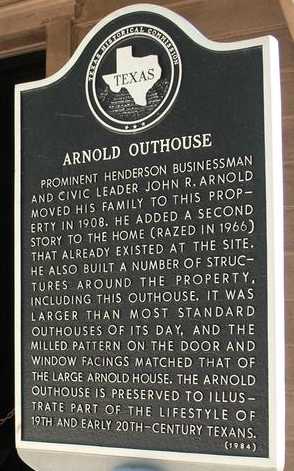
When the Rusk County Historical Commission announced
plans to refurbish a local outhouse and equip it with an official
Texas Historical Marker, normally sober East Texans were reduced to
schoolyard giggles. But the Commission went ahead with its plans and
made the late Victorian, three-house outhouse, built more than 100
years ago, a "privy to history".
In a sense, the outhouse is right at home. The library site was once
the homeplace of John R. Arnold. It was Arnold who originally built
the outhouse behind his two-story Victorian home.
When Arnold's home was torn down, the old outhouse was moved to a
farm on the outskirts of Henderson.
John and Peggy Pride, who owned the farm, donated the privy to the
Historical Commission. |
| The
outhouse is, pardon the pun, commodious. It measures six by eight
feet in floor space. The steeply pitched tin roof is fourteen feet
high at the peak and includes an awning over the three steps leading
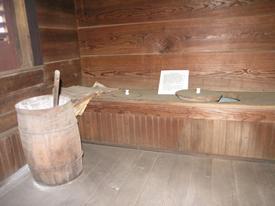
up to the door. The business portion of the outhouse is a simple,
unadorned bench along the back wall. The three holes are side by side,
each covered with a wooden lid. Each hole is a different size designed
to fit.... well, I think you get the idea. |
Photographer's
Note:
Subject: Arnold Outhouse
I've found East Texas to be a place bountiful with upscale architectural
heritage. Take the Arnold Outhouse, located on the grounds of the
Rusk County Memorial Library and Museum at Henderson,
for example. According to the Handbook of Texas, this Victorian deluxe
outhouse was awarded a Texas historical marker, giving Henderson legitimate
claim to fame as the location of the "Fanciest Little Outhouse in
Texas."
I know Mr. Bowman
has written about this marvelous work of architecture, but you really
need to see it to appreciate the refined nature of this early East
Texas privy. - Sam
Fenstermacher, June 10, 2006
See Revisiting Outhouses
by Bob Bowman |
|
|
 HOME
HOME