|
|
It
was about this time of the year in 1881 that Russian Czar Alexander
II was assassinated, and on that Easter Sunday large scale pogroms
began all over Russia. A pogrom, by the way, is an organized massacre
of an ethnic group. Just as had happened when Jesus Christ was nailed
to the cross almost 2,000 years before, masses of Russian peasants
decided that the Jews had killed the czar.
It is theological folly that "the" Jews killed Jesus. And it is historical
folly that "the" Jews killed Czar Alexander II.
Nevertheless, many Russian Jews were savagely beaten while others
had their homes burned down or ransacked or destroyed. The Russian
government, although it knew the truth, did nothing to protect its
Jewish countrymen; in fact it encouraged them to move away even though
Russia was the country of their birth.
So solely for survival, the Jews began finding ways out of Russia,
and quickly. By the thousands they came to the harbors of New York,
Boston, Philadelphia and Baltimore. There were few jobs and there
were relatively no support groups set up to help them integrate into
their new country and community, or even to assist them to find jobs.
Consequently, it wasn't long until the Russian Jews were bunched together
and those areas became slums and ghettos.
Rather than show compassion and to act on that compassion to help
solve the problems, citizens in those communities began to complain
about the slums and the ghettos full of Jews, and the pressure was
put on the federal government to do something about curbing further
immigration to those communities. Studying the problem, it became
evident that the immigrants were not disbursing throughout the United
States. They were primarily settling where the boat landed.
If the number of Jews in a community could be kept to a minimum, it
was reasoned, they would eventually fit in and there wouldn't be any
Jewish ghettos. |
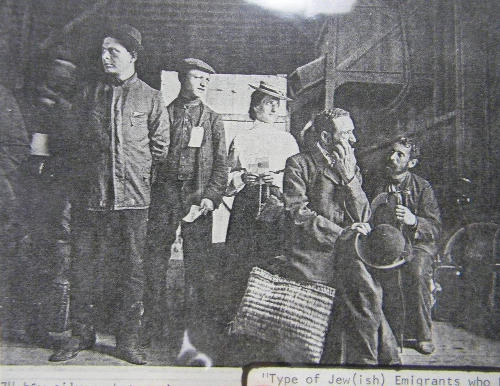 |
Jewish Immigrants
arriving in Galveston c.1880s
Photo courtesy Texas State Library & Archives |
|
Much
credit is given Galveston's Rabbi Henry Cohen for the salesmanship
he used to get the port of Galveston
opened as a new port of entry for immigrants And while his influence
was certainly contributory, the primary reason the federal government
accepted Cohen's proposal was not because he was particularly dynamic
or influential or a terrific salesman, although he was all of those.
It was because the immigration authorities realized that Galveston
was so small and so new, that it was felt that would encourage the
Jewish immigrants to eventually move inland where there would be
opportunities for them.
When the Jews began temporarily settling in the Galveston,
they were faced with a new problem, one that hadn't existed in New
York and Baltimore and Boston and Philadelphia. After all those
places were north. Galveston
was in the south.
While
the Galveston slaves had been freed some 25 years before, for all
practical purposes that labor still remained, and in Galveston
the slaves had been schooled and educated in trades. They weren't
picking cotton. They were blacksmiths and cabinet makers and seamstresses.
They could draw plans and build houses. And they could not only
speak English, but they could read and write it. And they were still
working for the same people and in the same jobs, just as free men
now, and no longer as slaves. And they were Christians. There were
black Christian churches all over Galveston.
What a quagmire. The jobs the Jews knew how to do were being done
very well by former slaves, and when there was an opening, given
a choice, an employer would normally take a Christian black tradesman
over a Jewish tradesman who couldn't speak or write English. So
in the main, there was no work for the Jewish immigrants.
What to do. Big warehouses were converted into makeshift living
quarters for them. But worse, often they were owned and run by Christian
German immigrants, and they had little regard for Jews. So the quarters
were universally unsanitary; the food was terribly substandard;
and frequently they were purposely served pork, a meat that is prohibited
by their faith. And here, too, they were frequently beaten and otherwise
berated and humiliated. Sometimes their wives and daughters were
raped.
But even with all of those obstacles, word was sent back to Russia
that if you could endure living here, there was at least some promise
it would get better, and your chances of not being killed were far
better. So the Jews continued to come.
Through
the benevolence of wealthy Jews of other European countries, generous
financial assistance programs were set up to help those who were
already here, and to help those who would follow. Things got better.
And while many of the Jews did remain in Galveston
and did become a significant part of the community, as predicted,
the greatest number eventually moved on and settled in towns throughout
the southern part of the United States.
While we are often encouraged to believe otherwise, history simply
doesn't support that Galveston
was a sympathetic community for Jews at the beginning. The original
settlers of Galveston
would have been happier had the Jews not come at all. It took decades
for the Island to begin to get control of its anti-Semitism. By
contrast, it took no time for the Island to accept the emancipation
of Christian black Americans.
Copyright William
S. Cherry. All rights reserved
June 4, 2007 column
More Bill Cherry's
Galveston Memories
Related Topics: Galveston
| People
| Columns | Texas
|
|
Galveston
Galveston Hotels
Bill
Cherry, a Dallas Realtor and free lance writer was a longtime
columnist for "The Galveston County Daily News." His book, Bill
Cherry's Galveston Memories, has sold thousands, and is still
available at Barnes and Noble and Amazon.com and other bookstores.
Related Topics:
Columns
People
Texas Towns
Texas |
|
| Texas
Escapes, in its purpose to preserve historic, endangered
and vanishing Texas, asks that anyone wishing to share their local
history, stories, and vintage/historic photos, please contact
us. |
|
|